



Do SIL Providers Have to Be Registered in 2026? Mandatory Registration Explained
Yes. Supported Independent Living (SIL) now requires NDIS provider registration. As of 1 July 2026, providers delivering SIL must either be registered with the NDIS Quality and Safeguards Commission or be operating under the transitional arrangements available to existing SIL providers.
Providers that were already delivering SIL before 1 July 2026 may continue providing supports during the transition period if they submit a valid NDIS registration application by 1 October 2026. Providers that commence delivering SIL after 1 July 2026 must obtain registration before providing SIL supports.
This is a significant change for the sector, as SIL has historically been available from both registered and unregistered providers. Under the new framework, SIL is classified as a higher-risk support requiring registration, certification audits, and compliance with the NDIS Practice Standards, including the new Module 5A – Assistance with Supported Independent Living.
Read our essential guide to SIL registration.
The NDIS Practice Standards set out the quality and safety requirements that registered providers must meet. SIL providers must comply with the Core Module (applicable to all registered providers), the SIL Practice Standards, plus any other supplementary module where supports are provided to participants: usually the High Intensity Daily Personal Activities Module and Implementing Behaviour Support Plans Module.
Core Module Requirements
All SIL providers must demonstrate compliance with the Core Module, which covers:
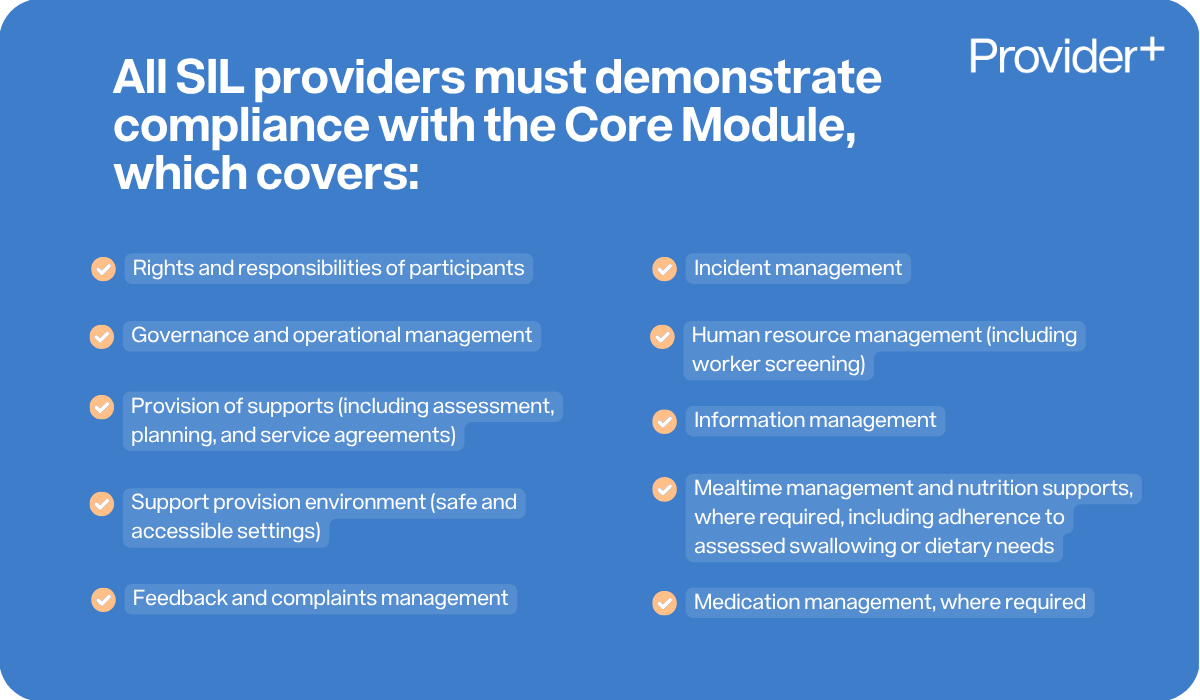
- Rights and responsibilities of participants
- Governance and operational management
- Provision of supports (including assessment, planning, and service agreements)
- Support provision environment (safe and accessible settings)
- Feedback and complaints management
- Incident management
- Human resource management (including worker screening)
- Information management
- Mealtime management and nutrition supports, where required, including adherence to assessed swallowing or dietary needs
- Medication management, where required
High Intensity Daily Personal Activities Module
Providers delivering High Intensity Daily Personal Activities, including within Supported Independent Living (SIL) settings, must demonstrate compliance with the High Intensity Daily Personal Activities Module. This module includes requirements for:
- Comprehensive assessment, planning, and delivery of high-intensity personal supports aligned to participants' individual needs and NDIS plans
- Provision of personal care supports in a manner that is safe, person-centred, and respectful of dignity, privacy, and rights
- Ongoing monitoring, documentation, and review of high-intensity supports and participant outcomes
- Responsive and flexible support delivery that adapts to changing health, functional, or personal care needs
- Clear processes for identifying, escalating, and responding to incidents, risks, or deterioration in a participant's condition
- Ensuring workers delivering high-intensity supports are appropriately trained, competent, and supervised, with skills specific to the supports they provide
Implementing Behaviour Support Plans Module
SIL providers delivering supports to participants with behaviour support needs must demonstrate compliance with the Implementing Behaviour Support Plans Module, which focuses on:
- Understanding and applying approved Behaviour Support Plans
- Supporting participants to reduce restrictive practices in line with the NDIS Quality and Safeguards Commission requirements
- Delivering supports that are person-centred, trauma-informed, and rights-based
- Ensuring positive behaviour support strategies are embedded into daily support delivery
- Monitoring, documenting, and reviewing behaviour support outcomes
- Recognising and responding appropriately to behaviours of concern
- Escalating concerns and incidents in accordance with incident management and reporting obligations
- Supporting participants to build skills, independence, and quality of life
- Working collaboratively with Behaviour Support Practitioners, families, and other stakeholders
- Ensuring workers are trained, competent, and supervised to implement Behaviour Support Plans safely and consistently
SIL-Specific Requirements (Module 5A – Assistance with Supported Independent Living)
Beyond the Core Module and any applicable supplementary modules, SIL providers must demonstrate compliance with Module 5A.
Module 5A introduces four SIL-specific Practice Standards:
- Supported decision-making and choice
- Safeguarding participants receiving SIL supports
- Practice governance and workforce capability
- Agreements relating to tenancy, housing, and support arrangements
These requirements strengthen expectations around participant choice and control, safeguarding, workforce competency, governance, tenancy protections, and the separation of housing and support arrangements where applicable. Providers must be able to demonstrate that participants are actively involved in decisions about their home, supports, and daily lives, including:
- Shared living arrangements and compatibility assessments
- Participant choice and control in their living environment
- Individualised support within shared settings
- Vacancy management that prioritises participant outcomes
- Supporting participants to build independent living skills
- Clear separation of housing and support arrangements where required
What Does the Shift From Unregistered to Registered Mean?
Under the current system, unregistered providers delivering SIL services operate without oversight from the NDIS Quality and Safeguards Commission. They are not required to meet Practice Standards, undergo audits, or demonstrate compliance with quality and safety requirements.
This is changing under the new graduated risk-proportionate registration model.
The Current Situation (Before 1st July 2026)
- Unregistered SIL providers can deliver services to participants with plan-managed or self-managed funding
- No requirement to meet NDIS Practice Standards
- No audits or compliance verification
- No direct oversight from the NDIS Quality and Safeguards Commission
- Worker screening requirements may not be enforced
The Current Requirement (From 1 July 2026)
- SIL is now a regulated NDIS support that requires provider registration.
- Existing unregistered providers delivering SIL before 1 July 2026 can continue operating during the transition period if they submit a valid registration application by 1 October 2026.
- Providers entering the SIL market after 1 July 2026 cannot deliver SIL supports until registration has been granted by the NDIS Quality and Safeguards Commission.
- Mandatory compliance with the NDIS Practice Standards, including Module 5A.
- Certification audits required as part of registration.
- Ongoing audit and compliance obligations to maintain registration.
- Full oversight from the NDIS Quality and Safeguards Commission.
- Mandatory worker screening and other regulatory requirements where applicable.
What Is an Independent Audit?
An independent audit is conducted by an approved quality auditor who assesses whether a provider meets the NDIS Practice Standards. This involves:
Certification Audit A comprehensive assessment of policies, procedures, and practices against all applicable Practice Standards modules. Auditors review documentation, interview staff, and speak with participants to verify compliance. Learn more: SIL certification audit: what auditors look for.
Ongoing Audits Regular audits conducted during the registration period to confirm continued compliance.
Providers must engage an approved auditor from the list maintained by the NDIS Quality and Safeguards Commission. Audit costs are the responsibility of the provider.
What Must Unregistered SIL Providers Do Now?
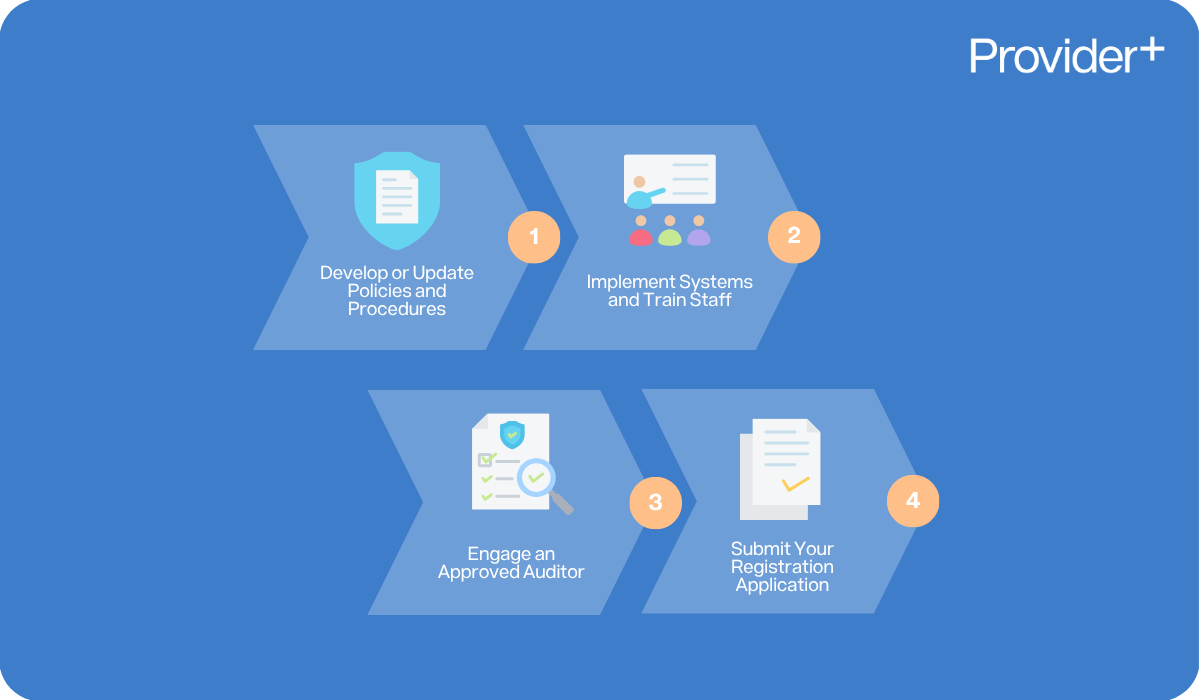
Providers currently delivering SIL services without registration need to take immediate action to meet the 1st October 2026 deadline.
Step 1: Develop or Update Policies and Procedures
Implement compliant documentation for all areas covered by the Practice Standards, including the Core Module, Module 5A – Assistance with Supported Independent Living, and any applicable supplementary modules. Providers that have not yet applied should prioritise this work immediately to support their registration application before the 1 October 2026 deadline. This typically includes:
- Service agreements and participant information
- Incident management policy and procedures
- Complaints and feedback policy
- Human resources policies (recruitment, training, supervision)
- Work health and safety documentation
- Privacy and information management policies
Step 2: Implement Systems and Train Staff
Policies are only effective if implemented. Ensure your team understands and follows the new requirements. This includes:
- Training staff on Practice Standards requirements
- Implementing incident reporting systems
- Establishing quality improvement processes
- Conducting internal audits to test compliance
Step 3: Engage an Approved Auditor
Contact approved auditors early to secure an audit date. Auditor availability will become increasingly limited as the deadline approaches. Expect:
- Waiting times of several weeks to months for audit appointments
- The audit process itself taking several days to weeks
- Time required to address any non-conformances before certification
Step 4: Submit Your Registration Application
Submit your registration application to the NDIS Quality and Safeguards Commission and complete your audit. Existing SIL providers seeking to rely on the transitional arrangements should ensure a valid registration application is submitted by 1 October 2026. The Commission may continue processing applications after that date, provided the application was lodged within the transitional timeframe.
Want us alongside you through this? We work with SIL providers through the full registration process. Book a free, no-obligation call and we'll map out exactly what yours looks like. Book a call.
Key Dates for SIL Provider Registration
We strive to keep our content accurate and up to date; however, NDIS Commission rules and requirements can change. For the latest information, visit the NDIS Quality and Safeguards Commission website or contact our team.
FAQs
Yes, as long as an application for registration has been submitted by the 1st October 2026 and the registration is in process. The safest course of action is to begin the registration process as soon as possible.
Costs vary depending on the size and complexity of your organisation. The largest expense is typically the certification audit, which for SIL providers can run to several thousand dollars. You may also need to factor in costs for developing or updating policies and procedures, staff training, and any remediation work required following the audit. Contact approved auditors directly for a quote specific to your organisation.
Auditors issue non-conformances — either minor or major — for areas where a provider does not meet the Practice Standards. Minor non-conformances can often be resolved quickly with updated documentation or processes. Major non-conformances require more significant remediation and may result in a follow-up audit, which adds both time and cost to the registration process. Providers should allow sufficient time before the deadline to address any issues that arise.
No. Registration covers the provider organisation, not individual locations. However, all locations must meet the Practice Standards, and auditors may visit multiple sites during the audit process.

Understand exactly why registration takes 6–12+ months


