
How Much Does NDIS Registration Cost for a Small Business in 2026?
If you are a small NDIS business weighing up registration in 2026, the real question is rarely “what does it cost?” It is usually “does registration unlock enough growth to justify the compliance load?”
This guide breaks the cost into practical buckets, explains what actually drives audit pricing, and reframes registration as a growth strategy, especially if you want access to participants whose plans are NDIA-managed, because those participants can only use registered providers.
.webp)
The short answer
- There is no fee to register with the NDIS Commission. Your major direct cost is the required quality audit (verification or certification), which you pay to an approved quality auditor.
- For small providers, most “cost blowouts” come from choosing high-risk registration groups, underestimating what certification requires, and building compliance systems after applying instead of before the audit.
- Registration can be a growth lever because it lets you serve NDIA-managed participants, which unregistered providers cannot do.
Registration as a growth strategy
Unregistered vs registered, what changes commercially?
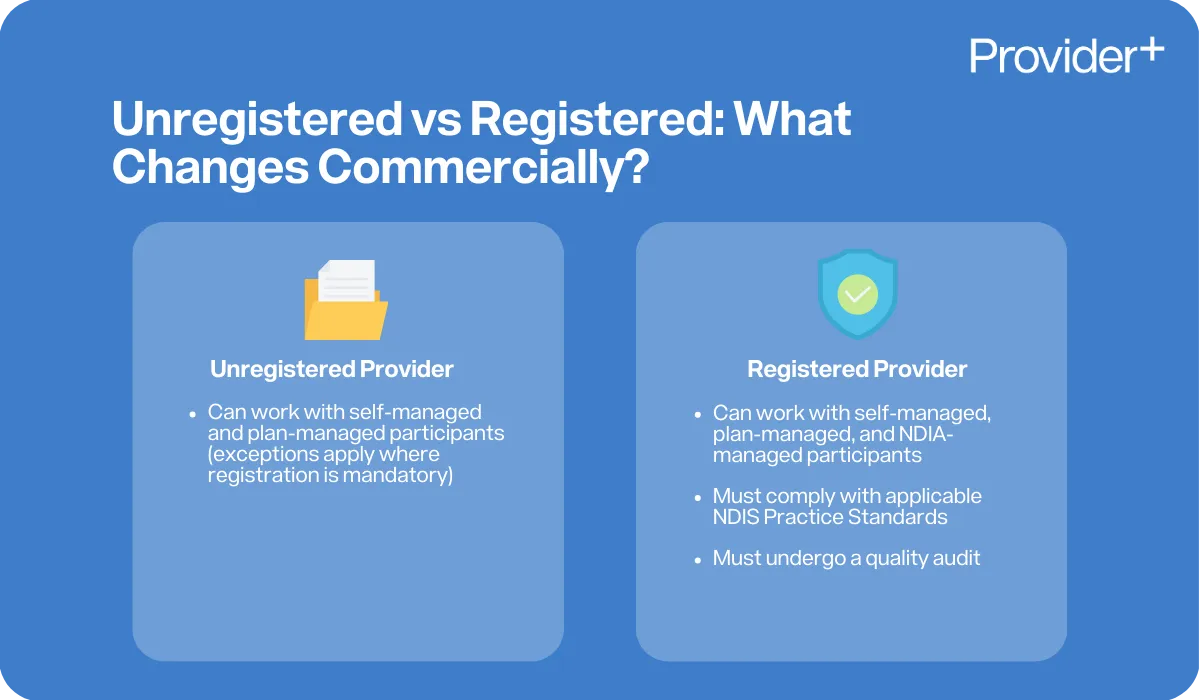
Unregistered provider (in most cases):
- Can work with self-managed and plan-managed participants (with exceptions where registration is mandatory for the support type).
Registered provider:
- Can work with self-managed, plan-managed, and NDIA-managed participants.
- Must comply with applicable NDIS Practice Standards and registration conditions, and must be audited.
The “market unlock” point, what is actually true
The NDIA explains there are three ways participants can manage funding: self-managed, plan-managed, and NDIA-managed.
The critical commercial constraint is this: if a participant’s funding is NDIA-managed, they can only use registered providers.
If you only serve self-managed and plan-managed participants, you are intentionally excluding the NDIA-managed segment. Public NDIA reporting indicates the proportion of participants fully or partly self-managing was about 27% as at 30 June 2025, which implies the majority of participants are not fully or partly self-managed.
That is why registration is often a growth decision, not just a compliance decision.
What costs are real, and what drives them
1) Audit cost (the main direct cost)
The NDIS Commission is explicit:

- No cost to register with the Commission
- Providers pay an approved quality auditor
- Audit cost depends on the size and scale of your organisation and the number of participants you support
- The Commission does not set audit prices, and encourages you to get multiple quotes
Verification vs certification matters because it changes scope and effort. As a general rule, verification is for lower risk and lower complexity supports, and certification is for higher risk supports.
Practical implication for small businesses:
- If you register for any higher risk supports that trigger certification, you should assume a more intensive audit process and budget accordingly.
2) “Build cost” to become audit-ready
Even if your audit fee is modest, you still have internal build costs. Common categories include:
- governance and operational management systems
- incident management, complaints management, risk management processes
- onboarding, training, competency checks
- record-keeping and registers that match your actual service delivery
These are not “nice to have.” Registration conditions include having effective systems for complaints and incidents, and ensuring worker screening clearances for certain roles, including key personnel.
3) Worker screening and workforce checks
The Commission’s registration conditions include worker screening requirements for certain roles, including key personnel.
Where you deliver supports to children, a Working With Children Check may also be required under your state or territory rules. The NDIS notes this expectation at a general level, but the exact requirement is jurisdiction-specific.
Typical budget ranges for a small business in 2026
The Commission does not publish “typical dollar ranges” for audits.
However, Australian provider industry guides commonly cite indicative ranges. These are not official, but they can help you build a planning budget while you obtain quotes.
Below is a conservative way to frame it.
Planning budget (indicative only)
Low complexity, low risk supports (verification pathway):
Industry guides commonly quote verification audits for small providers in the low thousands or below, depending on scope.
Higher risk supports (certification pathway):
Industry guides commonly quote certification audits for small providers in the several-thousand to five-figure range, depending on audit days, sites, and sampling.
What changes the price quickly
When you ask auditors for quotes, the cost usually moves based on:
- number of registration groups and modules in scope
- number of sites
- number of workers and participant sampling expectations
- travel and on-site requirements (for certification)
- whether you are “audit ready” or likely to require corrective actions
This aligns with the Commission’s position that cost depends on size, scale, and participants supported, and that pricing is set by auditors, not the Commission.
Is the cost worth the ROI in 2026?
Here is a practical way to think about ROI without hand-waving.
Step 1, define what registration unlocks for you
For most small providers, there are only a few valid reasons to register:
- you want to serve NDIA-managed participants
- you want to deliver supports where registration is mandatory (SDA, specialist behaviour support, plan management, and any use of regulated restrictive practices)
- you want to position as a higher assurance provider for commissioning, tenders, or risk-sensitive referrals
If none of those are true, registration might be premature.
Step 2, estimate your break-even point
A simple approach:
- Estimate your all-in first year registration cost:
- audit fee
- internal build time (your time plus staff time)
- systems, training, screening, insurance adjustments
- audit fee
- Estimate the gross margin from work you can only do as registered:
- NDIA-managed participant demand you can now accept
- support types that require registration
- NDIA-managed participant demand you can now accept
- Break-even = total first year cost ÷ monthly gross margin from registered-only work.
If the break-even is 3 to 6 months and demand is credible, registration is often commercially rational. If it is 18 months plus, and you do not have strong lead sources, stay unregistered and build capability first.
Step 3, account for the strategic downside of staying unregistered
Remaining unregistered can be a valid strategy, but you should be honest about its limits:
- you cannot serve NDIA-managed participants
- you cannot deliver certain supports at all without registration
- some referral pathways will prefer registered providers because registration requires an audit and Commission oversight
Best practice advice for small providers making the decision in 2026
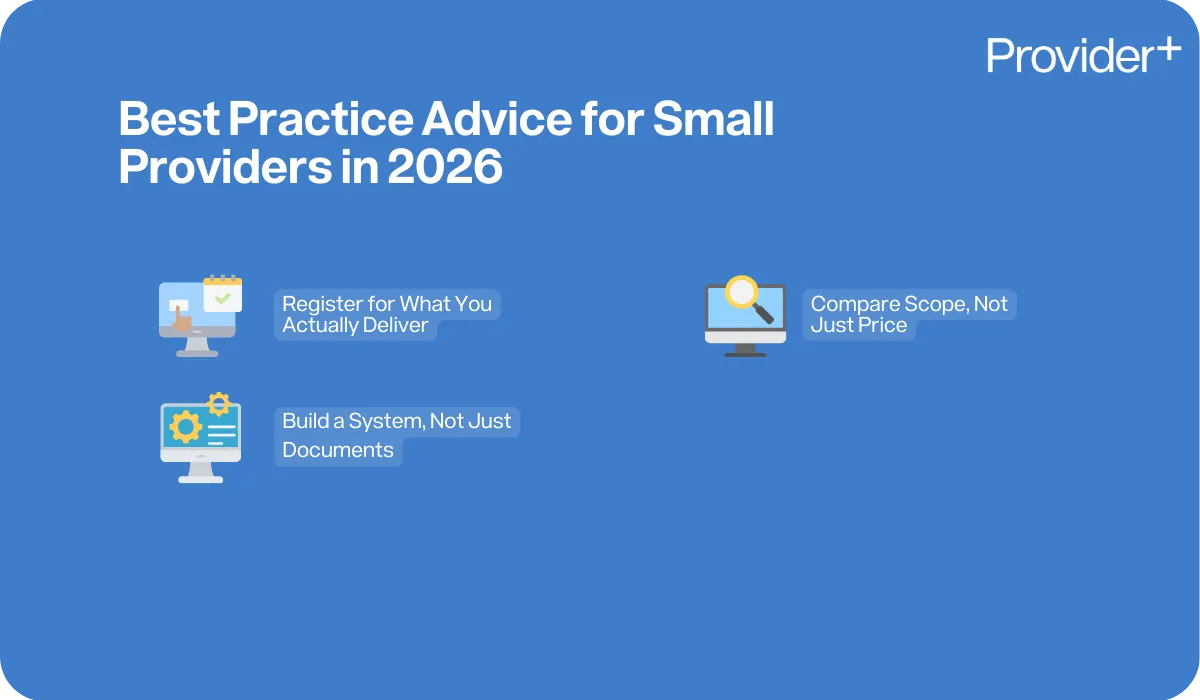
1) Register for what you actually deliver, not what you hope to deliver
Over-scoping registration groups is one of the fastest ways to inflate cost and complexity. If a higher risk group triggers certification, you have just increased audit scope by design.
2) Treat audit readiness as a system, not a document pack
The Commission assesses whether you meet the standards and conditions of registration, including having effective complaints and incident systems and appropriate worker screening arrangements. Templates without operational reality are a liability in a regulated scheme.
3) Get multiple auditor quotes, but compare scope, not just price
The Commission explicitly recommends getting multiple quotes and comparing them, because it does not set audit prices.
In practice, you want to compare:
- audit days
- sampling assumptions
- travel and on-site requirements
- turnaround time for reporting
- what they need from you to confirm scope
This article was published on 19/02/2026. We strive to keep our content accurate and up to date; however, NDIS Commission rules and requirements can change. For the latest information, visit the NDIS Quality and Safeguards Commission website or contact our team.
Need help with the NDIS?
Fill in the form below to get started.
FAQs
There is no fee to register with the NDIS Commission, but you must pay an approved quality auditor for the required audit. The Commission states audit cost depends on the size and scale of your organisation and the number of participants you support, and that audit prices are set by auditors, not the Commission.
The Commission states verification is generally for low risk, low complexity supports and certification is for higher risk supports, and certification audits typically involve more intensive assessment.
No. The NDIA states that if a participant’s NDIS funding is NDIA-managed, they can only use registered providers.
Yes. The Commission states you must be registered to provide SDA, specialist behaviour support services, supports or services to participants with NDIA-managed funding, and plan management services. Registration is also required if you plan to use regulated restrictive practices.
No. The Commission states it does not set prices for audit services and encourages providers to obtain quotes from multiple approved quality auditors.

Understand exactly why registration takes 6–12+ months