How to Become an NDIS Home Modifications Provider (Complete Guide 2026)
If you're a builder, plumber, electrician, or carpenter looking to work with NDIS participants, this guide explains exactly how to register as an NDIS home modifications provider in Australia.
Home modifications under the NDIS include accessibility upgrades like ramps, grab rails, bathroom renovations, and structural changes that help people with disabilities live safely and independently in their homes.
Registration gives you access to a growing market of NDIS participants who need skilled tradespeople to complete funded modifications.
Who Can Register as an NDIS Home Modifications Provider?
The following trades and professionals can register to deliver NDIS home modifications:
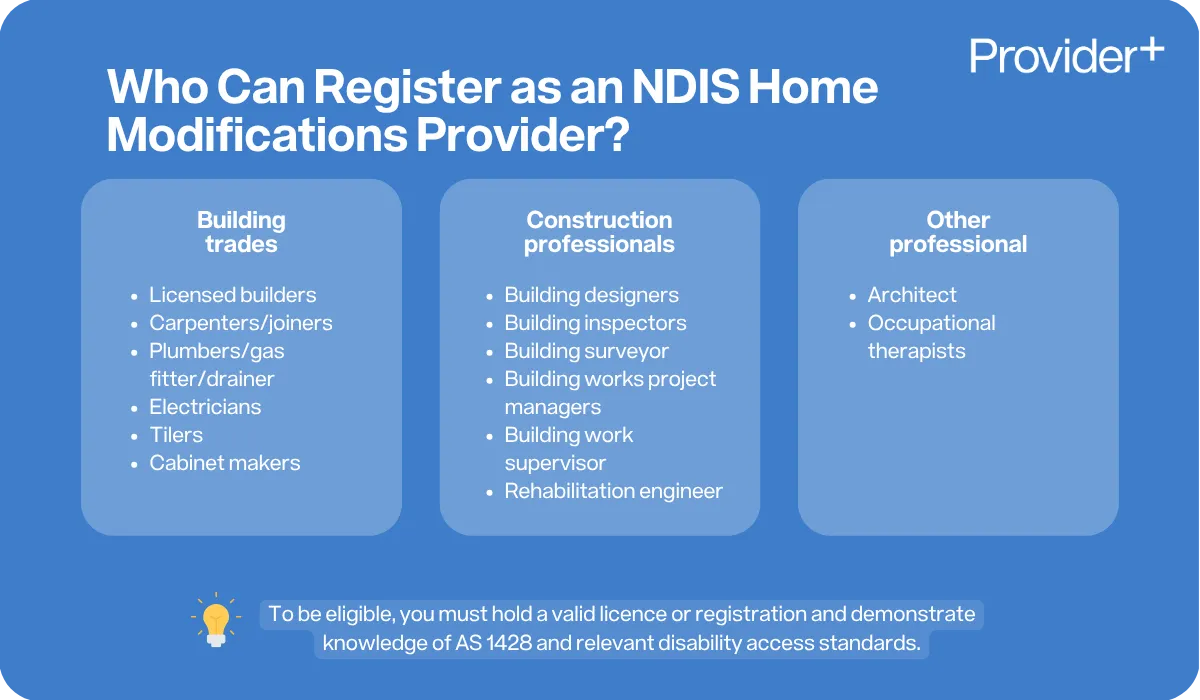
Building trades:
- Licensed builders
- Carpenters/joiners
- Plumbers/gas fitter/drainer
- Electricians
- Tilers
- Cabinet makers
Construction professionals:
- Building designers
- Building inspectors
- Building surveyor
- Building works project managers
- Building work supervisor
- Rehabilitation engineer
Other professional:
- Architect
- Occupational therapists
To be eligible, you must hold a current licence or registration valid for the state or territory where you intend to work. You must also demonstrate experience and understanding of AS 1428 (the Australian Standard for Design for Access and Mobility) and other disability access standards.
What Registration Group Covers Home Modifications?
NDIS home modifications fall under Registration Group 0111: Home Modifications. This includes both minor and complex home modifications.
Home modifications are funded under the Capital Supports category in a participant's NDIS plan. The funding covers:
- Minor home modifications (under $20,000, non-structural)
- Complex home modifications (over $20,000, structural changes)
- Building construction practitioner consultations
- Building works project management (if complex)
Requirements to Register as an NDIS Home Modifications Provider
To register with the NDIS Quality and Safeguards Commission, you need:
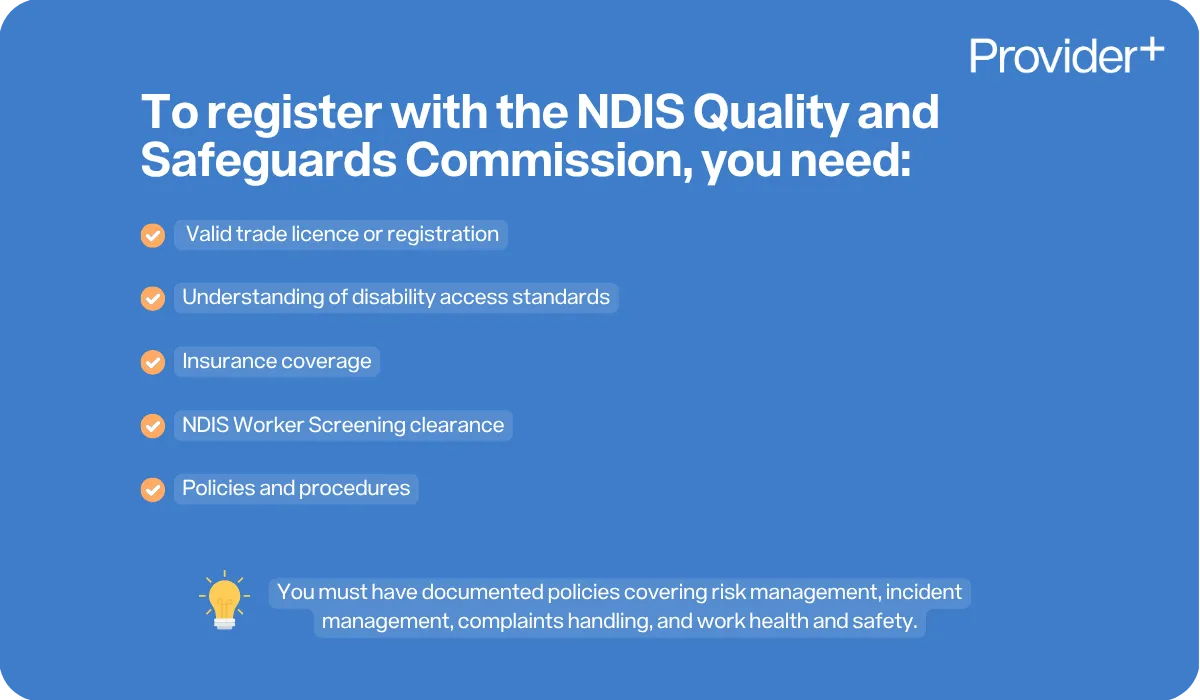
1. Valid trade licence or registration
You must hold the appropriate licence for your state or territory. This includes builders licences, electrical licences, plumbing licences, or other relevant trade certifications.
2. Understanding of disability access standards
You must demonstrate knowledge of AS 1428.1 (Design for Access and Mobility) and how to apply these standards based on individual participant needs and plan specifications.
3. Insurance coverage
You need public liability insurance and professional indemnity insurance appropriate to the work you will be delivering.
4. NDIS Worker Screening clearance
All key personnel involved in service delivery must have a valid NDIS Worker Screening Check clearance.
5. Policies and procedures
You must have documented policies covering risk management, incident management, complaints handling, and work health and safety.
Step-by-Step Registration Process
Here is how to register as an NDIS home modifications provider:
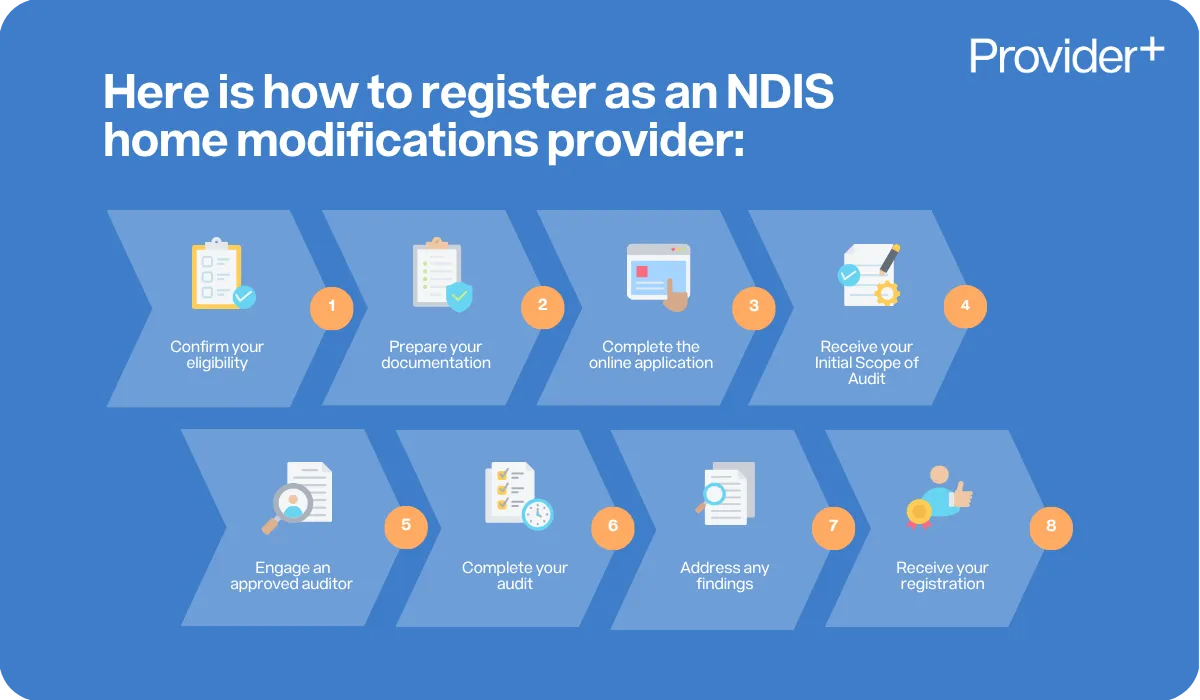
Step 1: Confirm your eligibility
Check that you hold the required trade licence and have experience with accessibility modifications. Review the NDIS Practice Standards to understand what compliance looks like.
Step 2: Prepare your documentation
Gather your trade licences, insurance certificates, worker screening clearances, and develop your policies and procedures before starting the application.
Step 3: Complete the online application
Submit your application through the NDIS Commission portal. You will need to provide details about your business, the registration groups you are applying for, and your key personnel.
Step 4: Receive your Initial Scope of Audit
After submitting your application, you will receive an Initial Scope of Audit document. This outlines whether you need a verification or certification audit.
Step 5: Engage an approved auditor
Select an auditor from the NDIS Commission's list of approved quality auditors. Request quotes from at least three auditors before making your decision.
Step 6: Complete your audit
The auditor will assess your business against the NDIS Practice Standards. For home modifications providers, this is typically a verification audit (lower risk category).
Step 7: Address any findings
If the auditor identifies non-conformities, you will need to address these before your registration can be approved.
Step 8: Receive your registration
Once approved, you will receive a Certificate of Registration and be listed on the NDIS Provider Register.
What Type of Audit Do Home Modifications Providers Need?
Most home modifications providers require a verification audit. This is the audit pathway for lower-risk supports and services.
A Verification audit assesses your business against the NDIS Verification Module, which covers:
- Human Resources
- Incident Management
- Complaints Management
- Risk Management
If you are wanting to include higher-risk registration groups such as Personal Care, Specialist Behaviour Support or Specialist Disability Accommodation. You will then be required to complete a more comprehensive audit for higher risk providers.
How Long Does Registration Take?
The NDIS registration process typically takes 8 to 16 weeks from application to approval. The timeline depends on:
- How quickly you submit complete documentation
- Auditor availability in your area
- Whether any non-conformities need to be addressed
- NDIS Commission processing times
You can reduce delays by preparing all documentation before starting your application and responding promptly to any requests for additional information.
Registration Costs
Budget for the following costs when registering:
NDIS Commission application fee: No fee to submit your application.
Verification audit fee: Typically $900 to $1,500 depending on the auditor and your business size.
Certification audit fee: Typically $3,000 to $5,000 (only required for higher-risk registration groups).
Ongoing costs: For verified providers there is a requirement for an audit every 3 years. For higher risk providers, you must complete a mid-term audit and renewal audit every three years to maintain registration.
Do You Need to Be Registered to Do NDIS Home Modifications?
It depends on how the participant's funding is managed:

Agency-managed participants: The participant's funding is managed by the NDIA. You must be a registered NDIS provider to deliver home modifications for these participants.
Plan-managed participants: The participant uses a registered plan manager. You do not need to be registered, but you must still hold appropriate trade licences and insurance.
Self-managed participants: The participant manages their own funding. You do not need to be registered, but you must still meet professional standards.
Registration gives you access to all participant types, including agency-managed participants who represent a significant portion of the market.
Types of Home Modifications You Can Deliver
NDIS home modifications are classified into three categories:
Low-cost assistive technology (under $1,500)
Simple items like grab rails, non-slip mats, and handheld shower heads. These do not require quotes or assessments and can be recommended by an Occupational Therapist. If they are for a bathroom modification they would be claimed under Home Modifications.
Minor home modifications ($1,500 to $20,000)
Non-structural changes such as:
- Installing ramps
- Widening doorways (non-load-bearing)
- Bathroom modifications (grab rails, shower seats, lever taps)
- Kitchen accessibility upgrades
- Handrail installation
Minor modifications are split into Category A (under $10,000) and Category B ($10,000 to $20,000).
Complex home modifications (over $20,000)
Structural changes involving multiple areas of the home:
- Major bathroom renovations
- Kitchen rebuilds
- Bedroom modifications
- Access ramp construction
- Structural doorway widening
- Installation of ceiling hoists
Complex modifications require an assessment from a qualified occupational therapist, two itemised quotes from licensed builders, and a Building Works Project Manager may be funded by the NDIA for complex projects.
Working with Occupational Therapists
Home modifications are driven by assessments from occupational therapists (OTs). The OT assesses the participant's needs and recommends specific modifications.
As a builder or tradie, you will typically:
- Receive a scope of works from the OT or Building Works Project Manager
- Provide an itemised quote based on the specifications
- Liaise with the OT during construction to address any questions
- Complete the work to the specified standards
- Participate in a final inspection to certify the modifications meet the participant's needs
Building strong relationships with OTs and support coordinators is key to generating referrals and repeat work.
What Can Delay or Derail Your Registration
The NDIS registration process typically takes 8 to 16 weeks, but many providers face delays of 6 months or longer due to avoidable issues. Here are the most common problems and how to prevent them.
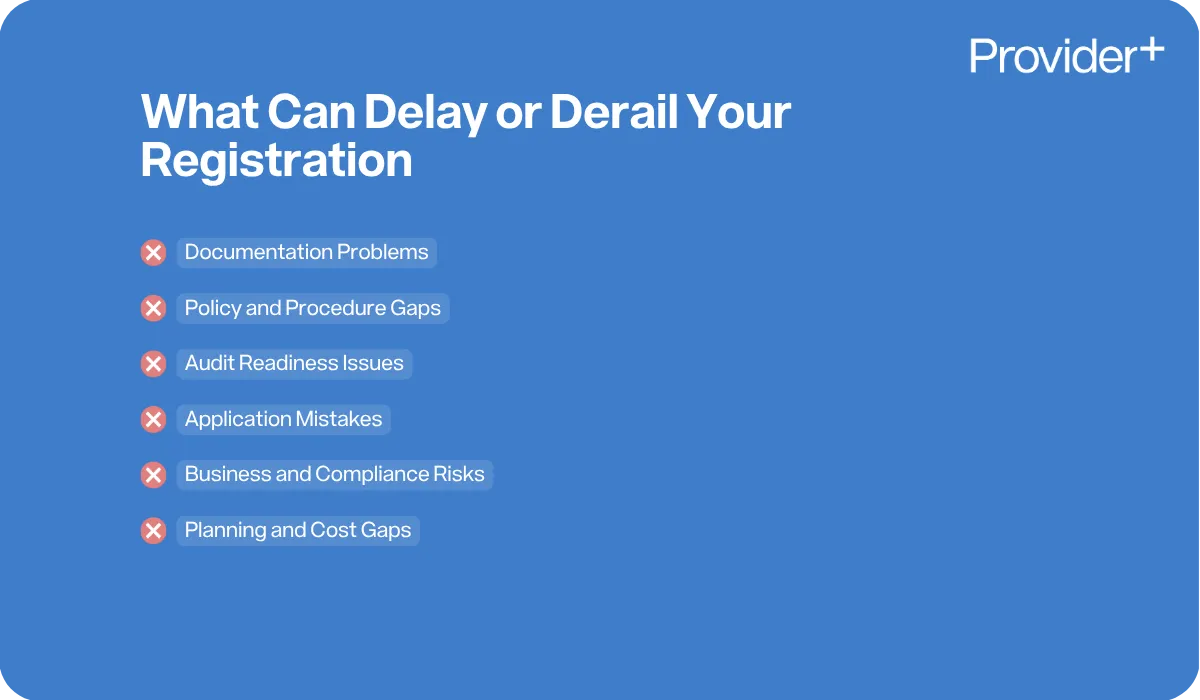
Documentation Problems
Expired licences or insurance
Your trade licence and insurance must be current at the time of application and remain current throughout the audit process. If your licence expires mid-application, you will need to provide updated documentation, which pauses the process.
Prevention: Check expiry dates before applying. If anything expires within 6 months, renew it first.
Missing worker screening clearances
All key personnel must have a valid NDIS Worker Screening Check clearance before you apply. Processing these clearances takes 2 to 6 weeks depending on your state. Applying without clearances in place is a guaranteed delay.
Prevention: Lodge worker screening applications at least 8 weeks before you plan to submit your NDIS application.
Incomplete or incorrect forms
Missing signatures, blank fields, or incorrect details cause applications to be returned for correction. Each round trip adds weeks to your timeline.
Prevention: Have someone else review your application before submission. Check every field twice.
Policy and Procedure Failures
Generic template policies
Generic documents downloaded from the internet are not sufficient. Auditors will ask questions about your policies and probe whether your staff understand and apply them. Inconsistencies between what your documents say and how your organisation actually operates will result in nonconformities.
Prevention: Customise every policy to reflect your actual business operations. If your incident management policy describes a process you do not actually follow, the auditor will identify this.
Policies that do not match your registration groups
Your policies must address the specific NDIS Practice Standards for the registration groups you are applying for. Generic business policies are not enough.
Prevention: Review the NDIS Practice Standards for Registration Group 0111 and ensure your policies directly address each requirement.
Audit Failures
Failing to prepare for auditor questions
The audit is not a document review only. The auditor will ask you questions about how you apply your policies in practice. If you cannot explain your own processes, this raises red flags.
Prevention: Know your policies inside out. Be prepared to give specific examples of how you have applied them in real situations.
Not understanding AS 1428 requirements
For home modifications providers, auditors expect you to demonstrate practical knowledge of disability access standards. Saying "I know about accessibility" is not enough. You need to explain specific requirements and how you apply them.
Prevention: Review AS 1428 before your audit. Be prepared to discuss specific dimensions, clearances, and requirements for bathrooms, ramps, doorways, and circulation spaces.
Non-conformities that require remediation
If the auditor identifies non-conformities, you must address these before registration can proceed. Minor non-conformities can usually be fixed quickly. Major non-conformities can add months to your timeline.
Prevention: Conduct a gap analysis against the NDIS Practice Standards before your audit. Fix any issues before the auditor finds them.
Application Errors
Selecting the wrong registration groups
Many applicants underestimate the scope of what they want to deliver, then have to amend their application later. Changing registration groups mid-application requires additional audit scope and extends your timeline.
Prevention: Map your intended services to registration groups before applying. For home modifications, this is typically Registration Group 0111. If you also want to provide other services, identify all required groups upfront.
Applying for registration groups you cannot support
Some providers apply for multiple registration groups hoping to maximise their market. If you cannot demonstrate capability to deliver those services, your application will be delayed or rejected.
Prevention: Only apply for registration groups where you have genuine experience and capability. You can add more groups later.
Business Structure Issues
Key personnel suitability concerns
The NDIS Commission assesses the suitability of all key personnel, including directors and senior managers. Criminal history, bankruptcy, or previous compliance issues can trigger additional scrutiny or rejection.
Prevention: Disclose any potential issues upfront. The Commission may still approve your application with appropriate conditions, but undisclosed issues discovered later will cause rejection.
Changes during the application process
If your business structure, key personnel, or services change while your application is being processed, you must notify the Commission. Failing to do so can result in compliance breaches.
Prevention: Keep your application details current. Notify the Commission immediately of any material changes.
Financial Surprises
Underestimating audit costs
Verification audits typically cost $900 to $1,500, but costs can be higher depending on your auditor and business complexity. Not budgeting for this can stall your application.
Prevention: Get quotes from at least three approved auditors before committing. Factor audit costs into your registration budget.
Not accounting for preparation time
Preparing documentation, developing policies, and getting worker screening clearances all take time. Many providers underestimate this and miss their target registration dates.
Prevention: Allow at least 3 months of preparation before you plan to submit your application.
How Provider+ Can Help
Provider+ specialises in helping construction businesses register as NDIS providers. Our team has guided hundreds of builders and tradespeople through the registration process.
We offer:
- Eligibility assessment to confirm you meet the requirements
- Documentation preparation including policies and procedures
- Application support and lodgement
- Audit preparation and coaching
- Ongoing compliance support after registration
Our Total Service for Initial Registration handles the entire process so you can focus on running your business.
Contact us to discuss your registration.
Pitfalls When Quoting and Delivering NDIS Work
Even after registration, many tradies run into problems with how NDIS home modifications work in practice. Understanding these upfront will save you headaches.
Quoting Issues
Not providing enough detail
NDIS quotes must include itemised breakdowns showing dimensions of the area being modified, separate costings for each stage of the job (demolition, plumbing, electrical work as separate line items), descriptions of fixtures including make and model, and an overall quote inclusive of GST.
A standard building quote is not detailed enough. The NDIA and participants need to see exactly what they are paying for.
Quoting without OT specifications
Do not quote on a job without clear specifications from the occupational therapist or Building Works Project Manager. Vague instructions lead to scope disputes and payment problems later.
If the scope is unclear, ask for clarification before providing a quote. Put any assumptions in writing.
Underquoting to win work
NDIS participants often need to obtain two quotes for complex modifications. Some tradies underquote to win the job, then find they cannot deliver profitably.
Quote accurately based on the scope of works. Participants and OTs prefer reliable delivery over the cheapest price.
Payment and Funding Issues
Not understanding funding management types
How you get paid depends on the participant's funding management:
- Agency-managed: You invoice the NDIA directly through the myplace portal
- Plan-managed: You invoice the participant's plan manager
- Self-managed: You invoice the participant directly
Each has different processes and payment timeframes. Ask upfront how the participant's funding is managed.
Starting work before funding is confirmed
Never start work until you have confirmed the participant has approved funding for the modifications. Participants cannot claim retrospectively for work completed before NDIS approval.
Get written confirmation of funding approval before commencing any work.
Not understanding staged payments
For larger projects, payments can be claimed in stages where this has been agreed in the service agreement and the NDIA has given prior approval. The final payment cannot be claimed until work is complete, including any required certifications.
Agree payment stages in writing before starting.
Scope and Compliance Issues
Deviating from approved scope
Once the NDIA approves a scope of works, any changes need to go back through the approval process. Making changes on site without approval can result in non-payment.
If the participant wants changes during construction, document these and get approval before proceeding.
Not meeting accessibility standards
All NDIS home modifications must comply with AS 1428 and other relevant disability access standards. Work that does not meet these standards may fail final inspection and require remediation at your cost.
Know the standards before you quote. If you are unsure about specific requirements, consult with the OT or a building certifier.
Missing certifications
Complex modifications often require building certifications, council approvals, or inspections. Failing to obtain these holds up final payment and can create legal issues.
Identify all required certifications upfront and include them in your quote.
This article was published on 15/04/2026. We strive to keep our content accurate and up to date; however, NDIS Commission rules and requirements can change. For the latest information, visit the NDIS Quality and Safeguards Commission website or contact our team.
Need help with the NDIS?
Fill in the form below to get started.
FAQs
Yes. Plumbers can register as NDIS home modifications providers under Registration Group 0111. You must hold a current plumbing licence for your state or territory and demonstrate understanding of AS 1428 disability access standards.
Yes. Electricians can register to deliver NDIS home modifications such as accessible lighting, power point relocations, and smart home automation for accessibility purposes. You need a current electrical licence and knowledge of disability access requirements.
You need public liability insurance and professional indemnity insurance. The specific coverage amounts should be appropriate to the scope and value of work you will be delivering. Most providers carry at least $10 million public liability and $2 million professional indemnity.
NDIS home modifications are quoted and paid based on the scope of works, not hourly rates. You provide itemised quotes based on OT assessments, and participants pay using their Capital Supports budget. Pricing should align with market rates in your area.
You only need to be registered if the participant's funding is agency-managed. Plan-managed and self-managed participants can use unregistered providers, though you still need appropriate trade licences and insurance.
AS 1428 is the Australian Standard for Design for Access and Mobility. It specifies requirements for access to buildings for people with disabilities, including dimensions for ramps, doorways, bathrooms, and circulation spaces. Understanding this standard is essential for NDIS home modifications work.
Build relationships with occupational therapists, support coordinators, and Building Works Project Managers in your area. Register on the NDIS Provider Finder so participants can find you. Deliver quality work and ask satisfied clients for referrals.
A Building Works Project Manager (BWPM) is an NDIS-funded role that helps participants manage complex home modifications over $30,000. The BWPM coordinates between the participant, OT, and builder to ensure the project runs smoothly. They must be independent of any builders quoting on the job.

Understand exactly why registration takes 6–12+ months