How to Write a Strong NDIS Self-Assessment: A Practical Guide for New Providers
What Is the NDIS Self-Assessment and Why Does It Matter?
If you're registering as an NDIS provider, one of the most important (and most commonly mishandled) parts of your application is the self-assessment. It's the section of your registration where you demonstrate how your organisation meets the NDIS Practice Standards.
The NDIS Quality and Safeguards Commission uses your self-assessment to evaluate whether your organisation is genuinely equipped to deliver safe, high-quality supports to NDIS participants. It's not a box-ticking exercise. Done well, it's your opportunity to show auditors exactly what you do, how you do it, and why that aligns with what the Commission expects.
Get it wrong and your application may be delayed, sent back for revision, or trigger additional scrutiny.
The NDIS Practice Standards Framework: What You're Actually Being Assessed Against
Before you write a single word, you need to understand what you're responding to.
The NDIS Practice Standards are structured around a set of quality indicators: specific, measurable descriptions of what good practice looks like in your service context. Each indicator begins with a participant outcome statement (what the participant should experience), followed by a list of quality indicators your response must address.
The standards are divided into:
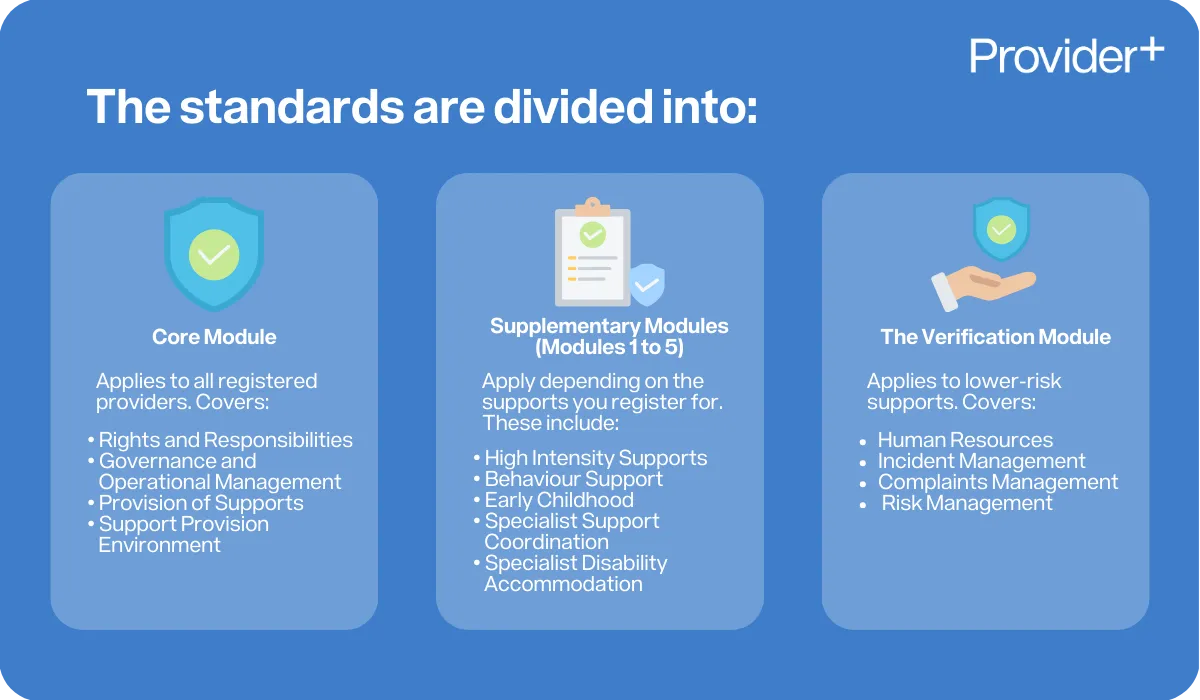
- The Core Module, which applies to all registered providers and covers Rights and Responsibilities, Provider Governance and Operational Management, Provision of Supports, and Support Provision Environment
- Supplementary Modules (Modules 1 to 5), which apply depending on the supports you're registering to deliver. These include High Intensity Daily Personal Activities (Module 1), Specialist Behaviour Support (Modules 2 and 2A), Early Childhood Supports (Modules 3 and 3A), Specialist Support Co-ordination (Module 4), and Specialist Disability Accommodation (Module 5)
- The Verification Module, which applies to lower-risk support types and covers Human Resource Management, Incident Management, Complaints Management, and Risk Management
Most new providers will need to complete the Core Module at a minimum. Depending on your registration groups, you may also need to complete one or more supplementary modules.
Understanding which modules apply to you before you begin writing is essential, and something many new applicants get wrong from the start.
The New Self-Assessment Rules: What Changed (And Why It Affects You)
A critical update all new providers need to know: the NDIS Commission has announced that all applicants must complete their self-assessment responses themselves. The NDIS Commission will not accept pre-written AI responses or generic templates submitted verbatim.
In response to poor self-assessment responses previously submitted, the Commission has introduced a specific condition for those regstering providers:
"A condition is imposed for a Certification audit to be conducted on site, including provision of revised responses to the NDIS Practice Standards, three months after service delivery commences."
This means your self-assessment isn't just a one-time submission. If auditors identify that your responses are generic or don't reflect your actual operations, you'll be required to resubmit revised responses during your certification audit. That's time and resources you don't want to spend.
Providers who have submitted templates with identical responses to other applicants have faced application delays, additional information requests, and in some cases, compliance concerns. Authenticity is no longer optional. It's a regulatory requirement.
What Auditors Are Actually Looking For
This is where understanding the intent behind the questions matters more than the questions themselves.
Every quality indicator in the Practice Standards is trying to establish one of three things:
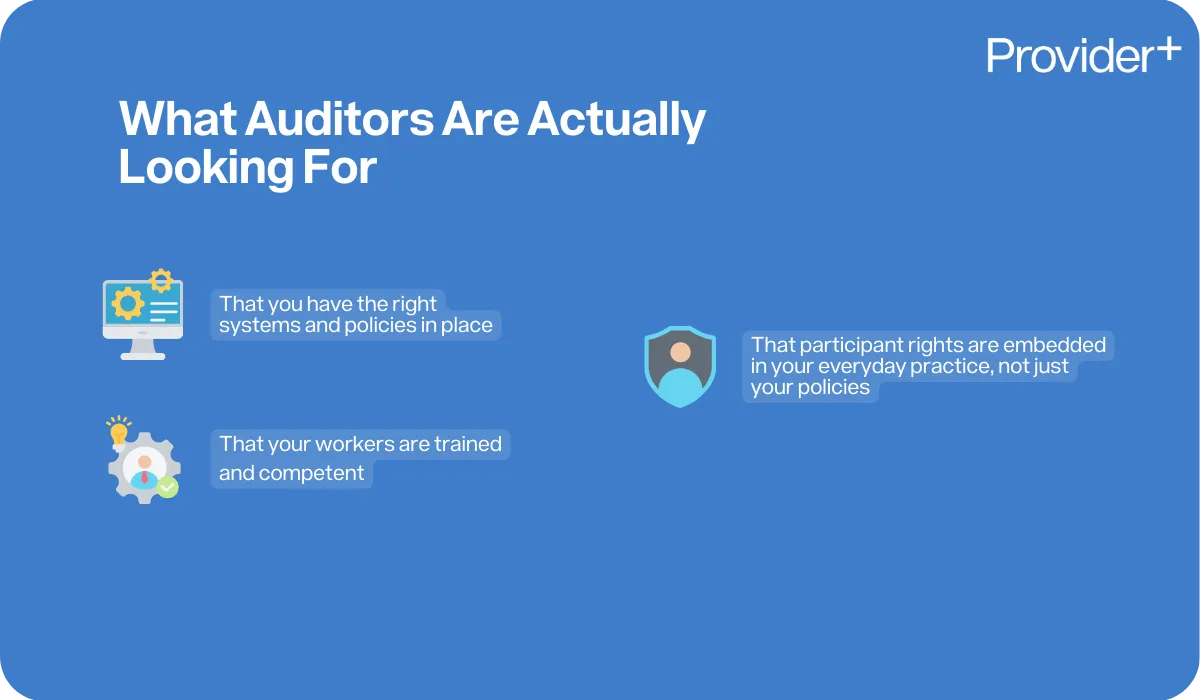
1. That you have the right systems and policies in place. Do you have an incident management system? A complaints process? A risk management framework? Auditors want to see that these aren't aspirational. They exist, they're documented, and they're proportionate to the scope and complexity of your services.
2. That your workers are trained and competent. Across every module, the Commission wants evidence that your staff have the qualifications, training, and ongoing professional development relevant to the supports they're delivering. This is particularly important in high-intensity or specialist support areas.
3. That participant rights are embedded in your everyday practice, not just your policies. This is the dimension most providers underestimate. It's not enough to say "we respect participant rights." Auditors want to understand how participant choice, control, dignity, and cultural responsiveness show up in your day-to-day operations.
How to Write Self-Assessment Responses That Actually Work
Start With the Quality Indicator, Not the Policy
A common mistake is to start with your existing policies and try to map them to the questions. Instead, start with what the indicator is asking, then draw from your policies and practices to respond.
Each indicator is asking: "How does your organisation ensure [this outcome] for participants?" Your job is to describe the mechanism: the actual process, system, or practice that makes it happen.
Be Specific About Your Organisation
Generic responses are the single most common reason applications are delayed. The phrase "we have a complaints process" tells the Commission almost nothing. A strong response describes how participants can lodge a complaint (in accessible formats, in their preferred language), how complaints are acknowledged and escalated, what your resolution timeframes look like, how you document outcomes, and how complaints feed back into service improvement.
The more specific your response is to your organisation's actual operations, the stronger your application. If your service context is unique, for example if you're delivering supports in rural or remote areas, to culturally and linguistically diverse communities, or to participants with complex communication needs, that context belongs in your responses.
Use the "What, How, Evidence" Framework
For each quality indicator, structure your thinking around three questions:
What does your organisation do to meet this standard?
How is it implemented in practice (the process, frequency, who's responsible)?
What evidence exists or could be provided (records, training logs, documented procedures, supervision frameworks)?
You don't need to include all of this in your self-assessment response, but thinking through all three ensures your response is substantive rather than superficial.
Demonstrate Proportionality
The Practice Standards acknowledge that requirements should be "relevant and proportionate to the scope and complexity of supports delivered and the size and scale of the organisation." A sole practitioner registering to deliver support coordination doesn't need the same infrastructure as a large multi-site organisation.
Your responses should reflect your actual scale and context, but they should also demonstrate that you've thought carefully about what proportionate compliance looks like for your organisation specifically.
Module-by-Module: What to Pay Attention To
Core Module
The Core Module covers four broad areas, and all providers need to address it. The areas where providers most commonly underdeliver:
Rights and Responsibilities. Don't just reference your rights policy. Describe how you communicate rights to participants in accessible formats, how you support informed decision-making, and how you handle situations where a participant's choices may create tension with safety.
Privacy and Dignity. This goes beyond a confidentiality clause in your service agreement. Auditors want to understand how dignity is maintained in the day-to-day delivery of supports, particularly in personal care or accommodation contexts.
Governance and Operational Management. For new organisations especially, this section needs to demonstrate that your leadership has genuine oversight of quality and safety, not just that you have a board or management structure.
Verification Module
The Verification Module applies to lower-risk support types. It covers Human Resources, Incident Management, Complaints Management, and Risk Management. While these questions may seem more operational than clinical, the same principles apply: specificity, evidence, and authenticity. A common weakness here is incident management responses that describe the policy without describing how workers are trained to use it or how the organisation reviews and learns from incidents.
Module 1: High Intensity Daily Personal Activities
This module covers complex clinical supports including complex bowel care, enteral feeding, severe dysphagia management, tracheostomy management, and others. The Commission's expectations here are very high. Every response needs to demonstrate not just that you have policies, but that workers delivering these supports have completed training specific to each participant's needs, delivered or verified by an appropriately qualified health practitioner. Generic training references will not be sufficient.
Modules 2 and 2A: Specialist Behaviour Support
These modules require demonstrated knowledge of the NDIS (Restrictive Practices and Behaviour Support) Rules 2018. Critically, providers need to show a genuine commitment to reducing and eliminating restrictive practices, not just complying with them. Your responses need to reflect how your organisation works collaboratively with participants, families, and implementing providers to review the effectiveness of behaviour support plans and move toward less restrictive approaches over time.
Module 3: Early Childhood Supports
Child safety and family-centred practice are the two defining themes here. Your responses need to demonstrate not just compliance with mandatory reporting obligations, but active risk management that prioritises children's safety. The family-centred components require you to show how your supports treat families as genuine partners, not just recipients of a service.
Module 4: Specialist Support Co-ordination
This module focuses on complex needs and crisis management. Strong responses demonstrate that your support coordinators have a genuine methodology for identifying and responding to risk, not just a process for documenting it. The Commission also looks closely at how you ensure participants understand their options and are genuinely supported to exercise choice and control, even in high-complexity situations.
Module 5: Specialist Disability Accommodation
The conflict-of-interest requirements in this module are frequently misunderstood. If you're providing both SDA and other supports to the same participant, you need separate service agreements and clear processes for managing conflicts of interest. Your responses need to reflect how housing rights, including security of tenure, are upheld independently of any decisions participants make about other supports.
The Most Common Self-Assessment Mistakes (And How to Avoid Them)
Using a template verbatim. Even well-structured guidance documents should be a starting point, not a final response. Every answer should be customised to your organisation.
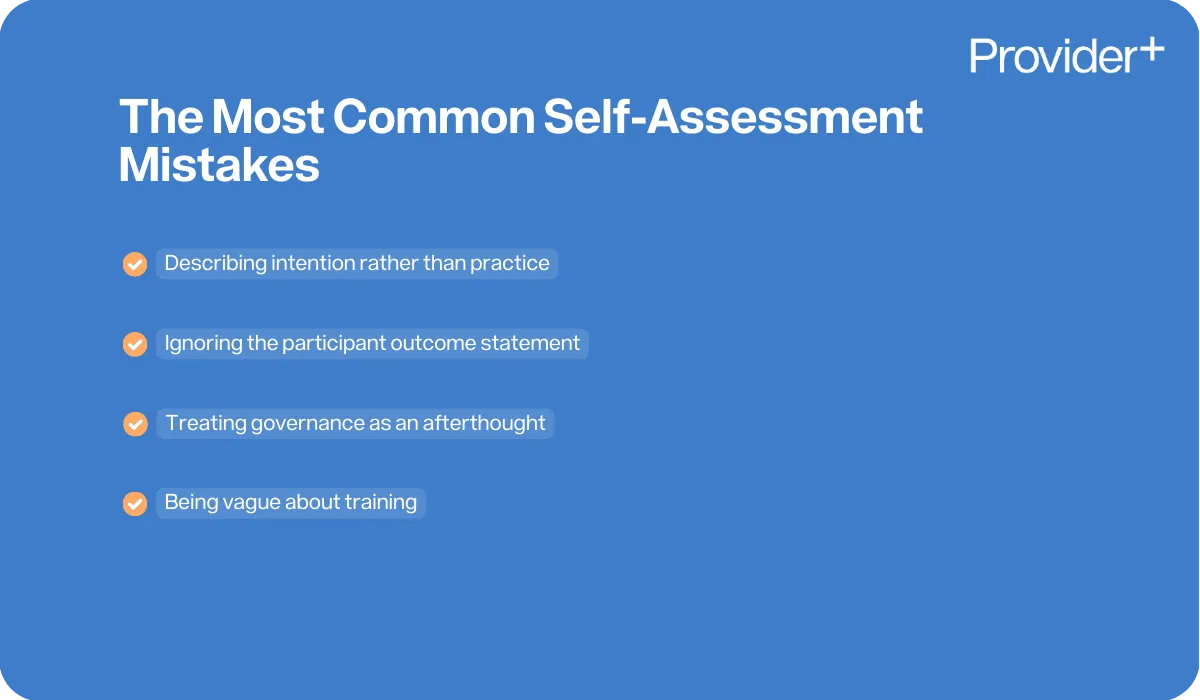
Describing intention rather than practice. "We plan to implement a complaints process" is not a self-assessment response. The Commission wants to know what you have in place now.
Ignoring the participant outcome statement. Each section opens with a statement about what participants should experience. If your response doesn't connect to that outcome, it's missing the point.
Treating governance as an afterthought. New providers sometimes write excellent operational responses but weak governance sections. The Commission wants evidence that your leadership takes quality and safety seriously, not just that your service delivery is well-designed.
Being vague about training. Across all modules, worker training is a recurring theme. "Workers receive appropriate training" doesn't cut it. Name the training, describe the frequency, explain how competency is assessed.
What a Strong Response Actually Looks Like: A Side-by-Side Example
Weak response (complaints management):
"We have a complaints process that participants can access."
Strong response:
"Our complaints management system is documented in our Complaints Policy and Procedure, which is proportionate to our service scope as a [support type] provider. Participants are informed of their right to make a complaint at intake, through our service agreement, and via our easy-read participant handbook. Complaints can be submitted verbally, in writing, via email, or through a third party. All complaints are acknowledged within 2 business days, investigated by a designated staff member independent of the complaint, and resolved within 10 business days where possible. Outcomes are communicated to the complainant and documented in our complaints register. Our management team reviews complaints quarterly to identify patterns and implement service improvements. All workers are trained in the complaints process as part of onboarding and receive refresher training annually."
The difference isn't length. It's specificity. The strong response tells the Commission exactly what exists, how it works, and how it's maintained over time.
When to Seek Professional Support
There's no shame in finding this process difficult. The NDIS Practice Standards are detailed, the regulatory language can be technical, and the stakes are high. Your registration depends on getting this right.
The value of experienced support isn't that someone writes your responses for you. It's that they help you understand what the Commission is really asking, identify gaps in your current systems before you apply, and ensure your responses are framed in a way that genuinely reflects your organisation's compliance.
At Provider+, we offer 1:1 consultation and community workshops for organisations navigating NDIS registration. Our role is to help you understand the framework, strengthen your existing systems, and submit an application that authentically represents your organisation's commitment to quality care.
Key Takeaways
The NDIS self-assessment is not a compliance form. It's your first formal demonstration of your organisation's quality culture. Providers who treat it as a meaningful reflection exercise, and who invest time in writing authentic, specific responses, are far better positioned not just for registration but for the ongoing audit cycle that follows.
The Commission wants to see that you understand the standards, that your systems are real, that your workers are trained, and that participants' rights are genuinely embedded in how you operate. Give them that evidence, in your own words and your own context, and your application will be considerably stronger for it.
Provider+ is an NDIS registration consultancy that supports new and existing providers through the registration process. We provide guidance, not advice, and we never write self-assessment responses for our clients. For more information, visit providerplus.com.au or contact us to book a consultation.
We strive to keep our content accurate and up to date; however, NDIS Commission rules and requirements can change. For the latest information, visit the NDIS Quality and Safeguards Commission website or contact our team.
Need help with the NDIS?
Fill in the form below to get started.
FAQs
The NDIS self-assessment is a mandatory component of provider registration where organisations describe how their practices align with the NDIS Practice Standards. It is completed through the NDIS Commission's online portal and is assessed by auditors as part of the verification or certification audit process.
Templates can be used as a guide to understand what information is required, but responses must be customised to reflect your organisation's specific policies, procedures, and practices. Submitting verbatim template responses can result in application delays or additional Commission scrutiny.
The Commission may return your application for revised responses, request additional information, or impose conditions on your registration requiring you to resubmit improved responses after your service commences. In some cases, this may delay your ability to begin delivering NDIS supports.
All providers must complete the Core Module. Supplementary modules (1 to 5) apply depending on your registration groups. The Verification Module applies to lower-risk support categories. An experienced NDIS registration consultant can help you identify which modules apply to your organisation.
There is no prescribed length, but responses should be thorough enough to demonstrate genuine compliance. A single sentence is rarely sufficient. Focus on specificity: describing your actual systems, training practices, and participant-centred approaches rather than length alone.

Understand exactly why registration takes 6–12+ months
.webp)