
Mandatory SIL Registration: Complete Guide for Unregistered Providers
Last updated: December 2025 | Source: NDIS Quality and Safeguards Commission
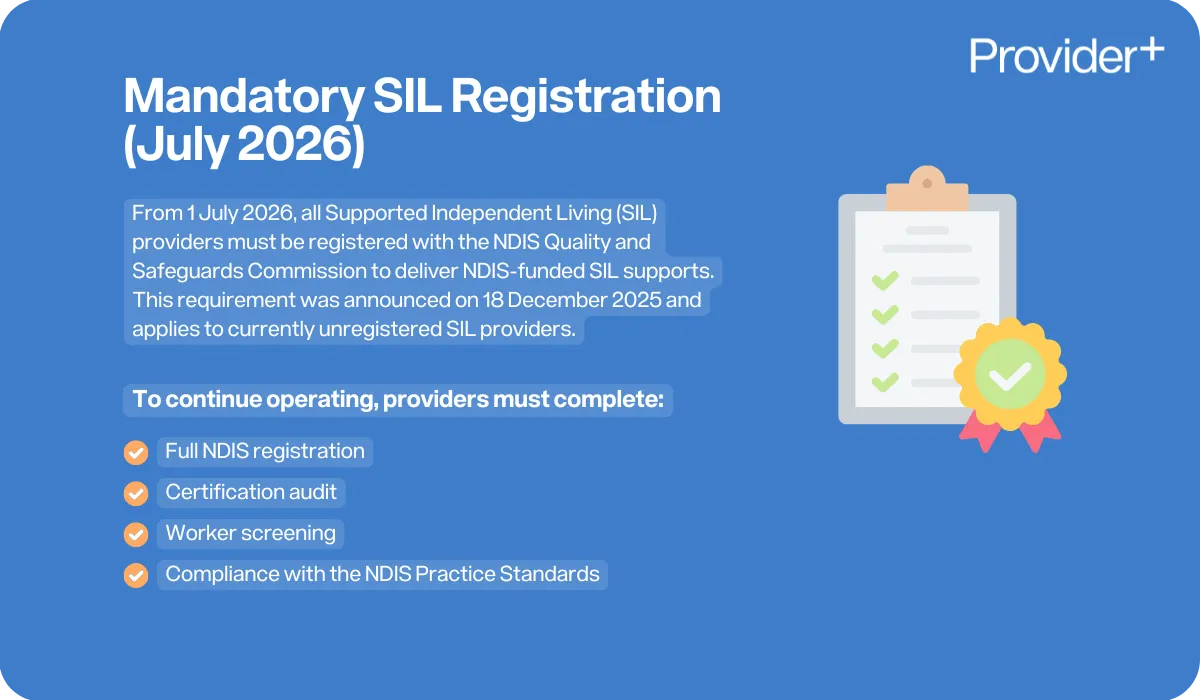
From 1 July 2026, mandatory registration with the NDIS Quality and Safeguards Commission for Supported Independent Living (SIL) providers in Australia will begin. This mandatory registration requirement, announced on 18 December 2025, means unregistered SIL providers will no longer be able to deliver NDIS-funded SIL supports without completing the full registration process, including certification audits, worker screening, and compliance with NDIS Practice Standards.
This guide explains exactly what unregistered SIL providers need to do to become registered before the deadline, including step-by-step instructions, costs, timeframes, and common mistakes to avoid.
What Is Mandatory SIL Registration?
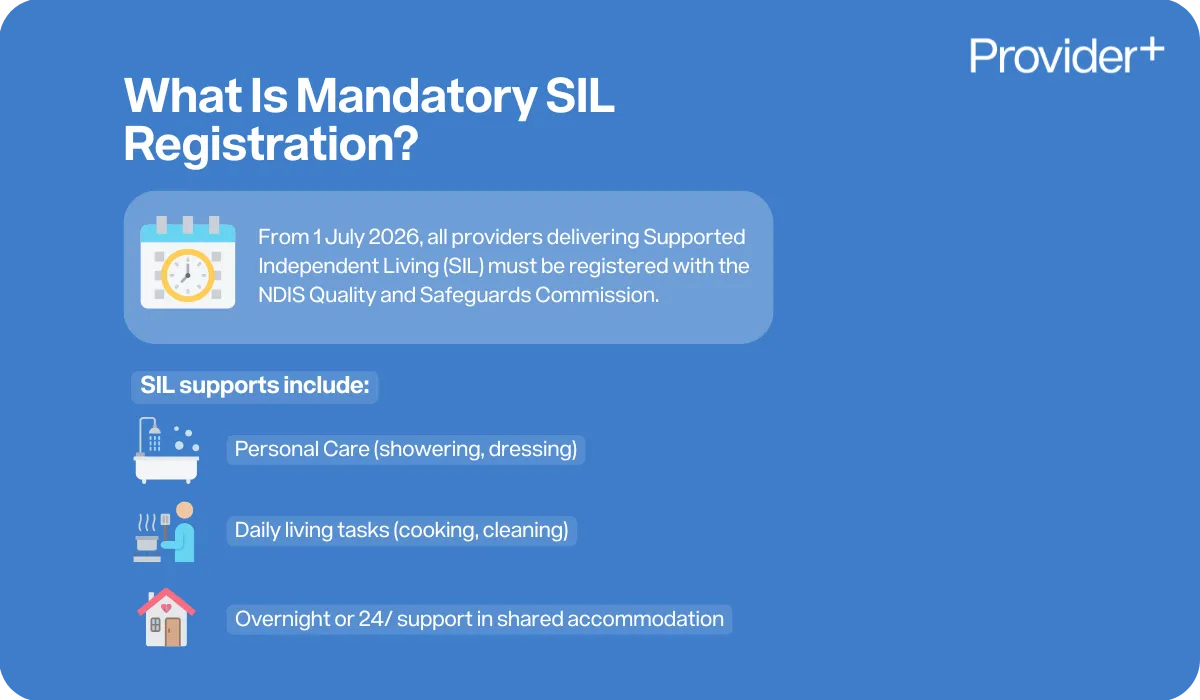
Mandatory SIL registration is a regulatory change requiring every provider delivering Supported Independent Living services under the NDIS to register with the NDIS Quality and Safeguards Commission. Previously, unregistered providers could deliver SIL supports to self-managed or plan-managed participants without registration. After 1 July 2026, this is no longer permitted.
SIL supports include in-home assistance and supervision helping people with disability live as independently as possible. This includes personal care (showering, dressing), daily living tasks (cooking, cleaning), and overnight or 24/7 support in shared accommodation settings.
Use our essential guide to SIL registration to understand the compliance requirement.
Why Is Registration Becoming Mandatory for SIL Providers?

The Australian Government introduced mandatory SIL registration following recommendations from three major reviews: the NDIS Review, the Disability Royal Commission, and the NDIS Provider and Worker Registration Taskforce. These reviews identified SIL as a high-risk support category requiring stronger oversight due to the vulnerability of participants and the intimate nature of services delivered.
According to NDIS Commissioner Louise Glanville, mandatory registration will enable the NDIS Commission to have "greater visibility and control over who operates in the NDIS market" and ensure providers meet "clear and consistent standards."
What Are the Key Dates for Mandatory SIL Registration?
18 December 2025: Mandatory SIL registration announced by the Albanese Government
Early 2026: NDIS Commission to release detailed transition arrangements and guidance
1 July 2026: Mandatory registration commences - all SIL providers must be registered
Important: The registration process typically takes 3-6 months. Unregistered providers should begin preparation immediately to avoid service disruption.
How Do Unregistered Providers Register for SIL?
SIL registration requires certification-level audit (not verification) because SIL is classified as a high-risk support. The registration process involves five main stages:
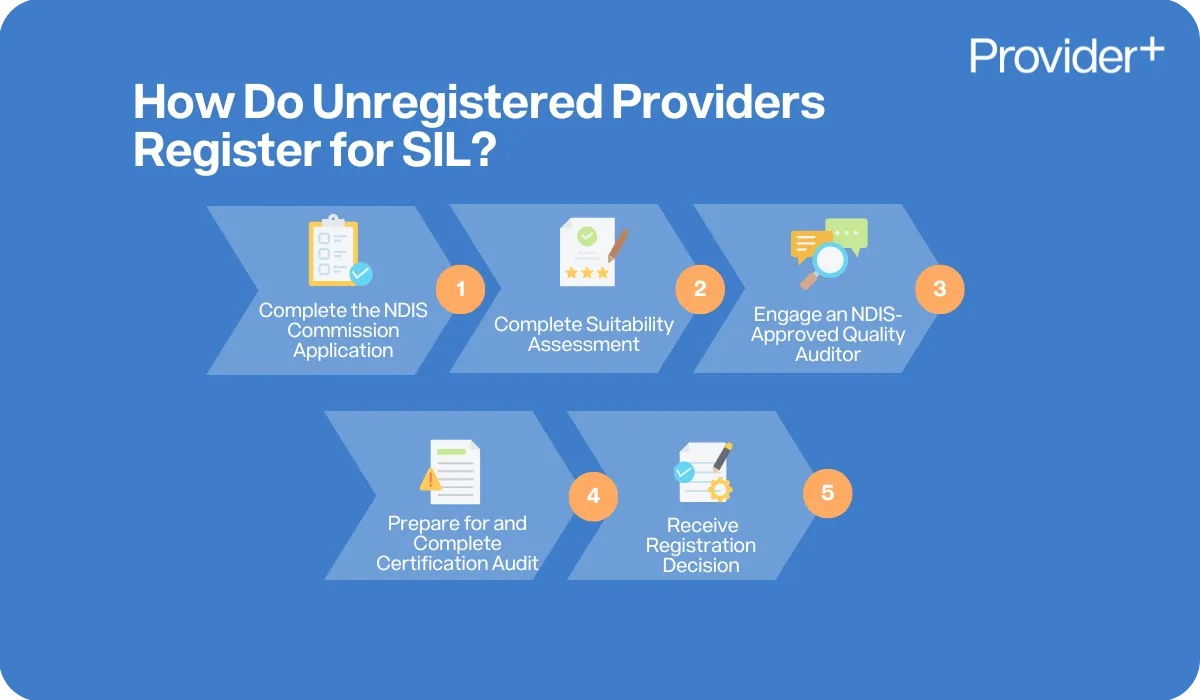
Step 1: Complete the NDIS Commission Application
Submit your application through the NDIS Commission's Applications Portal. You will need to provide organisational details, proposed registration groups (including SIL - Registration Group 0115), key personnel information, and declare any relevant history.
Step 2: Complete Suitability Assessment
The NDIS Commission assesses whether your organisation and key personnel are suitable to deliver NDIS supports. This includes criminal history checks, bankruptcy checks, and assessment of relevant experience. All key personnel must pass this assessment.
Step 3: Engage an NDIS-Approved Quality Auditor
Select an approved auditor from the NDIS Commission's list of approved quality auditors. For SIL registration, you need a certification audit (not verification). The auditor will assess your compliance with the NDIS Practice Standards Core Module and relevant supplementary modules.
Step 4: Prepare for and Complete Certification Audit
Before you start your certification audit, it’s important to understand what SIL auditors look for and how long the audit takes.
A certification audit involves a Stage 1 (document review) and Stage 2 (on-site assessment). The auditor reviews policies, procedures, and evidence of practice. For SIL providers, audits must include interviews with participants receiving SIL supports and observation of service delivery.
Step 5: Receive Registration Decision
Once the auditor submits their report, the NDIS Commission makes a registration decision. If approved, registration is typically granted for three years. You will receive conditions of registration outlining ongoing obligations.
What Standards Must SIL Providers Meet?
Registered SIL providers must comply with the NDIS Practice Standards. The Core Module applies to all registered providers, covering four outcome areas:

1. Rights and Responsibilities - respecting participant rights, privacy, dignity, and freedom from violence
2. Provider Governance and Operational Management - corporate governance, risk management, quality management, human resource management
3. Provision of Supports - access, support planning, service agreements, responsive support provision, transitions
4. Provision of Supports Environment - safe environment, medication management
SIL providers typically also need to meet the High Intensity Daily Personal Activities supplementary module if delivering complex personal care and Implementing Behaviour Support Plans supplementary module if supporting participants with restrictive practices.
New SIL-specific Practice Standards are being developed and will focus on quality and safety in shared accommodation settings and daily supports, while improving worker training requirements and the conduct of SIL audits.
More information and guidance on transition arrangements will be provided by the NDIS Commission in early 2026, so providers have adequate time to prepare for mandatory registration.
What Policies Do SIL Providers Need for Registration?
To pass a certification audit, SIL providers need documented policies and procedures demonstrating compliance with NDIS Practice Standards. Essential policies include:
• Incident Management Policy (including reportable incidents)
• Complaints Management Policy
• Risk Management Framework
• Participant Rights and Dignity Policy
• Privacy and Confidentiality Policy
• Abuse and Neglect Prevention Policy
• Medication Management Policy
• Mealtime Management Policy (if applicable)
• Behaviour Support and Restrictive Practices Policy
• Worker Screening and Recruitment Policy
• Continuity of Supports Policy
• Emergency and Disaster Management Policy
Follow this SIL registration checklist for unregistered providers to ensure you don’t miss any critical requirements.
What Are the Worker Screening Requirements for SIL Providers?
All workers delivering SIL supports through a registered provider must hold a valid NDIS Worker Screening Check clearance. This is a mandatory requirement - not optional.
Worker screening involves:
1. Criminal history check (national and international where applicable)
2. Workplace misconduct check (including any disciplinary findings)
3. Assessment of whether the person poses an unacceptable risk to NDIS participants
Workers apply through their state or territory's worker screening unit. Processing times vary but typically take 2-6 weeks. Providers must verify clearances before workers commence and maintain a register of worker screening clearances.
How Much Does SIL Registration Cost?
The main costs of SIL registration are:
NDIS Commission Application Fee: No fee to apply
Certification Audit: $5,000 - $15,000+ depending on organisation size, locations, and registration groups
Worker Screening Checks: $80 - $130 per worker (varies by state/territory)
Policy Development: $2,000 - $10,000 if using consultants (varies widely)
Mid-term Audit (after 18 months): $3,000 - $8,000
What Are Common Mistakes When Registering for SIL?

Starting too late: The registration process typically takes 3-6 months. With the July 2026 deadline, providers should begin by January 2026 at the latest - ideally earlier.
Generic policies without evidence: Auditors don't just check that policies exist - they verify implementation. You need evidence that staff know and follow policies, such as training records, signed acknowledgements, and incident records demonstrating policy application.
Incomplete worker screening: Every person delivering SIL supports needs a valid NDIS Worker Screening Check. Missing even one worker can result in audit non-conformity.
No participant feedback systems: Auditors interview participants and families. If your organisation has no systematic way to gather and respond to feedback, this is a major gap.
Underestimating audit preparation: A certification audit is rigorous. Prepare a self-assessment against the NDIS Practice Standards before booking your audit.
What Should Unregistered SIL Providers Do Now?
If you currently provide unregistered SIL supports, take these actions immediately:
- Confirm your business model - assess whether you will pursue registration or transition participants to registered providers
- Conduct a self-assessment against NDIS Practice Standards Core Module
- Identify policy and procedure gaps
- Ensure all workers have valid NDIS Worker Screening Checks
- Begin developing or updating required policies
- Research and contact NDIS-approved auditors for quotes and availability
- Start your application in the NDIS Commission Applications Portal
- Budget for registration costs (audit fees, policy development, worker screening)
Official Source
This guide is based on the NDIS Quality and Safeguards Commission media release dated 18 December 2025. For official information, visit: ndiscommission.gov.au
Need help with the NDIS?
Fill in the form below to get started.
FAQs
The NDIS Commission will release guidance transitional information in early 2026, and once mandatory registration is in place, unregistered providers will not be able to deliver NDIS-funded SIL supports. This applies regardless of whether participants are Agency-managed, plan-managed, or self-managed. Delivering SIL supports without registration after this date would breach NDIS legislation.
If you are already registered for SIL (Registration Group 0115), you are not required to re-register. However, you should prepare for new SIL-specific Practice Standards being developed, which will introduce additional requirements for SIL providers.
Yes, the NDIS Commission has indicated that transition arrangements will be provided in early 2026 for mandatory registration to commence from 1 July 2026.
SIL requires a certification audit, not a verification audit. Certification audits involve two stages: a document review (Stage 1) and an on-site assessment (Stage 2). This is more comprehensive and costly than verification audits used for lower-risk registration groups.
The full registration process typically takes 3-6 months from initial application to registration decision. This includes application processing, suitability assessment, engaging an auditor, audit scheduling, completing the audit, auditor report submission, and NDIS Commission decision. Delays commonly occur at the suitability assessment and audit scheduling stages.
Yes. The same 1 July 2026 date applies to platform providers - online marketplaces connecting NDIS participants with support workers. Platform providers must also register with the NDIS Commission and meet quality and safeguard requirements.
.webp)
Understand exactly why registration takes 6–12+ months
.webp)