
NDIS Registration Groups and Qualifications: Why Less Is Often More
The Temptation to Register for Everything
Over-registering is one of the most common and costly mistakes new NDIS providers make. It triggers a more complex audit scope, requires you to demonstrate compliance across practice standards you may not yet be ready for, and in some cases results in a failed or significantly delayed registration. Worse, it can put participants at risk if your organisation is registered to deliver supports your workers aren't actually qualified to provide.
When new providers first encounter the list of NDIS registration groups, it can be tempting to tick as many boxes as possible. The thinking is understandable: more registration groups means more potential participants, more services to offer, and more revenue opportunities down the track.
In practice, this approach almost always backfires.
The NDIS Commission's position is clear: registration groups should reflect the supports you are genuinely qualified to deliver and intend to actually provide. If you can't demonstrate that, your application will show it.
What Are NDIS Registration Groups?

Registration groups are the categories that define what supports a provider is approved to deliver under the NDIS. There are 36 registration groups in total, each corresponding to a type of support or service. Some are low-risk and subject to Verification audits. Others are higher-risk and require Certification audits against more stringent Practice Standards.
The group you register under determines three critical things: the audit pathway you'll follow, the Practice Standard modules you need to address in your self-assessment, and the qualifications and professional body memberships your workers must hold.
Getting this right from the start isn't just good practice. It's the difference between a smooth registration and months of delays.
Verification vs Certification: Why It Matters Which Groups You Choose
Every registration group sits in one of two audit categories.

Verification applies to lower-risk support types where the main requirement is evidence of worker qualifications, insurance, policies, and basic operational systems. Verification audits are generally shorter, less complex, and less expensive.
Certification applies to higher-risk supports and requires a full assessment against the NDIS Practice Standards, including potentially one or more supplementary modules. Certification audits involve on-site reviews, interviews with staff and participants, and a deeper examination of your governance, incident management, complaints systems, and service delivery practices.
Here's the critical point: if even one of your registration groups triggers Certification, your entire audit scope escalates to Certification. Adding a single high-risk group you're not ready for can transform a manageable Verification audit into a significantly more demanding and expensive process.
This is why choosing your registration groups strategically matters just as much as anything else in your application.
The Qualification Requirements Are Real (And Enforced)
Each registration group carries specific qualification and professional body membership requirements. These aren't guidelines. They are assessed during your audit, and if your workers can't demonstrate the required credentials for the supports you're registered to provide, your registration will be at risk.
Here's a snapshot of what the Commission expects across the most common registration groups:
Support Coordination (0132) requires qualifications and solid professional development evidence. Specialist Support Co-ordination (Level 3) specifically requires professionals such as psychologists, occupational therapists, social workers, or registered mental health nurses with AHPRA registration. Experience working with people with complex needs, including incarceration, complex mental health, significant trauma, or PTSS/D, is also expected.
Behaviour Support (0110) requires practitioners to be formally approved by the NDIS Commission as a Behaviour Support Practitioner, at one of four levels: Core, Proficient, Advanced, or Specialist. Core Practitioners must be supervised by someone at Proficient level or above. Providers cannot deliver Behaviour Support as an unregistered provider under any circumstances.
High Intensity Daily Personal Activities (0104) requires support workers to be trained and assessed by Registered Nurses, and Registered Nurses holding relevant AHPRA qualifications and specialist skill sets for those tasks that cannot be delegated to a support worker. Training must be specific to each participant's individual needs and delivered or verified by an appropriately qualified health practitioner. There are no shortcuts here: complex bowel care, enteral feeding, tracheostomy management, and other high-intensity supports carry genuine clinical risk, and the Commission treats them accordingly.
Therapeutic Supports (0128) requires a Bachelor's degree or higher in the relevant discipline, plus active professional body membership. This applies across occupational therapy, physiotherapy, speech pathology, psychology, social work, podiatry, dietetics, music therapy, art therapy, and a range of other allied health professions.
Early Childhood Supports (0118) requires therapist qualifications and professional body membership. The audit pathway also depends on your entity structure: Pty Ltd entities or sole traders and trust entities delivering more than just 0128 require Certification (Module 3), while sole traders and trust entities delivering 0128 only may be eligible for Verification (Module 3A).
Plan Management (0127) requires an accountant or bookkeeper with relevant qualifications and professional body membership. Plan managers must always be registered. They can never provide plan management as an unregistered provider, and they can never provide direct support to participants as an unregistered provider.
Specialist Disability Accommodation (0131) must always be provided by a registered provider. SDA providers can never operate unregistered, regardless of how a participant's plan is managed.
Community Nursing Care (0114) requires AHPRA registration. Workers must be registered nurses (including enrolled nurses or clinical nurse consultants) with experience in professional and clinical supervision as defined by their professional registration requirements.
What Happens When You Register for Groups You're Not Ready to Deliver
This is where the real-world consequences become very concrete.
If you register for a group but cannot demonstrate compliance during your audit, the most likely outcomes are: your application is placed on hold pending additional evidence, specific registration groups are removed from your scope, or conditions are placed on your registration requiring you to resubmit evidence after your service commences.
Beyond the audit, there are operational risks. If your organisation is registered to deliver a support but your workers don't hold the required qualifications, you are exposed to compliance action if the Commission receives a complaint or conducts a random audit. For high-risk supports like Behaviour Support or High Intensity Daily Personal Activities, the consequences can be severe.
There is also a subtler risk that many new providers underestimate: demonstrating compliance in your self-assessment. Every registration group you select adds questions to your self-assessment. If you're registered for Module 2 (Specialist Behaviour Support) but your team has no behaviour support practitioners, you won't be able to write credible responses to the quality indicators. Auditors are experienced at identifying responses that don't reflect real practice, and a weak self-assessment in even one module can cast doubt over your entire application.
The Right Approach: Register for What You'll Actually Use
The NDIS Commission expects applicants to register for the groups that reflect their genuine service offering, not their aspirational one. Here's a practical framework for deciding what to include in your initial registration.
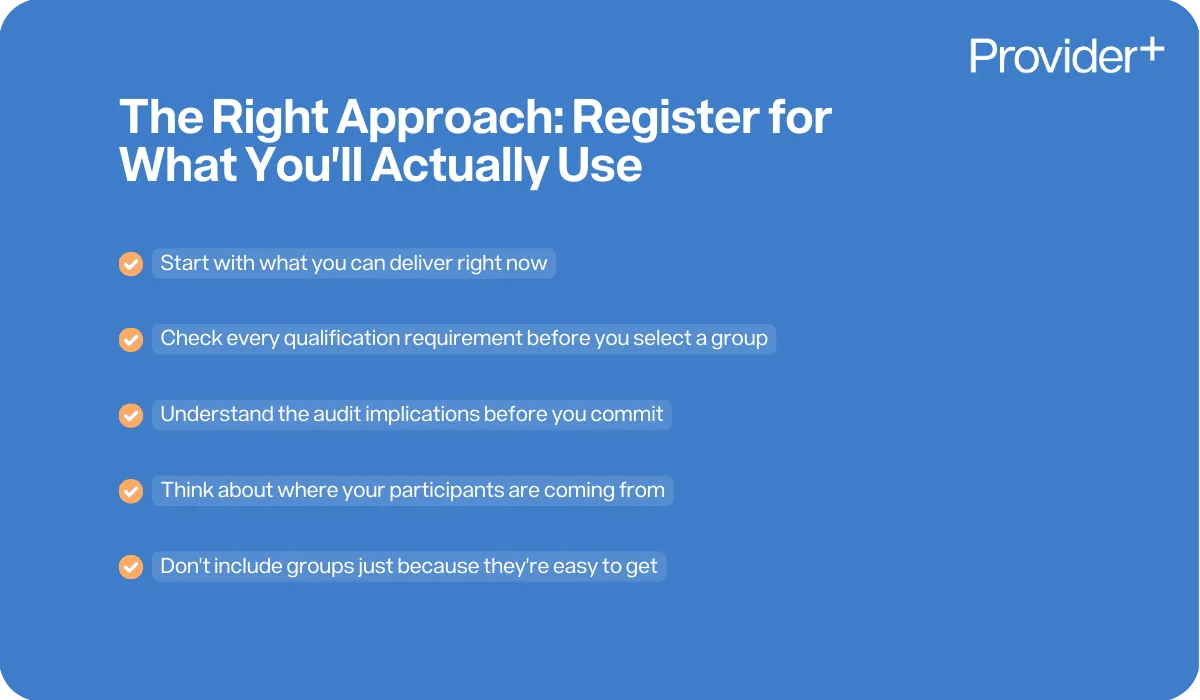
Start with what you can deliver right now. What supports does your team have the qualifications, experience, and systems to provide today? These are your core registration groups. Everything else can be added later through a variation to your registration once your organisation is operational and your capacity is established.
Check every qualification requirement before you select a group. Don't assume that having a broadly relevant background is sufficient. For each group you're considering, confirm that your workers hold the specific qualifications and professional body memberships the Commission requires.
Understand the audit implications before you commit. If a group triggers Certification and you're not ready for a Certification audit, including it in your initial registration will delay your entire application. It's almost always faster to register for a smaller scope, get your registration in place, and then apply for additional groups once you're operational.
Think about where your participants are coming from. If you have a clear referral pathway and an identified participant cohort, register for the groups that serve those participants specifically. Broad registrations without a corresponding participant pipeline add compliance burden without adding real value.
Don't include groups just because they're easy to get. Some providers include low-risk Verification groups simply because there's no immediate downside to having them. But every group you register for is a group you need to maintain compliance for, train workers to deliver, and demonstrate evidence of in future audits. Only register for supports you genuinely intend to provide.
Registered vs Unregistered: Understanding the Distinction

Not all NDIS supports require a registered provider. Many registration groups can be delivered by unregistered providers to participants who are either self-managing or plan-managed. Understanding which groups fall into this category can help you make a more informed decision about where registration genuinely adds value.
A number of supports, including Assist Personal Activities (0107), Development of Daily Living and Life Skills (0117), Participation in Community, Social and Civic Activities (0125), and Therapeutic Supports (0128), can be delivered by unregistered providers to plan and self-managed participants.
However, there are registration groups where registration is mandatory regardless of how the participant manages their funding. Behaviour Support (0110) must always be provided by a registered provider. Specialist Disability Accommodation (0131) must always be provided by a registered provider. Plan Management (0127) must always be provided by a registered provider. These are non-negotiable.
If your target participant cohort is primarily NDIA-managed, you will need to be registered to work with them across most support types. If you are primarily targeting plan-managed or self-managed participants, the registration decision is more nuanced and worth considering carefully before you apply.
Adding Registration Groups Later
One of the most useful things to understand about NDIS registration is that it is not a one-time, all-or-nothing decision. You can add registration groups after your initial registration through a variation process. This means there is no strategic benefit in over-registering on your initial application in an attempt to future-proof your scope.
Adding groups later allows you to build your operational systems and staff capacity first, which means your self-assessment and audit evidence for those groups will be far stronger. It also keeps your initial registration audit clean and focused, which typically means a faster outcome.
The providers who run into trouble are those who try to register for everything at once without the infrastructure to support it. The providers who register quickly and successfully are those who are honest about their current capacity, selective about their initial scope, and methodical about expanding from a stable base.
Where Provider+ Can Help
Selecting the right registration groups is one of the first and most consequential decisions you'll make as a new NDIS provider. The qualification requirements are specific, the audit implications are real, and the gap between what you think you're eligible for and what the Commission will actually accept can be significant.
At Provider+, our 1:1 consultation service helps you map your team's qualifications and your intended service model to the right registration groups before you apply. We help you understand exactly what each group requires, which audit pathway you'll face, and how to build a registration scope that sets your organisation up for a successful outcome.
Key Takeaways
More registration groups does not mean a better or stronger application. It means a more complex audit, more self-assessment questions to answer convincingly, and more compliance obligations to maintain over time. The strongest applications are focused, specific, and honest about what the organisation is actually ready to deliver.
Register for what you're qualified for. Register for what you intend to use. And when you're ready to grow your service offering, add groups from a position of genuine operational readiness rather than aspiration.
Provider+ is an NDIS registration consultancy that supports new and existing providers through the registration process. We provide guidance, not advice, and we never make registration decisions on behalf of our clients. For more information, visit providerplus.com.au or contact us to book a consultation.
Related articles in this series:
- How to Write a Strong NDIS Self-Assessment: A Practical Guide for New Providers
- Understanding the NDIS Audit Process: Verification vs Certification
- NDIS Provider Registration Checklist: What You Need Before You Apply
- The NDIS Quality Indicator Framework Explained
This article was published on 18/02/2026. We strive to keep our content accurate and up to date; however, NDIS Commission rules and requirements can change. For the latest information, visit the NDIS Quality and Safeguards Commission website or contact our team.
Need help with the NDIS?
Fill in the form below to get started.
FAQs
NDIS registration groups are the categories that define which supports a provider is approved to deliver. There are 36 registration groups in total. Each group has specific qualification requirements, a designated audit pathway (Verification or Certification), and corresponding Practice Standard obligations.
No. You can add registration groups after your initial registration through a variation process. It is almost always better to register for a focused, manageable scope initially and expand once you are operational and your systems are established.
Qualification requirements vary by registration group. Some groups require AHPRA registration, specific degrees, or professional body memberships. Others require relevant experience and industry-specific training. Before selecting a registration group, confirm that your workers meet the specific requirements the NDIS Commission expects for that group.
Many NDIS support types can be delivered by unregistered providers to participants who are self-managing or plan-managed. However, some supports, including Behaviour Support, Specialist Disability Accommodation, and Plan Management, always require a registered provider regardless of how the participant's plan is managed.
If your workers cannot demonstrate the required qualifications during your audit, your application may be placed on hold, specific groups may be removed from your registration scope, or conditions may be imposed on your registration. In ongoing operations, delivering supports outside your approved scope or without the required qualifications can result in compliance action by the NDIS Commission.

Understand exactly why registration takes 6–12+ months