



What the NDIS Reforms Actually Mean for Your Provider Business, and What’s Coming Next
The government says it's getting the NDIS back on track. Here's what that means in plain language for unregistered providers, new registrants, and those thinking about entering the market.
This article covers the five most significant NDIS legislative changes since October 2024, what they mean for unregistered providers, those in their initial or provisional registration period, and those considering entering the market, and what is confirmed for 2026 and beyond. It is based on the legislation, official government fact sheets, and sector guidance published to date.
Key dates at a glance
3 October 2024: New NDIS Supports definition commenced. Defined lists now determine what can and cannot be funded before the reasonable and necessary test is even applied.
1 January 2025: Impairment Notices introduced for new participants. Each funded support must now connect to a listed impairment category.
19 May 2025: Funding periods commenced. Most new and reassessed plans now release funding quarterly rather than as an annual lump sum.
1 July 2026: Mandatory SIL provider registration takes effect. Unregistered providers delivering Supported Independent Living must be registered or exit the market.
October 2026: Thriving Kids program launches. Children aged 8 and under with lower to moderate support needs begin transitioning to a separate early intervention program outside the NDIS.
July 2027: Mandatory provider registration expands beyond SIL to other support types, with full market implementation planned for 2030.
What the government is actually saying
In the last 18 months, the NDIS has undergone its most significant legislative overhaul since the scheme launched. Most of the coverage has focused on participants. But if you're running or building an NDIS business, the reforms affect you just as directly, and the window to act is narrowing.
It's worth getting the language right from the outset. You'll see terms like "curbing growth" and "cuts" used frequently in media coverage and advocacy circles. The government's own framing is different. Across legislation, ministerial statements, and official fact sheets, the consistent language is "getting the NDIS back on track," "better, fairer and more sustainable," and most recently, "securing the NDIS for future generations."
That said, the government's own regulatory impact analysis is direct about what these changes will achieve: they will "reduce the number of NDIS participants and some of the supports participants can receive." The growth target has been brought down from 14 per cent annually to 8 per cent, with a longer-term goal of 5 to 6 per cent.
This matters for providers because the scheme your clients are operating in is contracting at the margins, even if the official language doesn't say so plainly. Understanding that reality clearly is more useful than being surprised by it later.
Six changes every provider needs to understand
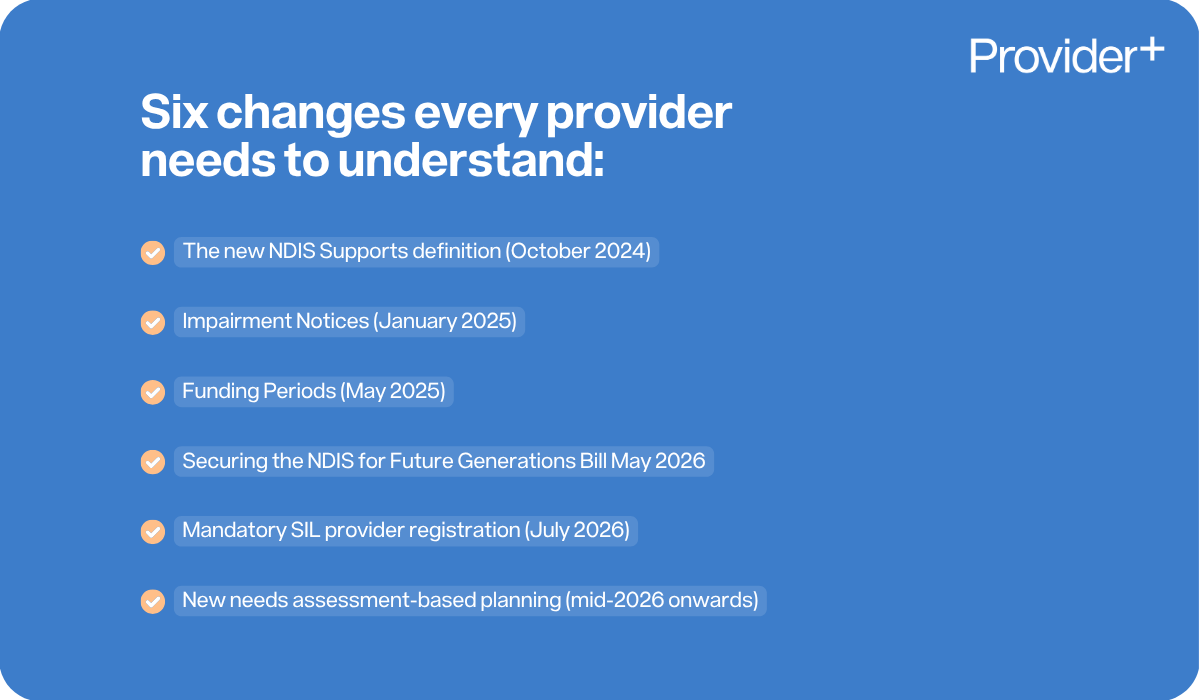
The new NDIS Supports definition (October 2024)
From 3 October 2024, the NDIS Act was amended to create a defined list of what is and is not an NDIS support. This replaced a more flexible framework where the "reasonable and necessary" test did most of the boundary work.
Before a support can even be assessed as reasonable and necessary, it now has to pass a threshold question first: is it on the approved list at all? Everyday costs like rent, standard utility bills, non-modified vehicles and generic phones are explicitly excluded, including for participants living in Supported Independent Living arrangements. For providers delivering or billing for anything in grey areas, this change has real implications for what clients can pay for using their NDIS funds.
Impairment Notices (January 2025)
From 1 January 2025, new participants receive a notice of impairments alongside their access decision. This notice lists the specific impairment categories under which they qualified for the scheme: intellectual, cognitive, sensory, neurological, physical or psychosocial.
The critical point for providers is this: the NDIS will only fund supports that can be connected back to the impairments listed on that notice. If a support can't be tied to a listed impairment, it is unlikely to be funded. This changes how participants' plans are built, and by extension, what supports providers can deliver and claim for.
Funding Periods (May 2025)
From 19 May 2025, new and reassessed plans began releasing funding in quarterly instalments rather than as an annual lump sum. The total yearly budget generally does not change, but the timing of when that money is accessible does.
For providers, particularly those working with self-managed or plan-managed participants, this has cash flow implications. Participants can't bring forward future funding, and some have found quarterly blocks insufficient to cover front-loaded or high-cost supports. Understanding how your clients' plans are now structured is important for managing service agreements and payment expectations.
Securing the NDIS for Future Generations Bill May 2026
The Australian Government has introduced the National Disability Insurance Scheme Amendment (Securing the NDIS for Future Generations) Bill 2026, which proposes significant reforms aimed at improving the long-term sustainability, integrity and effectiveness of the NDIS. For providers, the changes are expected to increase regulatory oversight, strengthen registration and compliance requirements, introduce greater scrutiny of claims, funding and service delivery, and place a stronger focus on quality, evidence-based supports and operational accountability.
Mandatory SIL provider registration (July 2026)
In December 2025, the government announced that all Supported Independent Living providers must be registered with the NDIS Quality and Safeguards Commission. Transition to registration will commence on 1 July 2026. Refer to the following link for more information on transition arrangements:
The Commission has described SIL as a "critical, high-risk disability support," and mandatory registration will bring SIL providers under formal audit requirements, quality standards, worker screening and compliance obligations.
This is the single most time-sensitive reform for providers currently delivering SIL without registration. The deadline is real, and the registration process takes longer than most people expect.
New needs assessment-based planning (mid-2026 onwards)
The 2024 legislation created the architecture for a new way of setting participant budgets, based on a standardised Support Needs Assessment tool called I-CAN. Rather than line-by-line support decisions, budgets will be generated from a standardised baseline assessment, with complex or high-cost supports still requiring detailed functional capacity assessments.
Live testing of I-CAN began in early 2026, with a phased rollout to participants aged 16 and over starting from mid-2026. This is the reform that will most significantly reshape how participant plans are structured over the next two to three years.
What this means for you
If you're currently delivering supports without registration
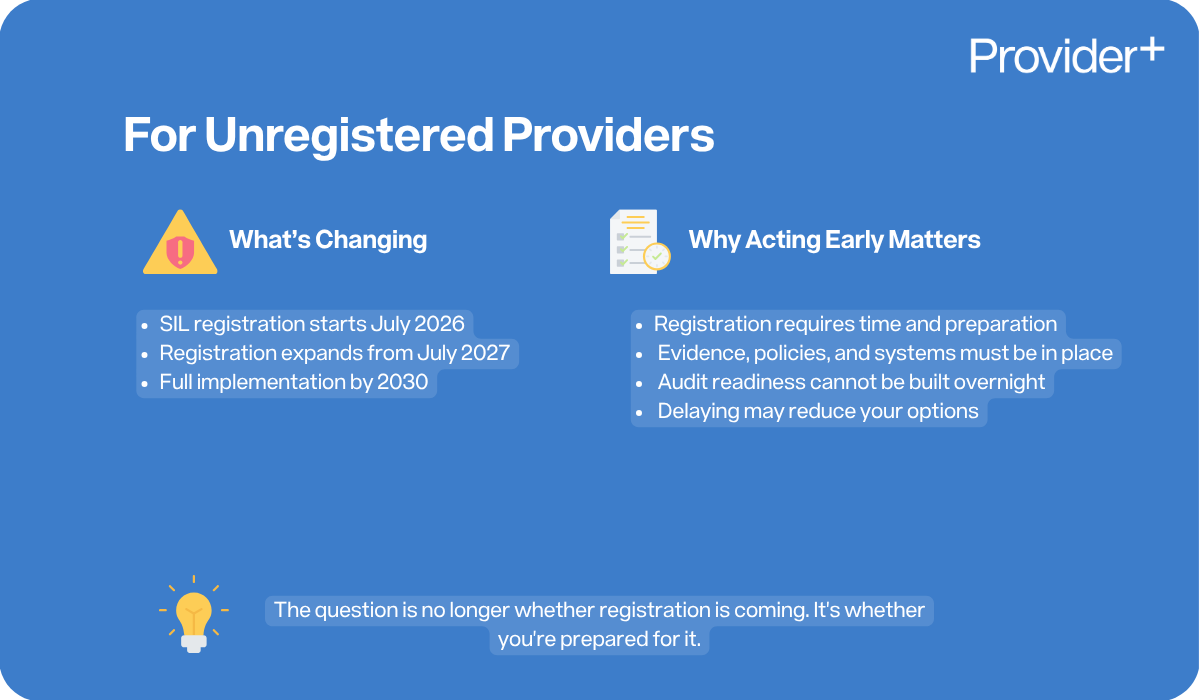
The mandatory SIL registration deadline of 1 July 2026 is the most immediate issue. If you are delivering SIL right now as an unregistered provider, you are operating in a support type that will require registration in a matter of weeks. A staged transition period has been confirmed, and the direction is clear: the unregistered model for SIL is being closed.
Beyond SIL, the broader picture is also shifting. The government has confirmed that provider registration will expand across the market from July 2027, with full implementation across all support types by 2030. This is not a SIL-specific reform. It is the systematic end of the unregistered provider model across the NDIS.
The question for unregistered providers is not whether to register, but whether there is still time to do it properly. Registration involves evidence gathering, policy and procedure development, audit preparation, and in many cases a significant investment of time and resources. If you haven't started, the time to start is now.
If you're in your initial or provisional registration period
You entered the market under one set of rules and are now operating under another. That's a difficult position, and it's one we see regularly.
The supports you can deliver and bill for are now defined more tightly. Your clients' plans are being restructured, with quarterly funding releases affecting how and when they can pay for services. Impairment notices are beginning to scope what supports participants can access, which directly affects your service delivery model. The compliance obligations attached to your registration are only increasing as the scheme matures.
This is precisely the moment where good advice pays for itself. Making sure your registration scope reflects the scheme you're actually operating in now, rather than the one you applied under, protects both your business and your clients.
If you're considering entering the NDIS market
The NDIS market is consolidating. Unregistered providers are being systematically moved out, which is creating real gaps, particularly in SIL, that registered providers can fill. For those who enter correctly, the timing is actually favourable.
The providers who will struggle are those who enter without understanding what the scheme now looks like. Some support types will see reduced demand as plans tighten and participant numbers at the lower end of the needs spectrum shift to programs outside the NDIS, including the $2 billion Thriving Kids program for children aged 8 and under launching in October 2026. The supports you choose to register for, and the client cohorts you plan to serve, matter more than they did two years ago.
Entering registered, correctly scoped, and with a clear understanding of how participant plans are now being built is the difference between a sustainable NDIS business and one that spends its first year firefighting compliance and cash flow.
What the data actually shows
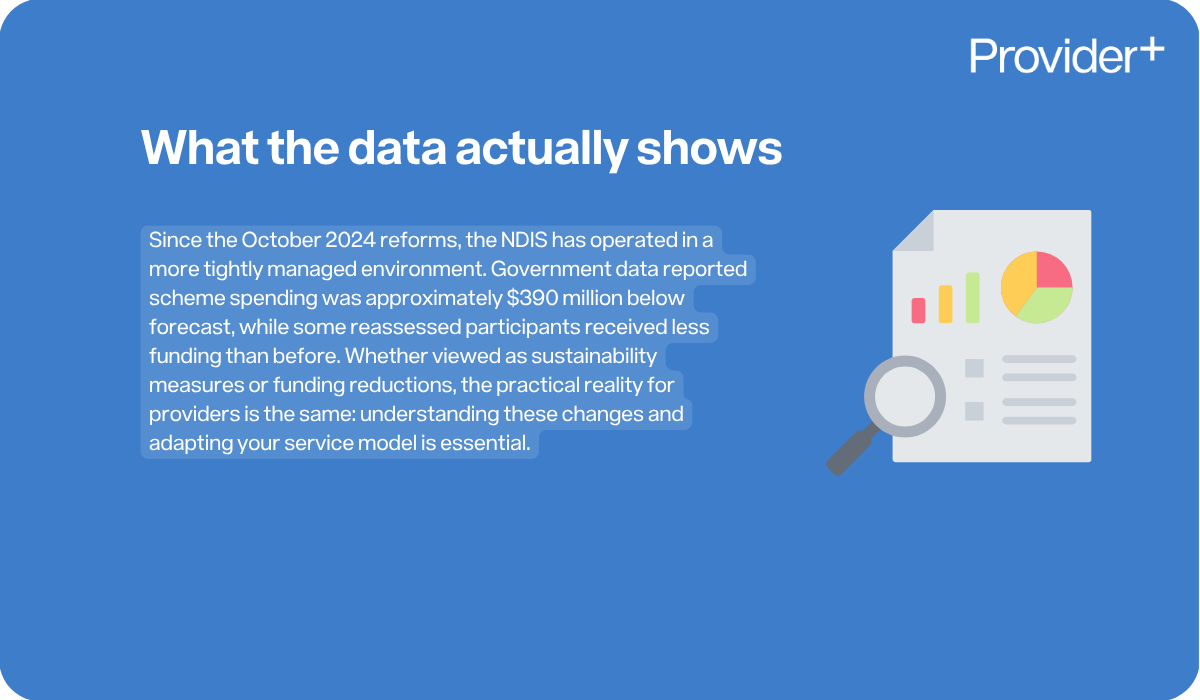
The government's own early evaluation of the October 2024 changes reported that scheme spending in the first half of 2024-25 came in approximately $390 million below forecast. Among the roughly 105,000 plans issued with funding periods since May 2025, around one in three saw funding reduced, with average cuts of approximately 22.5 per cent.
Advocacy organisations including Advocacy WA have reported plans being cut without consultation, and The Guardian documented dozens of participants whose supports were reduced or refused in the year following October 2024. The NDIA's own evaluation acknowledged it could not yet fully quantify the extent of support changes across the participant cohort.
The government frames these outcomes as improved consistency and scheme sustainability. Advocacy groups frame them as cuts. For providers, the practical reality sits between those two positions: the scheme is tighter than it was, and participants with reassessed plans may have less funding available than they previously did. Building your service model around that reality is more useful than waiting to see how it plays out.
This article was published on 02/06/2026. We strive to keep our content accurate and up to date; however, NDIS Commission rules and requirements can change. For the latest information, visit the NDIS Quality and Safeguards Commission website or contact our team.
Need help with the NDIS?
Fill in the form below to get started.
FAQs
Yes. The government announced in December 2025 that all Supported Independent Living providers must be registered with the NDIS Quality and Safeguards Commission. As part of the reforms, a new registration group, 0138 – Assistance with Supported Independent Living (SIL), will commence from 1 July 2026, with mandatory registration requirements and new SIL-specific Practice Standards applying to providers delivering SIL supports. Existing registered providers holding registration group 0115 will transition automatically to 0138, while currently unregistered SIL providers will be required to apply for registration by 1 October 2026 to continue delivering SIL supports during the transition period, with all providers expected to demonstrate compliance with enhanced audit, quality assurance, worker screening, governance and safeguarding requirements under the new regulatory framework.
An impairment notice is a document issued to new NDIS participants from 1 January 2025, listing the specific impairment categories under which they qualified for the scheme. The NDIS will only fund supports that can be directly connected to those listed impairments. For providers, this means the supports you can deliver and bill for are increasingly tied to what is documented in each participant's impairment notice, not just what was previously funded under their plan.
The National Disability Insurance Scheme Amendment (Getting the NDIS Back on Track No. 1) Act 2024 commenced on 3 October 2024. The most immediate change was the introduction of a defined list of what is and is not an NDIS support. Participants can only use NDIS funding for supports on the approved list. Everyday costs including rent, standard utilities, non-modified vehicles and generic phones are explicitly excluded, even for those in Supported Independent Living arrangements.
I-CAN is a standardised Support Needs Assessment tool the NDIA is developing to set participant budgets under the new framework planning system. Rather than building plans line by line, budgets will be generated from a baseline assessment of support needs. Live testing began in early 2026, with a phased rollout to existing participants aged 16 and over from mid-2026. Complex or high-cost supports will still require detailed functional capacity assessments from allied health professionals.
The government's position is that the reforms are improving consistency and sustainability, not cutting funding. However, the government's own regulatory impact analysis acknowledges the changes will reduce the number of participants and some of the supports available. Data from sector reporting suggests around one in three reassessed plans issued with funding periods since May 2025 saw funding reduced, with an average reduction of approximately 22.5 per cent. For providers, this means some clients may have less funding available in reassessed plans than they previously did.
The reasonable and necessary test in section 34 of the NDIS Act determines whether a support can be funded. It has not been removed, but its operation has changed significantly. Since October 2024, a support must first qualify as an NDIS support under the new defined lists before the reasonable and necessary criteria are even applied. This means the boundary work has shifted from the test itself to the list of approved supports, making the approved list the first and often decisive gate for funding decisions.
It is the formal title of the first major legislative reform package: the National Disability Insurance Scheme Amendment (Getting the NDIS Back on Track No. 1) Act 2024. The government uses this phrase, along with "better, fairer and more sustainable" and "securing the NDIS for future generations," to describe the overall reform program. In practical terms, the reforms tighten what the NDIS funds, how participant budgets are set, and who can deliver certain supports, with the stated aim of reducing scheme growth from 14 per cent annually to between 5 and 8 per cent.
The expansion of mandatory registration beyond SIL is confirmed to begin from July 2027, with full implementation across all support types planned for 2030. The government has described this as implementing recommendations from the NDIS Review to bring the entire provider market under registration requirements over time.
The NDIS is changing in ways that are structural, not temporary. The providers who come through this period in the strongest position will not be those who waited to see what happened. They will be the ones who understood what was coming, made decisions based on that understanding, and built their businesses accordingly.
Whether you are unregistered and facing a deadline, newly registered and navigating a shifting landscape, or still deciding whether to enter the market, the most important thing you can do right now is get clear on where you stand and what the path forward looks like.
If you'd like to talk through what these changes mean for your specific situation, the team at Provider+ is here to help.

Understand exactly why registration takes 6–12+ months

.webp)
