



When Do Unregistered NDIS Providers Have to Register? SIL Registration Deadline Explained
Unregistered NDIS providers delivering Supported Independent Living (SIL) services must commence the transition to registration from 1 July 2026. As part of the reforms, a new registration group, 0138 – Assistance with Supported Independent Living (SIL), will commence from 1 July 2026, with mandatory registration requirements and new SIL-specific Practice Standards applying to providers delivering SIL supports. Existing registered providers holding registration group 0115 will transition automatically to 0138, while currently unregistered SIL providers will be required to apply for registration by 1 October 2026 to continue delivering SIL supports during the transition period, with all providers expected to demonstrate compliance with enhanced audit, quality assurance, worker screening, governance and safeguarding requirements under the new regulatory framework.
Platform providers must also commence the transition to mandatory registration from 1 July 2026 with the NDIS Commission still to release transition information. This deadline is part of the broader NDIS reforms following the 2023 NDIS Review, which introduces a new graduated risk-proportionate registration model with four tiers. SIL is expected to fall within Tier 1 (Advanced Registration) under the proposed model.
More information and guidance on transition arrangements will be provided by the NDIS Commission. There will be a considered transition period to:
- Prepare for mandatory registration
- Ensure continuity of support to participants
What Is the New Proposed Graduated Risk-Proportionate Registration Model?
The NDIS is considering replacing its current registration system with a graduated risk-proportionate model featuring four distinct tiers. This new framework categorises providers based on the level of risk associated with their services.
The Four Tiers of NDIS Provider Registration
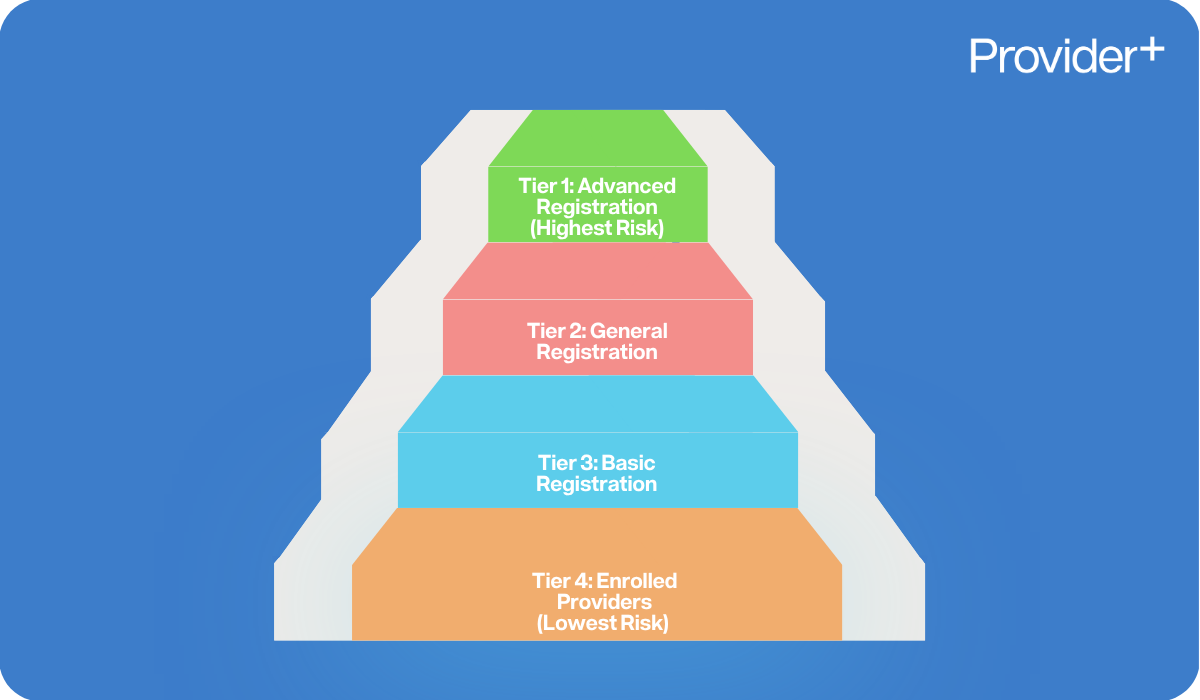
Tier 1: Advanced Registration (Highest Risk) Required for providers delivering high-risk supports including SIL, Specialist Disability Accommodation (SDA), and behaviour support involving restrictive practices. These providers face the most rigorous audit and compliance requirements.
Tier 2: General Registration Applies to providers delivering supports with moderate risk levels. Includes services requiring professional qualifications or ongoing participant relationships.
Tier 3: Basic Registration Designed for lower-risk services with simplified compliance requirements. Suitable for providers delivering straightforward supports without complex participant needs.
Tier 4: Enrolled Providers (Lowest Risk) A streamlined pathway for providers delivering minimal-risk supports. Features reduced administrative burden while maintaining essential safeguards.
SIL providers fall under Tier 1: Advanced Registration, meaning they face the most comprehensive audit and certification requirements.
Why Waiting Is a Mistake
Many providers are taking a "wait and see" approach to the new registration requirements. This is a high-risk strategy that could force providers to cease operations, especially now that the NDIS Commission has released SIL transition information.
The Audit Bottleneck Problem
The NDIS Quality and Safeguards Commission has a limited number of approved auditors. As 1 July 2026 approaches, thousands of SIL providers will be competing for audit appointments simultaneously.
What this means in practice:
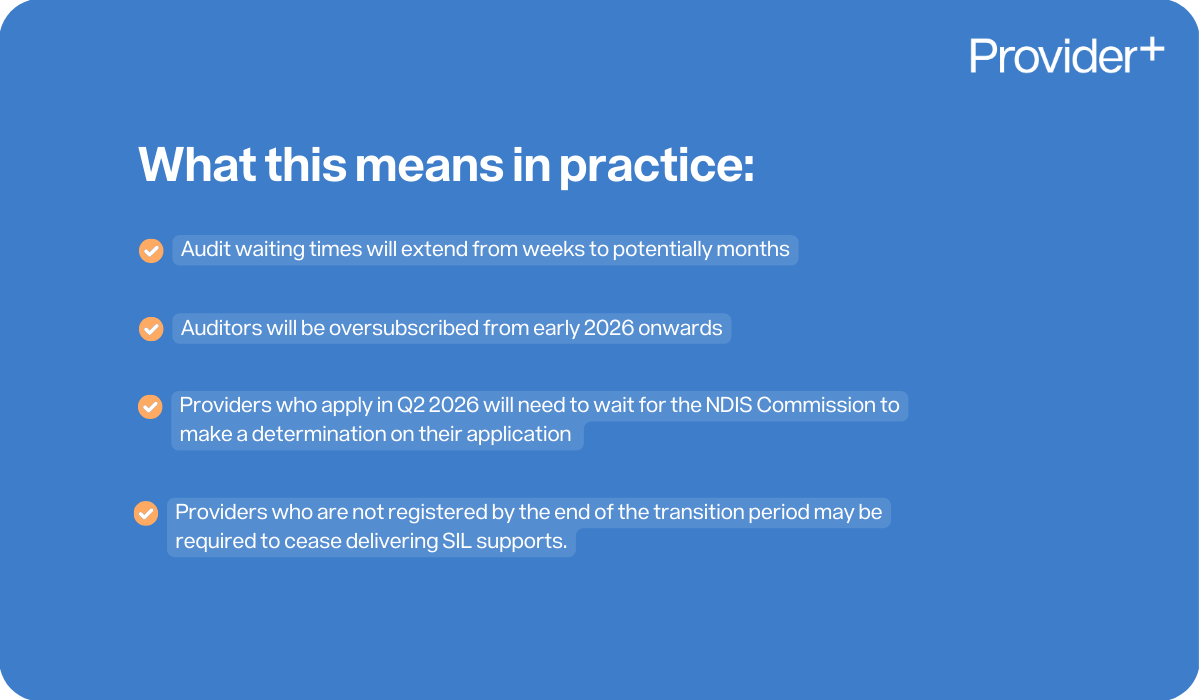
- Audit waiting times will extend from weeks to potentially months
- Auditors will be oversubscribed from early 2026 onwards
- Providers who are not registered by the end of the transition period may be required to cease delivering SIL supports
The Financial Impact of Missing the Deadline
Providers who cannot deliver SIL services after the transition period face:
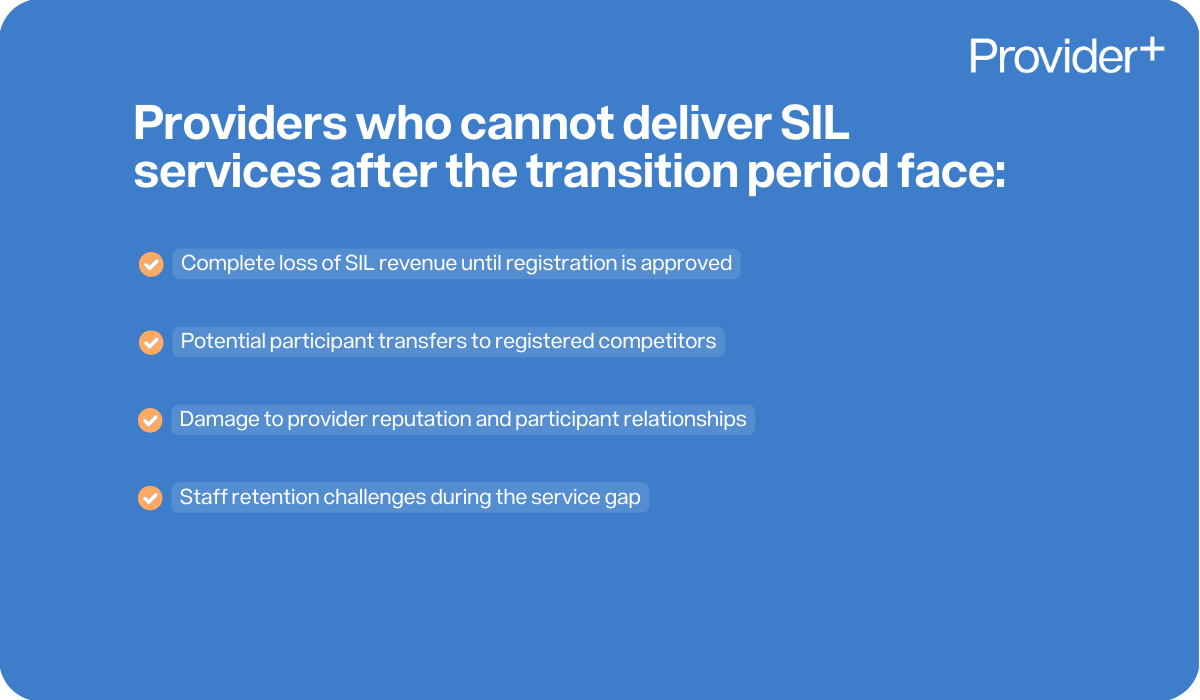
- Complete loss of SIL revenue until registration is approved
- Potential participant transfers to registered competitors
- Damage to provider reputation and participant relationships
- Staff retention challenges during the service gap
When Should SIL Providers Start the Registration Process?
Now. Providers delivering SIL services should begin the registration process as soon as possible. Delaying this process could impact service delivery to NDIS participants. Providers should follow the steps below for mandatory registration:
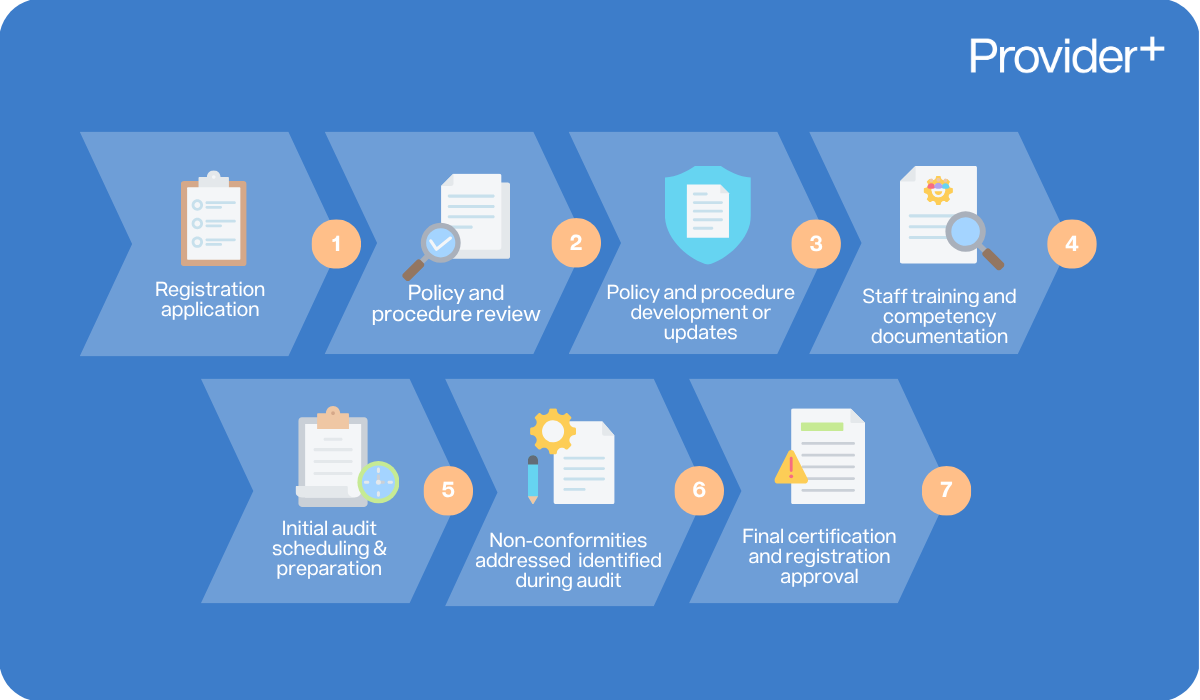
- Registration application
- Review policies, forms and procedures against Practice Standards requirements
- Policy and procedure development or updates
- Staff training and competency documentation
- Initial audit scheduling and preparation
- Addressing any non-conformances identified during audit
- Final certification and registration approval
Providers who begin this process in early 2026 position themselves well ahead of the anticipated audit bottleneck.
What Happens to Existing Registered Providers?
Existing registered providers holding registration group 0115 will automatically transition to 0138, and from 1 July 2026 will be required to implement the updated NDIS Practice Standards. The updated NDIS Practice Standards for SIL will be assessed at the providers next audit. The NDIS Commission will provide further updates and guidance as this information becomes available as the NDIS Practice Standards for SIL are still in DRAFT.
Next Steps for SIL Providers
- Assess your current position. Review your existing policies, procedures, and compliance documentation against registration requirements and the DRAFT NDIS Practice Standards for SIL.
- Engage with the process early. Contact approved auditors now to understand availability and secure preferred audit dates.
- Seek specialist guidance. Work with an NDIS consultant who understands the registration framework and can guide you through your policies, forms and procedures, audit preparation, and compliance requirements.
- Do not assume extensions. Plan your registration timeline assuming 1 July 2026 is immovable.
How Provider+ Can Help
Provider+ has helped thousands of providers get registered, pass audits, and maintain compliance. We understand the specific requirements for SIL certification and the urgency of the July 2026 deadline.
We offer:
Dedicated Expert Consultant. A specialist NDIS registration and compliance expert is assigned to guide you 1:1 through your entire registration process, answering your questions and advising you every step of the way.
NDIS Policies, Forms and Procedures. All the policies, forms and procedures required for your registration, designed to pass audit and be practically implemented in your business.
Personal Audit Coach. A structured 6-step program working 1:1 with you to fully prepare for your certification audit, tackling each audit area in sequence from required documents to the questions auditors will ask.
Auditor Introduction. Direct connection to appropriate independent certifiers who understand our systems and standards.
PQM Pro. Our Quality Management System keeps your documentation centralised, version-controlled, and always audit ready.
Start Up Club. Training and support to get your NDIS business operational once registration is complete.
Provider+ Community. An exclusive provider-only platform with live workshops, Q&As, Audit School, and ongoing NDIS business support.
Book a free 30-minute call with our team to clarify the process, confirm you have everything in place, and map out your pathway to SIL registration.
This article was last updated on 01/06/2026. We strive to keep our content accurate and up to date; however, NDIS Commission rules and requirements can change. For the latest information, visit the NDIS Quality and Safeguards Commission website or contact our team.
FAQs
There is currently no indication the Commission intends to delay the 1 July 2026 commencement date. Providers should plan on the basis that transition will begin from that date.
The Commission has indicated there will be transitional arrangements. However, the specific requirements, including any cut-off dates for unregistered providers, are yet to be released. Once the transitional period has ended, unregistered SIL providers must cease service delivery to all NDIS participants.
Under normal circumstances, the full registration process including audit takes approximately three to six months. However, as the deadline approaches, this timeline is expected to extend significantly due to auditor availability constraints and the influx of unregistered providers seeking registration.

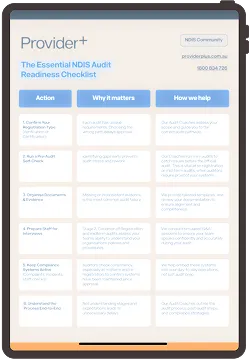
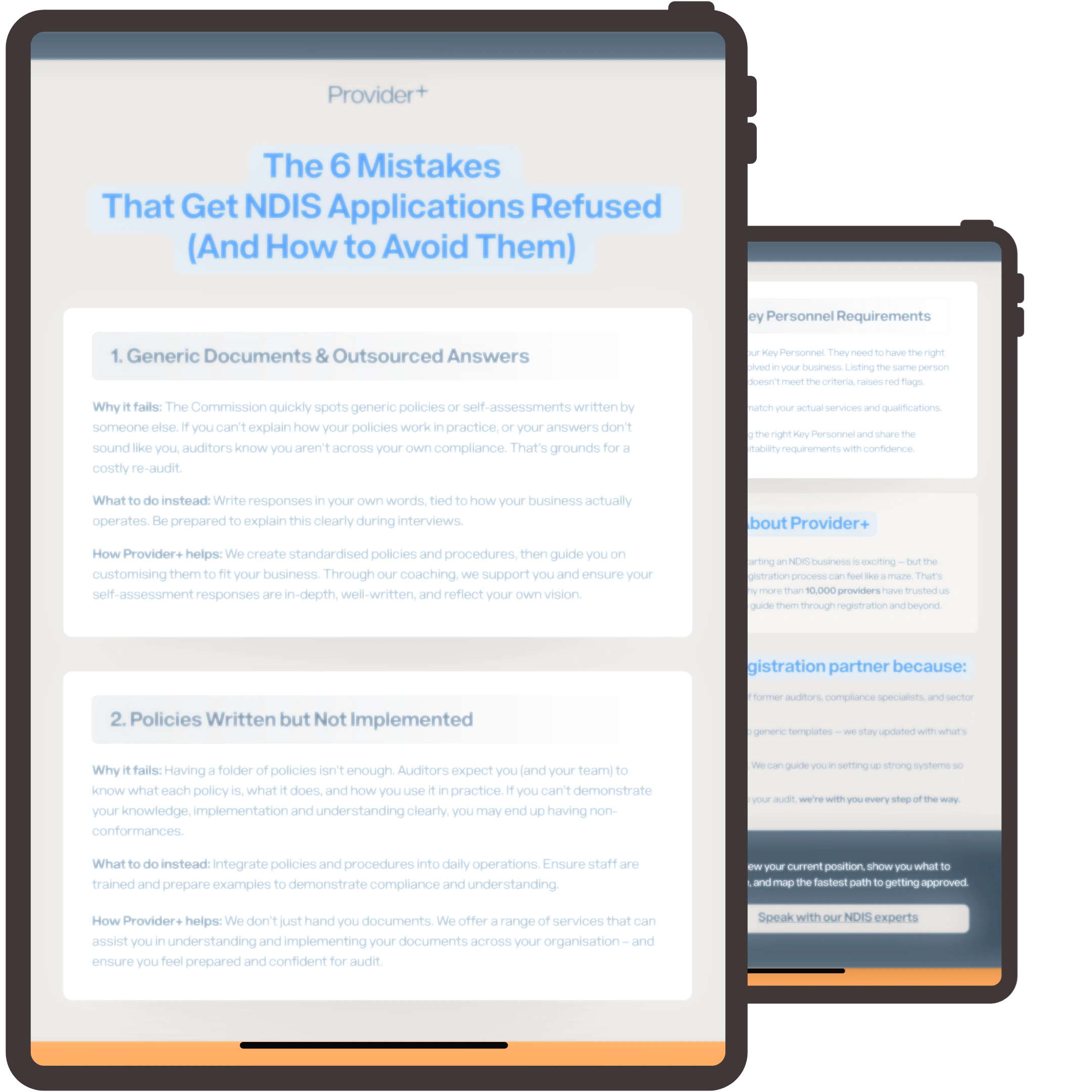
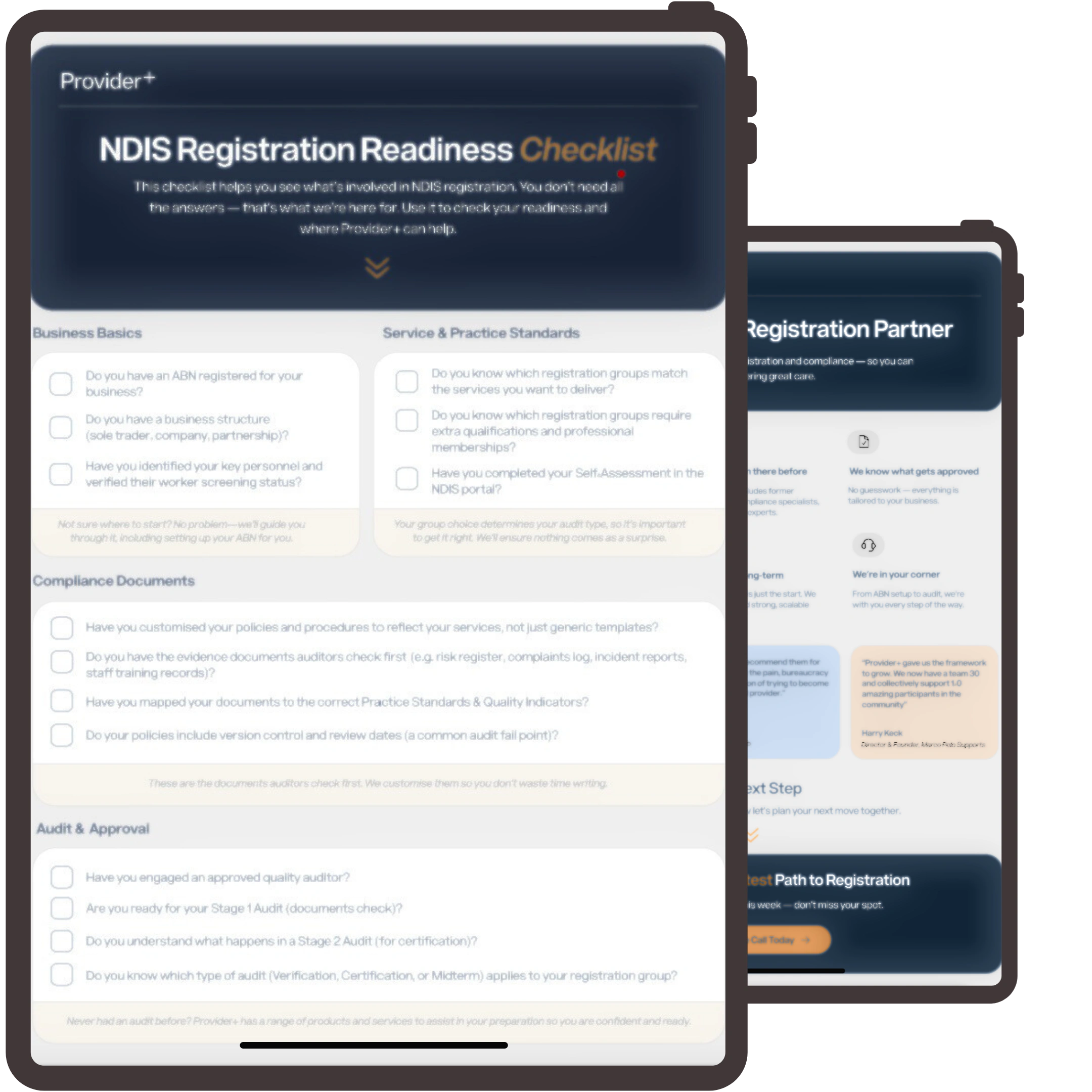
Understand exactly why registration takes 6–12+ months


%20.webp)