



Which NDIS Providers Need to Register Under the New Rules and What Comes Next?
This article reflects the NDIS Amendment (Integrity and Safeguarding) Act 2025, the confirmed 1 July 2026 mandatory registration deadline, and Minister Butler's April 2026 National Press Club address.
Key takeaways
- Not all NDIS providers are required to register. The changes affect specific service categories, not the sector as a whole.
- Four categories have always required registration with the NDIS Commission: Specialist Disability Accommodation, Plan Management, Specialist Behaviour Support, and services involving regulated restrictive practices. Any provider serving NDIA-managed participants must also be registered regardless of service type.
- From 1 July 2026, Supported Independent Living (SIL) providers and platform providers must register with the NDIS Commission. This deadline is confirmed.
- The government has indicated it intends to extend mandatory registration further to providers of personal care, daily living supports, and supports in closed settings. This has not yet been legislated.
- The NDIS Amendment (Integrity and Safeguarding) Act 2025 is now law. It introduces criminal penalties for operating without registration where it is required, civil penalties of up to $15 million for serious misconduct, and expanded banning powers that now cover auditors and consultants.
- Registration typically takes three to twelve months from application to approval. Providers affected by the July 2026 deadline should begin preparation now.
- Already-registered providers face a shift toward continuous compliance monitoring. Audit readiness, renewal timelines, and Practice Standards updates all require attention in 2026.
Recent reforms to the NDIS have brought meaningful changes to provider registration requirements. Not all providers are affected, but for those who are, the timelines are real and the preparation involved is substantial. If you are unsure whether these changes apply to you, now is a good time to find out.
What changed with NDIS provider registration in 2025 and 2026?
Parliament has passed the NDIS Amendment (Integrity and Safeguarding) Act 2025, the most substantial legislative reform to the scheme's regulatory framework in years. The changes include
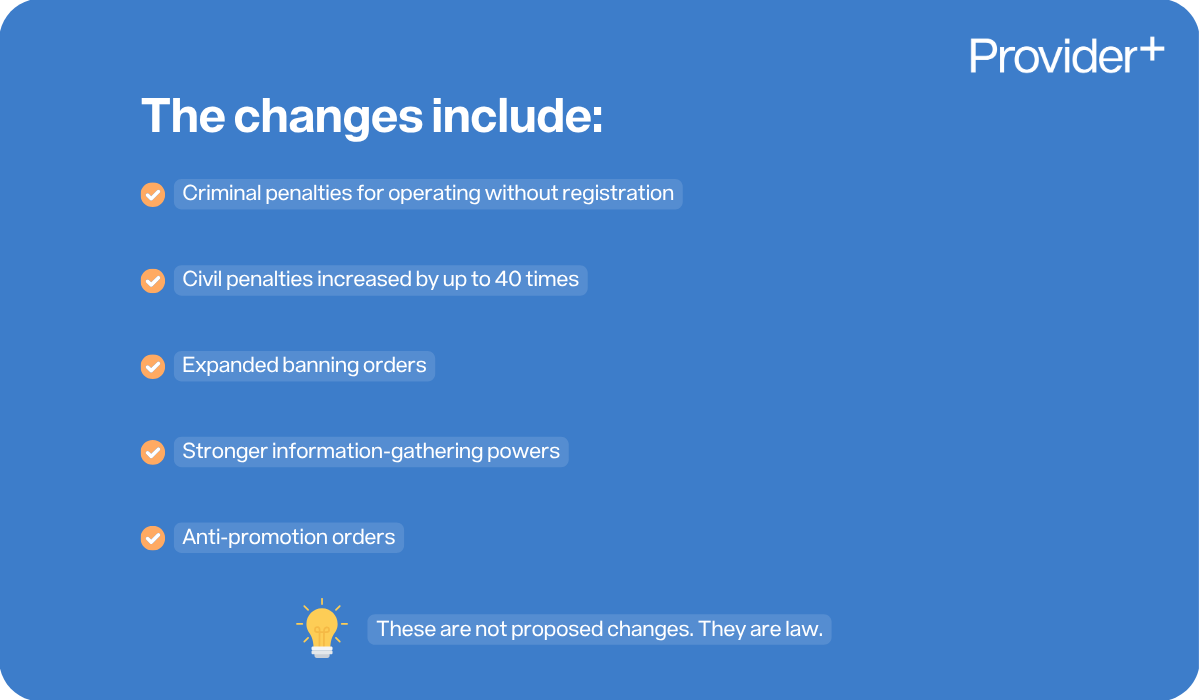
- Criminal penalties for operating without registration in categories that require it, carrying a maximum sentence of five years imprisonment
- Civil penalties increased by up to 40 times, from a previous maximum of $412,500 to more than $15 million where serious misconduct leads to death or serious injury
- Expanded banning orders that now cover auditors, consultants and business advisors, not just providers
- Stronger information-gathering powers for the NDIS Commission, including the ability to shorten the standard 14-day deadline for document requests when participant safety is at immediate risk
- Anti-promotion orders allowing the Commission to restrict misleading advertising that exploits participants or undermines the scheme
These are not proposed changes. They are law.
Which NDIS providers have always been required to register?
Four categories of service have always required registration with the NDIS Commission
- Specialist Disability Accommodation (SDA)
- Plan Management
- Specialist Behaviour Support
- Any service involving regulated restrictive practices
Additionally, any provider wanting to serve NDIA-managed participants must be registered, regardless of service type.
Which NDIS providers must register from 1 July 2026?
From 1 July 2026, two further categories become mandatory.
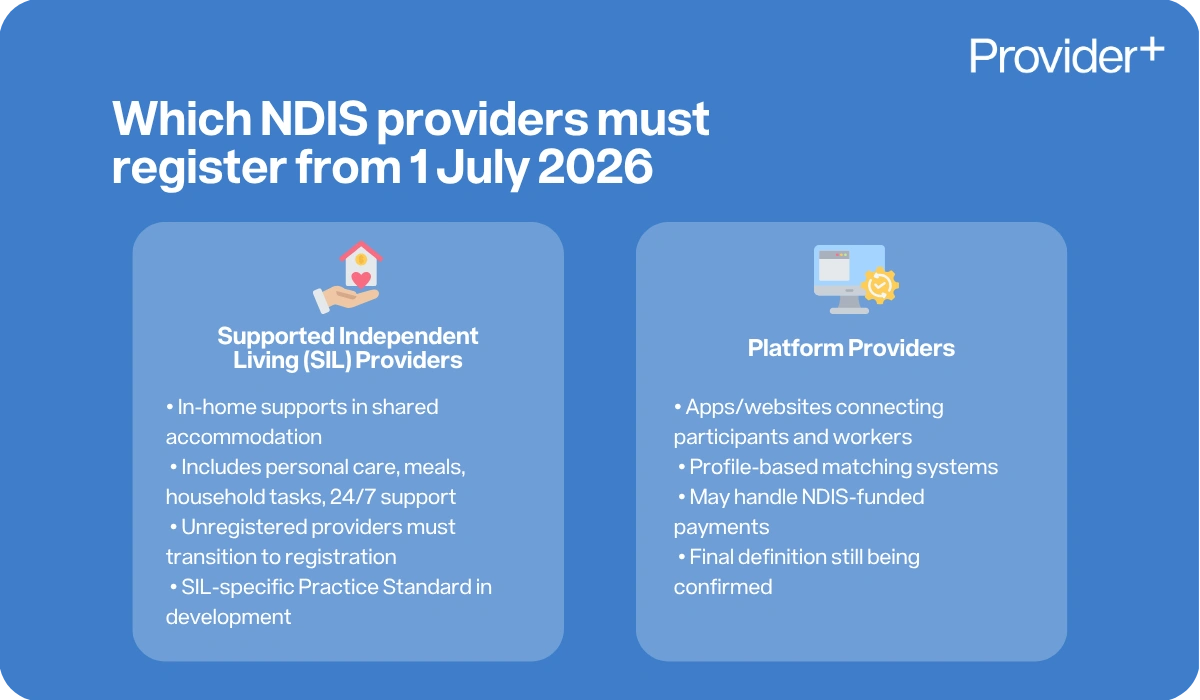
Supported Independent Living (SIL) providers. This covers providers delivering in-home supports in shared accommodation arrangements, including personal care, meal preparation, household tasks and overnight or 24-hour supervision. SIL providers currently operating without registration will need to transition. The NDIS Commission is also developing a new SIL-specific Practice Standard alongside this change.
Platform providers. These are providers using profile-based apps or websites to connect participants with workers. The Commission has not yet finalised the exact definition, but the working description covers platforms where workers and participants create profiles and find each other through digital directories, and where the platform collects NDIS-funded payments as part of its operations.
Transition guidance from the Commission is expected through early to mid 2026, and the Commission has indicated providers will have adequate time to prepare.
Will more NDIS providers be required to register beyond July 2026?
In a recent National Press Club address, Minister Mark Butler indicated the government intends to extend mandatory registration further, to providers delivering personal care, daily living supports, and supports in closed settings. He described these as higher-risk service categories requiring greater oversight.
He also raised a figure worth noting. The NDIA currently has no visibility of supporting evidence for approximately 90% of claims, around 600,000 transactions a day. The government's stated goal is for 90% of all NDIS payments to flow through registered providers, alongside a new digital payments system giving the NDIA direct line of sight over where money is going.
Registration is being built into the scheme's payment architecture. Sitting outside it will increasingly mean sitting outside a portion of the market.
This broader expansion has not yet been legislated. But given the political momentum behind these reforms and bipartisan support in parliament, providers in adjacent categories would be wise to at least begin thinking about what registration would involve.
What do the 2026 NDIS changes mean for already-registered providers?
Registration is an ongoing requirement, not a one-time achievement. The NDIS Commission has been moving toward continuous compliance monitoring. The standard is no longer just whether you pass an audit every three years, but whether your documentation, incident records, governance and staff training hold up whenever the Commission asks to see them.
Key priorities for registered providers right now
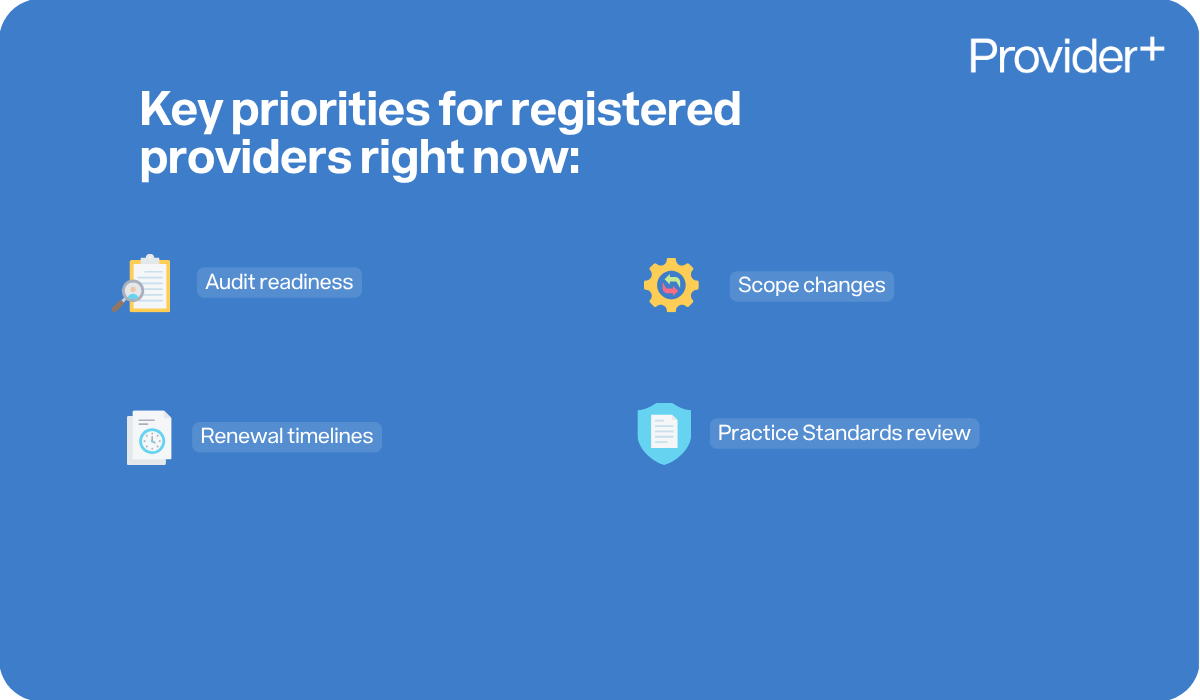
- Audit readiness. Verification audits cover lower-risk services and run 4 to 8 hours via document review. Certification audits for higher-risk services can run 12 to 36 hours and may include site visits. Neither should catch you unprepared.
- Renewal timelines. Registrations run for three years. The Commission typically sends reminders six months before expiry, but tracking your own renewal date independently is sensible; a lapsed registration means losing access to agency-managed participants.
- Scope changes. Adding higher-risk registration groups can move you from a verification to a certification audit. Factor that into any decisions about expanding your service offering.
- Practice Standards review. The Commission is updating the NDIS Practice Standards and developing a new SIL-specific standard. If your scope covers SIL or related services, your current policies may need to be updated before your next renewal.
The bottom line
The reforms do not affect every provider in the same way. If you deliver low-risk services exclusively to self-managed or plan-managed participants, your immediate obligations have not changed materially.
But if you deliver SIL, platform-based services, or supports involving close personal care, the July 2026 deadline is a real constraint. Registration typically takes three to twelve months from application to approval, depending on audit availability and whether any non-conformities need to be addressed first.
Working out where your organisation stands now means you have time to prepare properly. Leaving it until the rules are fully finalised narrows your runway considerably.
This article was published on 01/05/2026. We strive to keep our content accurate and up to date; however, NDIS Commission rules and requirements can change. For the latest information, visit the NDIS Quality and Safeguards Commission website or contact our team.
Need help with the NDIS?
Fill in the form below to get started.
FAQs
No. Unregistered providers can still deliver many NDIS services, provided they work only with participants who self-manage or plan-manage their funding. Unregistered providers cannot serve NDIA-managed participants. If your services are low-risk and your client base is entirely self-managed or plan-managed, your immediate registration obligations have not changed.
Supported Independent Living (SIL) providers and platform providers. SIL covers shared-accommodation in-home supports including personal care, meal preparation and overnight supervision. Platform providers are those using apps or websites to connect participants and workers where the platform also collects NDIS-funded payments.
Specialist Disability Accommodation, Plan Management, Specialist Behaviour Support, and any service involving regulated restrictive practices have always required registration. Any provider serving NDIA-managed participants must also be registered regardless of service type.
Registration typically takes three to twelve months from application to approval, depending on audit availability, the complexity of the application, and whether any non-conformities need to be addressed before the audit can be completed. Providers with a July 2026 deadline should not assume transition guidance from the Commission is a reason to delay starting.
A verification audit applies to lower-risk, lower-complexity services. It involves a desktop document review and runs approximately 4 to 8 hours. A certification audit applies to higher-risk services, runs 12 to 36 hours, and may include site visits. Providers who add higher-risk registration groups to their scope may be required to move from a verification to a certification audit. Mid-term audits are also required 18 months into a registration period for providers who completed a certification audit.
Under the NDIS Amendment (Integrity and Safeguarding) Act 2025, providing supports that require registration without holding registration is a criminal offence carrying a maximum sentence of five years imprisonment. Civil penalties for serious misconduct can reach more than $15 million where a breach leads to death or serious injury.
A platform provider is an NDIS provider that uses a profile-based app or website to connect participants with workers, and that collects NDIS-funded payments as part of its operations. The NDIS Commission has not yet published a final definition, but the working description includes providers where both workers and participants create profiles and find each other through a digital directory. Mandatory registration for platform providers begins 1 July 2026.
The government has indicated it intends to extend mandatory registration to providers of personal care, daily living supports, and supports in closed settings, but this has not yet been legislated. Minister Butler flagged this intention in an April 2026 National Press Club address. Providers in these categories should monitor NDIS Commission announcements and factor potential registration requirements into their planning.

Understand exactly why registration takes 6–12+ months


.png)