



SIL Renewal Audit 2026: How to Prepare as the Sector Faces Increased Scrutiny
Update
The 1 October 2026 date was the transition deadline for certain existing SIL providers to apply for registration. For providers reading this guide after that date, the transition deadline has passed. The relevant question is whether the provider is registered and meeting the requirements that apply to its circumstances.
The NDIS Commission's mandatory registration push has put Supported Independent Living (SIL) squarely in the regulatory spotlight. While this directly targets unregistered providers, registered SIL providers approaching renewal should consider whether this heightened focus on the sector will influence their audit experience, and prepare accordingly.
Regardless of whether renewal audits become more intensive, the fundamentals remain the same: you need to demonstrate sustained compliance, not just policies on paper. This guide covers what registered SIL providers should prepare for to complete their renewal audit in the current environment.
Read our essential guide to SIL registration for NDIS providers to revisit core SIL requirements.
Why SIL Is Under the Spotlight
On 1 July 2026, the transition to mandatory registration for SIL providers commences. This is the NDIS Commission's clearest signal that SIL is considered a high-risk support category requiring greater oversight.
The rationale is straightforward: SIL involves 24/7 support for participants with complex needs, often in shared living environments. The potential for harm if standards are not met is significant. The Commission has determined that all providers delivering these supports must be registered, audited, and subject to ongoing oversight.
This regulatory focus on SIL has several implications for registered providers:
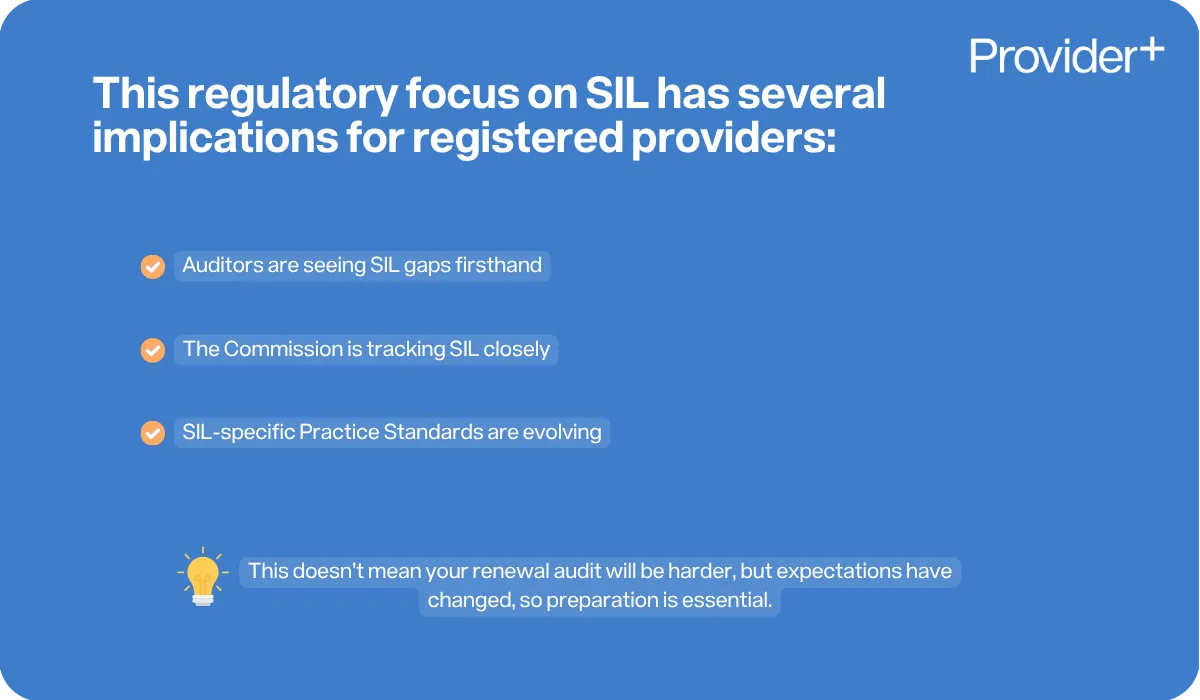
Auditors are seeing SIL gaps firsthand. As unregistered providers go through certification for the first time, auditors are assessing SIL services that have operated without oversight. The gaps they identify in incident management, restrictive practices, and workforce governance inform their expectations across the sector.
The Commission is tracking SIL closely. Incident data, restrictive practice reports, and complaints give the Commission visibility into how SIL services operate. Patterns and trends across the sector influence regulatory priorities.
SIL-specific Practice Standards are evolving. The Commission has flagged that new SIL-specific standards will focus on participant-centred outcomes, human rights, privacy, worker training, and participant safety. Renewal audits may reflect these evolving expectations once the new standards are finalised. Read current SIL operational guidelines for NDIS providers.
None of this means your renewal audit will necessarily be harder. But it does mean the environment has changed since your initial registration. Preparing thoroughly is the sensible response.
What Renewal Audits Assess for SIL Providers
Your renewal audit is a full recertification against the NDIS Practice Standards. Unlike your midterm audit — which covers governance and operational management as mandatory standards, plus any areas where non-conformities were previously identified — the renewal audit reassesses all relevant modules in full.
Core Module
- Rights and responsibilities
- Governance and operational management
- Provision of supports
- Support provision environment
- Feedback and complaints
- Incident management
- Human resource management
- Information management
Module 1: High Intensity Daily Personal Activities (if applicable)
- Assessment and planning for high-intensity supports
- Safe personal care delivery
- Mealtime management (where applicable)
- Monitoring and documentation
- Responsive support delivery
- Incident escalation
- Worker training and supervision
Module 2a: Implementing Behaviour Support Plans (if applicable)
- Understanding and applying Behaviour Support Plans
- Implementing authorised restrictive practices
- Reducing restrictive practices
- Person-centred, trauma-informed support
- Monitoring behaviour support outcomes
- Collaboration with Behaviour Support Practitioners
- Worker training for behaviour support implementation
Refer to our SIL certification audit: what auditors look for. The key difference from your initial audit: auditors expect to see three years of evidence demonstrating sustained compliance, not just systems that exist on paper.
Areas of Focus for SIL Renewal Audits
Based on the nature of SIL services and current regulatory priorities, these are the areas where auditors typically focus attention, and where gaps are most commonly identified.
Restrictive Practices
Restrictive practices in SIL settings receive significant scrutiny. Auditors will examine:
Authorisation
- Are all restrictive practices authorised under relevant state/territory legislation?
- Is there a current, approved Behaviour Support Plan for every participant where restrictive practices are used?
- Are the plans developed by a registered Behaviour Support Practitioner?
Reporting
- Are you reporting restrictive practice use to the NDIS Commission as required?
- Is your reporting accurate and timely?
Reduction
- Do you have documented strategies to reduce restrictive practice use?
- Can you demonstrate progress toward reduction over the three-year period?
- If restrictive practice use has increased, can you explain why?
Staff competency
- Are all staff implementing restrictive practices trained and assessed as competent?
- Is training current and refreshed regularly?
Restrictive practice non-conformances are among the most serious findings an auditor can record. If you have gaps in this area, address them before your audit.
Incident Management
SIL services involve 24/7 support, which means incidents will occur. Auditors expect to see mature incident management across your full registration period.
What auditors look for:
- Complete incident register covering all three years
- Evidence every incident was investigated with root cause analysis
- Documented corrective actions for each incident
- Reportable incidents notified to the NDIS Commission within required timeframes (24 hours for most)
- Incident trend analysis reported to management
- Evidence that incidents inform risk management and quality improvement
Common gaps:
- Incidents logged but not investigated
- Investigations without documented corrective actions
- Reportable incidents not notified or notified late
- No trend analysis (incidents treated as isolated events)
- Staff unsure what constitutes a reportable incident
Three years of SIL operations will generate incidents. The question is whether you have managed them properly.
Workforce Governance
SIL relies on a workforce that often includes casual staff, agency workers, and overnight support workers who may have limited supervision. Auditors will examine:
Worker screening
- Do all workers have current NDIS Worker Screening clearances?
- Have clearances been maintained continuously (no gaps)?
- Are new workers screened before they commence?
Training and competency
- Have all workers completed the NDIS Worker Orientation Module?
- Do workers have role-specific training for SIL (manual handling, medication, mealtime management, behaviour support)?
- Is competency assessed for high-risk tasks?
- Is training refreshed, or was it one-off at induction?
Supervision
- Are all workers receiving regular supervision?
- How do you supervise casual or agency staff?
- How do you supervise overnight workers?
- Are supervision sessions documented?
Continuity and handover
- How do you ensure continuity for participants when staff change?
- Are handover processes documented?
Workforce governance is central to SIL quality. Gaps here suggest systemic risk.
Participant Rights and Choice
SIL involves shared living arrangements, which creates tension between group dynamics and individual rights. Auditors will examine:
- How do participants exercise choice and control in their living environment?
- How are compatibility assessments conducted for shared housing?
- How are individual needs balanced against shared arrangements?
- How is participant privacy maintained?
- How do participants provide feedback or raise concerns?
- Is there evidence participants were involved in their support planning?
Continuous Improvement
Three years is enough time to demonstrate that your organisation learns and improves. Auditors will look for:
- Internal audits conducted regularly (at least annually)
- Findings from internal audits actioned
- Participant feedback collected and responded to
- Complaints leading to systemic improvements
- Incidents leading to process changes
- Policies reviewed and updated (not static since initial registration)
- Quality improvement register showing actions taken
If your systems look identical to when you first registered, this raises questions about whether continuous improvement is genuinely embedded.
What Three Years of Evidence Looks Like
Your renewal audit requires evidence from your full registration period. Here is what you should have:
Incident Management
- Complete incident register (all three years)
- Investigation reports for each incident
- Corrective action records
- Evidence of reportable incident notifications
- Incident trend reports to management
- Evidence of improvements made following incidents
Restrictive Practices (if applicable)
- Restrictive practice use register
- Current Behaviour Support Plans for all relevant participants
- Evidence of authorisation under state/territory requirements
- NDIS Commission reporting records
- Reduction strategies and progress evidence
- Staff training records for restrictive practice implementation
Complaints
- Complaints register (all three years)
- Investigation and resolution records
- Evidence outcomes communicated to complainants
- Systemic improvements following complaints
Workforce
- Worker screening register with clearance dates
- Training register for all workers
- Supervision records
- Competency assessments for high-risk tasks
- Induction records
- Code of conduct acknowledgements
Risk Management
- Risk register with regular review evidence (quarterly minimum)
- New risks added as identified
- Control measures updated
- Evidence of risk escalation and management
Quality Management
- Internal audit schedule and reports (at least annual)
- Corrective actions from internal audits
- Participant feedback records
- Quality improvement register
- Policy review records with version control
Participant Files (sample)
- Service agreements
- Support plans aligned to NDIS goals
- Participant risk assessments
- Evidence of participant involvement in planning
- Progress notes and daily records
- Health and safety information
- Consent records
- Plan reviews
Governance
- Management meeting minutes
- Evidence of Board or governance oversight (if applicable)
- Financial viability
- Strategic planning evidence
SIL Renewal Audit Checklist
Use this checklist to assess your readiness:
Restrictive Practices
- [ ] All restrictive practices authorised under state/territory legislation
- [ ] Current Behaviour Support Plans for all relevant participants
- [ ] Plans developed by registered Behaviour Support Practitioners
- [ ] Restrictive practice use reported to NDIS Commission as required
- [ ] Reduction strategies documented with evidence of progress
- [ ] All staff trained and competent to implement restrictive practices
Incident Management
- [ ] Complete incident register for full registration period
- [ ] All incidents investigated with root cause analysis
- [ ] Corrective actions documented and implemented
- [ ] Reportable incidents notified within required timeframes
- [ ] Incident trends analysed and reported to management
- [ ] Evidence incidents inform risk and quality processes
Workforce
- [ ] All workers have current NDIS Worker Screening clearances
- [ ] No gaps in clearance coverage over registration period
- [ ] All workers completed NDIS Worker Orientation Module
- [ ] Role-specific training completed and current
- [ ] Competency assessed for high-risk tasks
- [ ] Regular supervision for all workers (including casuals)
- [ ] Supervision sessions documented
Participant Rights
- [ ] Evidence of participant involvement in support planning
- [ ] Compatibility assessments for shared living documented
- [ ] Participant feedback collected and responded to
- [ ] Privacy maintained in shared environments
- [ ] Complaints process accessible to participants
Continuous Improvement
- [ ] Internal audits completed (at least annually)
- [ ] Internal audit findings actioned
- [ ] Policies reviewed and updated during registration period
- [ ] Quality improvement register maintained
- [ ] Evidence of improvements made based on feedback, incidents, complaints
Previous Audit Findings
- [ ] All corrective actions from initial audit implemented
- [ ] All corrective actions from midterm audit implemented
- [ ] Improvements sustained (not lapsed)
Documentation
- [ ] All policies current and reviewed
- [ ] Participant files complete and consistent
- [ ] Records organised and accessible for audit
Common SIL Renewal Audit Failures
These issues commonly cause non-conformities at SIL renewal audits:
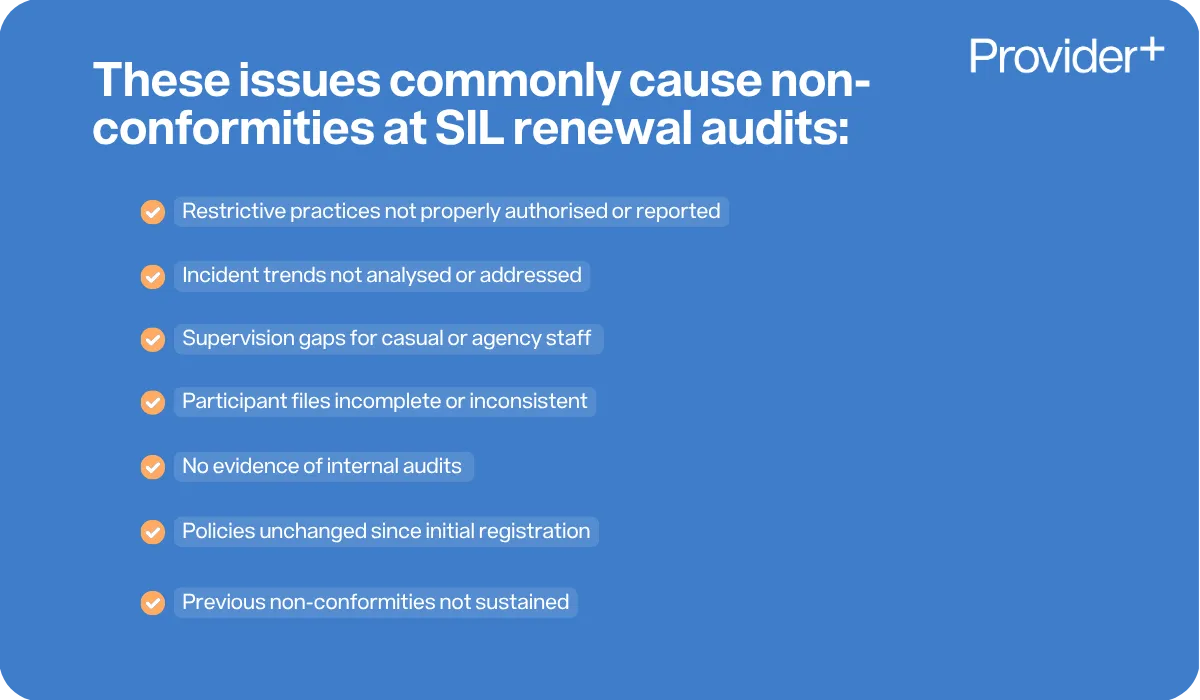
Restrictive practices not properly authorised or reported. If you are using restrictive practices without proper authorisation, or not reporting within required timeframes, expect a major non-conformity.
Incident trends not analysed or addressed. Logging incidents is not enough. Auditors expect trend analysis and evidence that patterns are identified and addressed.
Supervision gaps for casual or agency staff. If your supervision records only cover permanent staff, this is a gap. All workers need supervision regardless of employment type.
Participant files incomplete or inconsistent. Files missing service agreements, consent records, or support plans suggest systemic problems.
No evidence of internal audits. The Practice Standards require a documented internal audit program. If you cannot produce internal audit reports, this is a non-conformity.
Policies unchanged since initial registration. Policies should be living documents, reviewed and updated regularly. Static policies suggest compliance is treated as a one-off exercise.
Previous non-conformities not sustained. If corrective actions from your initial or midterm audit have lapsed, auditors will identify this. Improvements must be embedded, not temporary.
What Happens If You Get a Non-Conformity
Minor Non-Conformity
A gap exists but does not present high risk. Common causes include documentation gaps, inconsistent implementation, or failure to demonstrate regular reviews.
- Submit a Corrective Action Plan within 7 calendar days of written notification
- Your auditor can recommend renewal with an accepted Corrective Action Plan — you do not need to wait until the issue is fully resolved
- Minor non-conformities must be closed out within 18 months
- If not closed out within 18 months, the non-conformity escalates to a major non-conformity
Major Non-Conformity
A significant gap presenting high risk, or three or more minor non-conformities within the same module.
- Submit a Corrective Action Plan within 7 calendar days of written notification
- Implement corrections and undergo a follow-up audit within 3 calendar months
- Failure to close out within 3 months may result in suspension of registration
For SIL providers, major non-conformities in restrictive practices or incident management are particularly serious given the participant cohort and risk profile.
Timeline for SIL Renewal Preparation
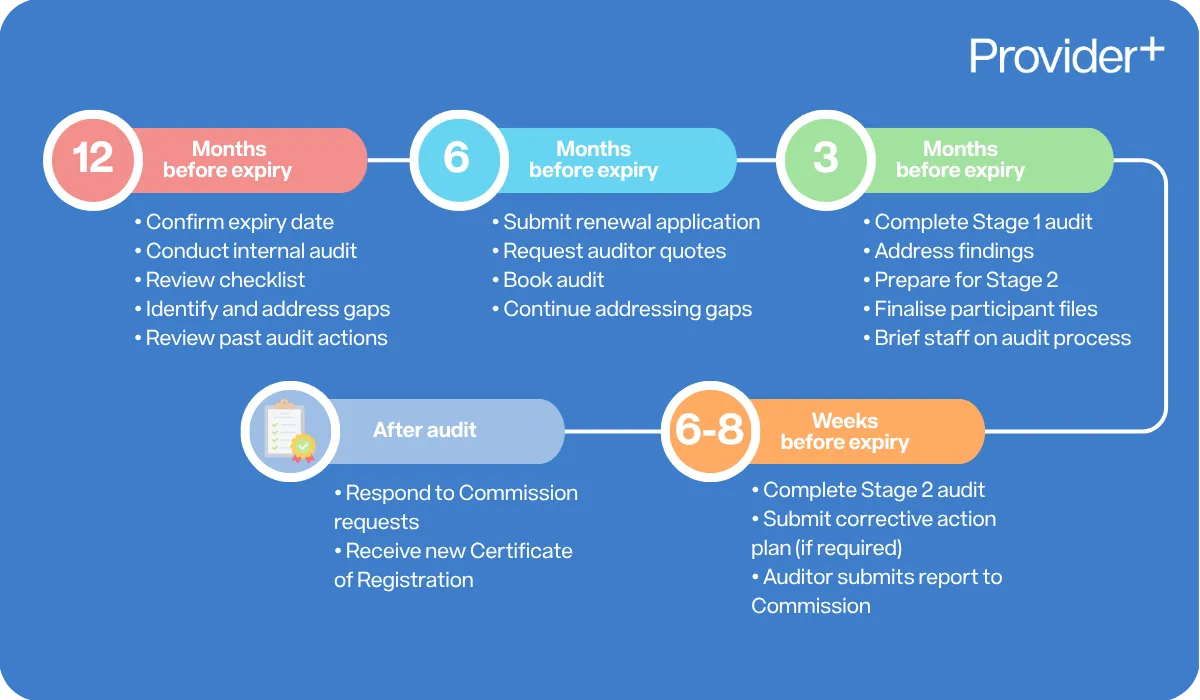
12 months before expiry:
- Confirm your registration expiry date
- Conduct comprehensive internal audit
- Review all areas on this checklist
- Identify gaps and begin addressing them
- Review previous audit reports and confirm corrective actions sustained
6 months before expiry:
- Complete renewal application in NDIS Commission portal
- Contact approved auditors and request quotes
- Book your audit (allow time for Stage 1 and Stage 2)
- Continue addressing any gaps identified
3 months before expiry:
- Complete Stage 1 audit (desktop review)
- Address any Stage 1 findings
- Prepare for Stage 2 audit
- Ensure participant files are complete
- Brief staff on audit process
6 to 8 weeks before expiry:
- Complete Stage 2 audit (on-site assessment)
- Submit corrective action plan if non-conformities identified
- Auditor submits report to NDIS Commission
After audit:
- Respond promptly to any NDIS Commission requests
- Receive new Certificate of Registration
How Provider+ Can Help
Provider+ has extensive experience supporting SIL providers through renewal audits. We understand the specific requirements for high-intensity services and the current regulatory environment.
We offer:
- Dedicated Expert Consultant. A specialist NDIS registration and compliance expert is assigned to guide you 1:1 through your entire registration process, answering your questions and advising you every step of the way.
- NDIS Policies, Forms and Procedures. All the policies, forms and procedures required for your registration, designed to pass audit and be practically implemented in your business.
- Personal Audit Coach. A structured 6-step program working 1:1 with you to fully prepare for your certification audit, tackling each audit area in sequence from required documents to the questions auditors will ask.
- Auditor Introduction. Direct connection to appropriate independent certifiers who understand our systems and standards.
- PQM Pro. Our Quality Management System keeps your documentation centralised, version-controlled, and always audit ready.
- Start Up Club. Training and support to get your NDIS business operational once registration is complete.
- Provider+ Community. An exclusive provider-only platform with live workshops, Q&As, Audit School, and ongoing NDIS business support.
Contact us for a free strategy call to assess your renewal readiness.
This article was published on 17/04/2026. We strive to keep our content accurate and up to date; however, NDIS Commission rules and requirements can change. For the latest information, visit the NDIS Quality and Safeguards Commission website or contact our team.
Need help with the NDIS?
Fill in the form below to get started.
FAQs
The renewal audit covers the same Practice Standards as your initial certification. However, auditors expect to see three years of evidence demonstrating sustained compliance, not just policies and systems in place. The increased regulatory focus on SIL may also influence auditor attention to areas like restrictive practices and incident management.
Address this before your audit. Review all current restrictive practice use, ensure authorisations are in place, confirm Behaviour Support Plans are current, and establish proper reporting to the NDIS Commission. If there are historical gaps, document what happened and what you have done to fix it.
The Practice Standards require a documented program of internal audits. At minimum, you should have conducted one comprehensive internal audit per year — so at least three across your registration period. If you have gaps, conduct a thorough internal audit now and document your findings and actions.
You cannot technically fail. However, if major non-conformities are identified and not closed out within three calendar months, your registration may not be renewed. If your registration expires before renewal is complete, you must stop delivering SIL supports.
If your registration expires, you must immediately stop delivering SIL supports and cannot claim NDIS payments. You would need to submit a fresh application and undergo full certification again. This is significantly more costly and disruptive than timely renewal.
The process is similar — Stage 1 desktop review, Stage 2 on-site assessment — and the same Practice Standards apply. The key difference is that auditors expect mature, embedded systems with three years of evidence, not just documentation of what you intend to do.
All SIL properties must meet the Practice Standards. Auditors may visit multiple sites during your renewal audit. Ensure all properties have appropriate documentation, safety compliance, and up-to-date participant records.
Costs depend on your organisation's size, number of SIL properties, and number of participants. SIL renewal audits typically cost $5,000 to $15,000+. Get quotes from multiple approved auditors to compare.
Yes. You should inform participants in advance that an audit is taking place and that they have the opportunity to speak with the auditor if they wish to. Participation in auditor interviews is voluntary and requires the participant's informed consent. Auditors will not interview participants who have not agreed to participate.
Auditors will reassess any standards where non-conformities were previously identified. They expect corrective actions to be implemented and sustained. If previous issues have recurred or lapsed, this will likely result in new non-conformities.

Understand exactly why registration takes 6–12+ months


