SIL Certification Audit: What Auditors Look For and How Long It Takes
Update
The 1 October 2026 date was the transition deadline for certain existing SIL providers to apply for registration. For providers reading this guide after that date, the transition deadline has passed. The relevant question is whether the provider is registered and meeting the requirements that apply to its circumstances.
If you are an unregistered SIL provider facing mandatory registration from 1 July 2026, here is the direct answer: SIL registration typically takes 6 to 12 months from start to finish, and requires a certification audit assessing 22+ practice standards across multiple modules. This guide covers exactly what auditors look for, common failures, and a realistic timeline for first-time SIL providers. Read our essential guide to SIL registration for providers and coordinators to understand key SIL requirements.
How Long Does SIL Registration Take?
SIL registration typically takes 6 to 12 months from initial preparation to receiving your Certificate of Registration. The actual timeline depends on your starting point, the gaps in your current systems, and auditor availability.
Here is a realistic breakdown:
Total realistic timeline: 6 to 12 months
Providers who already have strong governance systems and documentation may complete the process faster. Providers starting from scratch, or those with significant gaps, should plan for the longer end of this range. Use our SIL registration checklist before your audit.
Use our SIL registration checklist before your audit.
Why Does SIL Registration Take So Long?
SIL registration takes longer than other NDIS registrations because SIL is classified as a high-risk support requiring the most comprehensive audit pathway. Four factors drive the extended timeline.
Certification audit required. SIL providers must complete a certification audit, not a verification audit. Certification audits involve two stages, Stage 1: desktop review and Stage 2: on-site assessment. This is significantly more intensive than a single-stage verification audit.
Evidence of implementation required. Auditors do not just review your policies. They require evidence that your systems are implemented and operating. This means you need to generate records, conduct internal audits, document incidents and complaints, and show that staff are trained before your audit. You cannot rush this evidence gathering.
Complexity of SIL supports. SIL providers are often required to administer medication, deliver mealtime supports, provide high-intensity personal care, and implement behaviour support plans including restrictive practices. These additional supports increase the scope of the audit and the volume of evidence required.
Auditor availability is limited. As the transition to mandatory registration progresses, demand for NDIS auditors is increasing. Providers who wait to begin may face delays of weeks or months securing an audit slot.
What Is a SIL Certification Audit?
A SIL certification audit is a comprehensive two-stage assessment conducted by an NDIS-approved quality auditor to determine whether your organisation meets the NDIS Practice Standards required for SIL registration.
Stage 1: Desktop review
The auditor reviews your documentation remotely, including:
- Governance documents (business registration, structure, key personnel)
- Policies and procedures
- SIL Practice Standard requirements
- Risk management framework
- Quality management system
- Worker training records and screening evidence
- Internal audit reports
The auditor identifies any gaps that must be addressed before Stage 2.
Stage 2: On-site assessment
The auditor visits your SIL properties and conducts:

- Site inspections of SIL accommodation
- Worker interviews (frontline workers, supervisors, management)
- Participant interviews (with consent)
- Participant file reviews
- Observation of service delivery (where possible)
- Verification that documented systems match actual practice
The auditor assesses your compliance against all applicable Practice Standards modules.
Which Practice Standards Apply to SIL Providers?
SIL providers must demonstrate compliance with multiple NDIS Practice Standards modules. The specific modules depend on your service model, but most SIL providers are assessed against the following:
Core Module (all registered providers)
The Core Module applies to every registered NDIS provider and covers the foundations of safe, quality service delivery:
- Rights and responsibilities of participants
- Provider governance and operational management
- Provision of supports
- Support planning
- Feedback and complaints management
- Incident management
- Worker screening, training and qualifications
- Risk management
- Mealtime management and nutrition supports (where required)
- Medication management
SIL Practice Standards (all registered providers)
The SIL Practice Standards introduce requirements specifically for Supported Independent Living services. These standards place greater emphasis on the quality of shared living arrangements, participant choice, independence, and oversight of SIL service delivery.
Key focus areas include:
- Shared Living Arrangements and Compatibility Assessments – ensuring participants are involved in decisions about who they live with and that compatibility assessments are undertaken and reviewed.
- Participant Choice and Control – supporting participants to make decisions about their home environment, daily routines, visitors, activities, and household arrangements.
- Individualised Support within Shared Settings – ensuring participants receive supports tailored to their goals, preferences, communication needs, and support requirements rather than adopting a "one size fits all" approach.
- Independent Living Skill Development – actively supporting participants to develop, maintain, and increase their independence in daily living activities and community participation.
- Vacancy Management – ensuring participant needs, preferences, compatibility, and wellbeing are prioritised when filling vacancies within shared accommodation.
- Participant Safety and Safeguarding – strengthening oversight of participant wellbeing, risk management, and support delivery within shared living environments.
- Workforce Capability – ensuring workers have the skills, knowledge, supervision, and training necessary to support participants in SIL settings.
- Quality Monitoring and Continuous Improvement – demonstrating how participant feedback, incidents, complaints, audits, and quality activities are used to improve SIL service delivery.
Module 1: High Intensity Daily Personal Activities
Most SIL providers deliver high-intensity supports and must comply with this module:
- Assessment and planning for high-intensity personal care
- Safe delivery of personal care respecting dignity
- Responsive support that adapts to changing needs
- Incident escalation for high-intensity supports
- Worker competency for complex care tasks
Module 2a: Implementing Behaviour Support Plans
If your SIL services involve implementing behaviour support plans and using restrictive practices, you must also comply with this module:
- Understanding and correctly implementing Behaviour Support Plans
- Authorisation processes for restrictive practices
- Working to reduce and eliminate restrictive practices
- Person-centred, trauma-informed support
- Collaboration with Behaviour Support Practitioners
- Worker training for behaviour support implementation
- Monitoring and reporting on behaviour support outcomes and restrictive practices
What Do Auditors Look For in a SIL Certification Audit?
Auditors assess whether your documented systems match your actual practice. They look for evidence that you are implementing the Practice Standards, not just that you have written policies.
Here are the key areas auditors focus on for SIL providers.
Restrictive Practices
Restrictive practice compliance receives significant scrutiny in SIL audits. Auditors will verify:
- All restrictive practices are authorised under state/territory legislation
- Current Behaviour Support Plans exist for every participant where restrictive practices are used
- Plans are developed by NDIS-registered Behaviour Support Practitioners
- Restrictive practice use is reported to the NDIS Commission within required timeframes
- Documented strategies exist to reduce restrictive practice use
- All staff implementing restrictive practices are trained and assessed as competent
Common failure: Using restrictive practices without proper authorisation or without a current Behaviour Support Plan.
Incident Management
SIL services operate 24/7, which means incidents will occur. Auditors expect mature incident management systems:
- Complete incident register with investigation records
- Root cause analysis for all incidents
- Documented corrective actions
- Reportable incidents notified to the NDIS Commission within required timeframes (24 hours for most categories; 5 business days for unauthorised restrictive practices unless harm occurred)
- Evidence that incidents inform risk management and quality improvement
Common failure: Logging incidents without investigating them or documenting corrective actions.
Workforce Governance
SIL workforce often includes casual staff, agency workers, and overnight support workers. Auditors will examine:
- All workers have current NDIS Worker Screening clearances
- All workers have completed the NDIS Worker Orientation Module
- Role-specific training is completed for SIL tasks (personal care, medication, mealtime management, behaviour support)
- Competency is assessed for high-risk tasks
- Regular supervision is provided for all workers including casuals
- Supervision sessions are documented
- Workforce planning is in place to ensure continuity of supports
Common failure: Gaps in worker screening or supervision records for casual and agency staff.
Participant Rights and Choice
SIL involves shared living arrangements, creating tension between group dynamics and individual rights. Auditors will examine:
- Evidence participants were involved in their support planning
- Compatibility assessments for shared housing
- How participant privacy is maintained in shared environments
- How participants provide feedback or raise concerns
- How individual needs are balanced against shared arrangements
Common failure: No documented evidence of participant involvement in planning or decision-making.
Governance and Risk Management
Auditors assess whether your organisation has the governance structures to deliver safe, quality SIL services:
- Clear organisational structure with defined roles and responsibilities
- Financial viability to sustain operations
- Risk register identifying key risks with control measures
- Regular risk reviews documented
- Quality management system with internal audits
- Policies reviewed and updated regularly
Common failure: Policies exist but have not been reviewed since they were written.
Explore our SIL operational guidelines for NDIS providers.
What Documentation Do Auditors Review for SIL Registration?
Auditors review extensive documentation during a SIL certification audit. Here is a checklist of what you need to prepare:
Governance and Business Structure
- Certificate of incorporation or business registration
- Organisational structure chart
- Key personnel details and qualifications
- Evidence of financial viability
- Board or governance meeting minutes (if applicable)
Policies and Procedures
- All policies required under NDIS Practice Standards
- Evidence policies have been reviewed
- Version control showing policy history
- Procedures align to actual work practices
Risk and Quality Management
- Risk register with control measures
- Evidence of regular risk reviews
- Internal audit schedule and reports
- Quality improvement register
- Evidence of improvements implemented
Workforce
- Worker screening register with clearance dates and expiry
- Training register for all workers
- Supervision records
- Competency assessments for high-risk tasks
- Induction records
- Signed code of conduct acknowledgements
Incident and Complaints Management
- Incident register with investigation records
- Complaints register with resolution records
- Evidence of reportable incident notifications to NDIS Commission
- Evidence incidents and complaints inform improvement
Participant Files (sample)
- Service agreements
- Support plans aligned to NDIS goals
- Participant risk assessments
- Participants personal emergency preparation plans (where applicable)
- Evidence of participant involvement in planning
- Progress notes and daily records
- Consent records
- Health and safety information
- Restrictive practice authorisations (where applicable)
- Behaviour Support Plans (where applicable)
SIL-Specific Documentation
- Property compliance records
- Fire safety inspections and maintenance records.
- Smoke alarm testing and servicing.
- Electrical test and tag records.
- Emergency lighting and fire equipment servicing records.
- Property maintenance records.
- Accessibility assessments and modifications.
- Building compliance certificates where applicable.
- Emergency and evacuation plans for each property
- Property-specific Emergency Management Plans.
- Personal Emergency Evacuation Plans (PEEPs) for participants.
- Emergency contact lists.
- Emergency drill records and training evidence.
- Alternative accommodation and participant relocation arrangements.
- Utility disruption response plans (power, water, internet and telecommunications).
- Mealtime management plans (where applicable)
- Shared living and participant compatibility documentation, including:
- Compatibility assessments.
- Shared accommodation agreements.
- Household meeting records.
- Participant consultation and decision-making records.
- Vacancy management assessments and participant consultation documentation.
- Overnight support and active night support documentation, including:
- Sleepover and active night support procedures.
- Night shift handover processes.
- Escalation and emergency response procedures.
- Participant monitoring requirements.
- Lone worker arrangements where applicable.
- Night support rostering and staffing records.
What Are Common SIL Certification Audit Failures?
First-time SIL providers commonly fail their certification audit due to these issues:
Policies without evidence of implementation. Having a policy document is not enough. Auditors want to see records proving your systems are being used, including supervision logs, training registers, incident investigations, and internal audit reports.
Restrictive practices used without authorisation. Any restrictive practice must be authorised under state/territory legislation and accompanied by a current Behaviour Support Plan developed by a registered practitioner.
Gaps in worker screening. Every worker, including casuals and agency staff, must hold a current NDIS Worker Screening clearance before delivering supports. Expired or missing clearances are a common and serious finding.
Incident logs without investigations. Recording that an incident occurred is not sufficient. Auditors expect root cause analysis, documented corrective actions, and evidence that lessons learned have been applied.
No evidence of participant involvement. Support plans, risk assessments, and compatibility arrangements must show genuine participant involvement. Generic plans with no personalisation or consultation evidence will attract non-conformities.
Outdated policies. Policies that have never been reviewed since they were written signal a governance system that exists on paper only.
What Happens If You Get a Non-Conformity?
If the auditor identifies gaps in your compliance, they will record a non-conformity. There are two types:
Minor non-conformity
A gap exists but does not present immediate high risk. Common causes include documentation gaps, inconsistent implementation, or missing evidence of regular reviews.
- You must submit a Corrective Action Plan within 7 calendar days
- Minor non-conformities must be closed out within 18 months. If not resolved, they escalate to major.
- The relevant standard will be reassessed at your next audit
Major non-conformity
A significant gap presenting high risk, or multiple minor non-conformities in the same module escalated to major.
- You must submit a Corrective Action Plan within 7 calendar days
- Implement corrections and undergo a follow-up audit within 3 calendar months
- Failure to close out within 3 months means certification is automatically suspended and registration cannot proceed
For SIL providers, major non-conformities in restrictive practices or incident management are particularly serious given the participant cohort and risk profile.
How Much Does SIL Certification Audit Cost?
SIL certification audit costs vary depending on your organisation's size, number of SIL properties, and number of participants. Here are typical cost ranges:
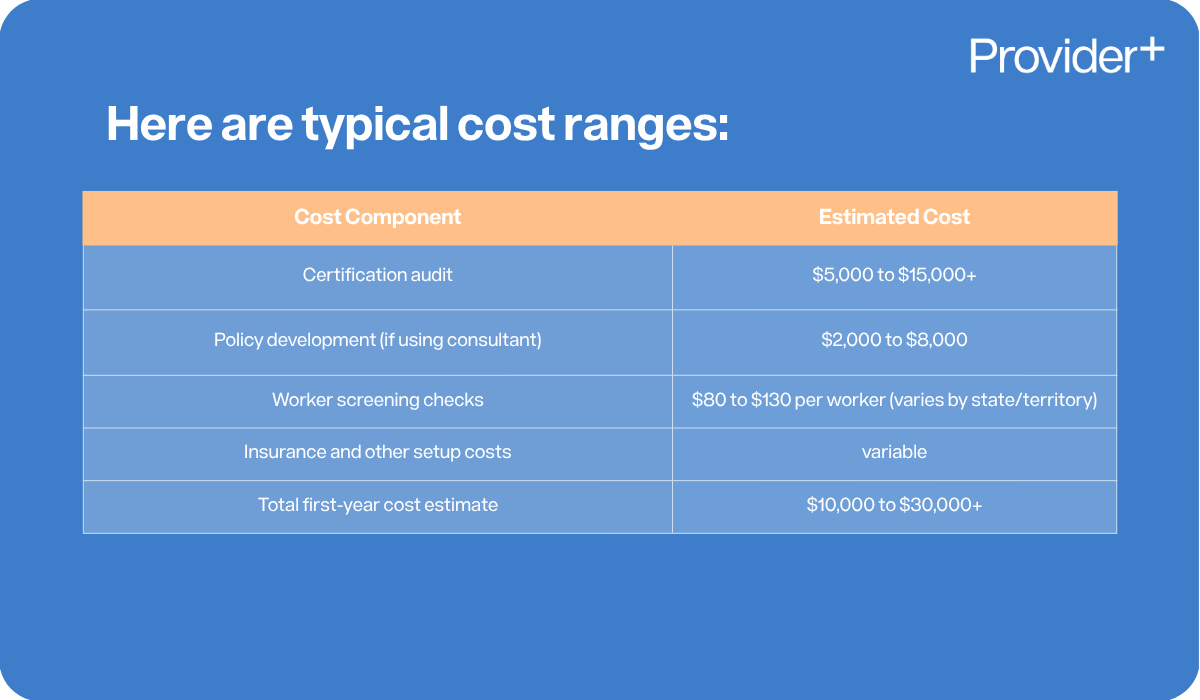
- Certification audit: $5,000 to $15,000+
- Policy development (if using a consultant): $2,000 to $10,000+
- Worker screening checks: $80 to $130 per worker (varies by state/territory)
- Insurance and other setup costs: variable
Total first-year cost estimate: $10,000 to $30,000+
Larger organisations with multiple SIL properties will pay more due to additional site visits required during the audit.
Why You Need to Start Now for July 2026
.png)
Mandatory registration for Supported Independent Living (SIL) providers commences on 1 July 2026. This date marks the beginning of the transition period and is not the date by which all SIL providers must hold a Certificate of Registration.
From 1 July 2026, providers delivering SIL supports will be required to register under Registration Group 0138 – Assistance with Supported Independent Living. Existing registered providers delivering SIL supports under Registration Group 0115 will automatically transition to Registration Group 0138 as part of the NDIS Commission's transition arrangements.
Unregistered providers that are already delivering SIL supports on 1 July 2026 may continue to provide those supports during the transition period, provided they submit a registration application by 1 October 2026. Providers that have not commenced the registration process by this date will not be able to continue delivering SIL supports.
Providers that are not currently delivering SIL supports and wish to commence providing SIL services after 1 July 2026 must obtain NDIS registration before delivering SIL supports.
Given the time required to prepare for certification audits, implement compliant governance and operational systems, address the Draft SIL Practice Standards, and complete the NDIS registration process, providers should commence preparation as early as possible. Registration commonly takes several months, and providers that delay preparation may not have sufficient time to achieve registration before transition deadlines apply.
Here is why starting now matters.
Registration takes 6 to 12 months. If you have not started preparation, you are already behind. Providers who begin today are working against the clock.
Auditor availability is tightening. As the transition progresses, thousands of SIL providers will be competing for audit appointments at the same time. Providers who wait may face significant delays securing an audit slot, pushing their registration timeline well beyond their intended deadline.
You need time to generate evidence. Auditors require evidence of implemented systems, not just documents created the week before your audit. You cannot create months of incident records, supervision documentation, and internal audit reports overnight. The evidence-gathering phase alone typically takes three to six months.
The stakes of not complying are significant. Providers who are not registered by the end of the transition period may be required to cease delivering SIL supports entirely, face loss of SIL revenue until registration is approved, and risk participants being transferred to registered competitors.
How Provider+ Can Help
Provider+ has helped thousands of providers get registered, pass audits, and maintain compliance. We understand the specific requirements for SIL certification and the urgency of the July 2026 deadline.
We offer:
Dedicated Expert Consultant. A specialist NDIS registration and compliance expert is assigned to guide you 1:1 through your entire registration process, answering your questions and advising you every step of the way.
NDIS Policies, Forms and Procedures. All the policies, forms and procedures required for your registration, designed to pass audit and be practically implemented in your business.
Personal Audit Coach. A structured 6-step program working 1:1 with you to fully prepare for your certification audit, tackling each audit area in sequence from required documents to the questions auditors will ask.
Auditor Introduction. Direct connection to appropriate independent certifiers who understand our systems and standards.
PQM Pro. Our Quality Management System keeps your documentation centralised, version-controlled, and always audit ready.
Start Up Club. Training and support to get your NDIS business operational once registration is complete.
Provider+ Community. An exclusive provider-only platform with live workshops, Q&As, Audit School, and ongoing NDIS business support.
Book a free 30-minute call with our team to clarify the process, confirm you have everything in place, and map out your pathway to SIL registration.
This article was last updated on 11/06/2026. We strive to keep our content accurate and up to date; however, NDIS Commission rules and requirements can change. For the latest information, visit the NDIS Quality and Safeguards Commission website or contact our team.
FAQs
Providers should allow a minimum of several months for the complete process: eligibility assessment, policy development, Commission application processing, audit scheduling, the audit itself, and the Commission's registration determination. Providers starting from scratch with limited documentation in place should allow more time. Beginning the process in the first half of 2026 is strongly advisable.
SIL registration requires a certification audit, which is the most comprehensive NDIS audit pathway. Certification audits involve two stages: Stage 1 (desktop review of documentation) and Stage 2 (on-site assessment at your SIL properties with staff and participant interviews).
SIL certification audits typically cost $5,000 to $15,000+, depending on organisation size and number of SIL properties. Total first-year registration costs, including policy development, worker screening, and insurance, typically range from $10,000 to $30,000+.
Most SIL providers must comply with the Core Module, SIL Practice Standards plus Module 1 (High Intensity Daily Personal Activities). If you implement Behaviour Support Plans or use restrictive practices, you must also comply with Module 2a (Implementing Behaviour Support Plans).
Auditors focus heavily on restrictive practices compliance, incident management, workforce governance (screening, training, supervision), participant rights and choice, and evidence that documented policies match actual practice.
For both minor and major non-conformities, your first step is the same: submit a Corrective Action Plan to your auditor within 7 calendar days of written notification. Minor non-conformities must be closed out within 18 months. If not resolved, they escalate to major. Major non-conformities prevent registration from proceeding and must be closed out within 3 calendar months via a follow-up audit. If they are not resolved within that period, certification is automatically suspended.
Yes, if you are a current unregistered SIL provider, but you must complete your application for registration by 1 October 2026. New SIL providers are not able to provide SIL supports until the NDIS Commission has granted registration.
Stage 1 is a desktop review where the auditor assesses your documentation remotely. Stage 2 is an on-site assessment where the auditor visits your SIL properties, interviews staff and participants, reviews files, and verifies that your documented systems match actual practice.
Auditors typically visit multiple SIL properties during a certification audit. The number of visits depends on how many properties you operate and how many participants you support. Expect at least one visit per property, or a representative sample for larger providers.
The most common non-conformities for SIL providers involve restrictive practices (used without authorisation or a current Behaviour Support Plan), incident management (incidents not investigated or corrective actions not documented), and workforce governance (gaps in screening or supervision records for casual and agency staff).

Understand exactly why registration takes 6–12+ months