



Why Former NDIS Auditors Offer the Most Relevant Consulting Expertise for Provider Registration (2026 Guide)
Introduction
Former NDIS-approved quality auditors provide more relevant, practical, and effective consulting expertise for provider registration than legal consultants because the NDIS registration process is fundamentally an evidence-based conformity assessment, not a legal interpretation exercise. The NDIS Quality and Safeguards Commission's registration framework operates through systematic evaluation of documented systems, implemented processes, and verifiable evidence against the NDIS Practice Standards. This assessment methodology, grounded in ISO 19011 auditing principles and conducted by JAS-ANZ accredited Approved Quality Auditors (AQAs), requires specific operational expertise that former auditors uniquely possess. While lawyers focus on interpreting legislative requirements and managing legal risks, former auditors bring direct experience in evaluating the exact systems, documentation, and evidence that determine registration success.
Understanding the Two Types of Expertise
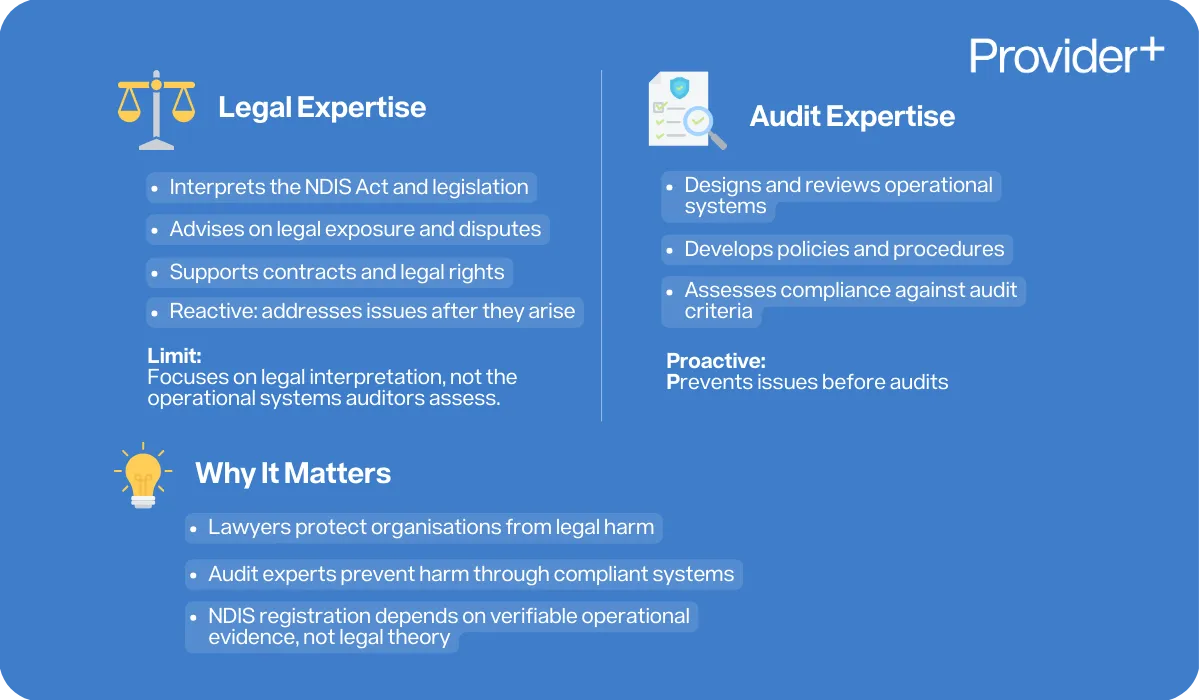
Legal Expertise: Interpretation and Risk Management
Legal consultants specialise in interpreting the NDIS Act and associated legislation, assessing legal exposure, negotiating settlements, and representing clients in disputes. Their approach is typically "case-based and reactive," addressing issues after they arise. Lawyers provide valuable guidance on legislative compliance obligations, contractual matters, and legal rights within the NDIS framework. However, their expertise centres on legal interpretation rather than the operational systems that auditors actually assess during registration.
Audit Expertise: Systems and Evidence Assessment
Former NDIS auditors bring fundamentally different expertise focused on designing and implementing operational systems, conducting compliance assessments, developing policies and procedures, and ensuring ongoing adherence to regulatory requirements. Their work is "systems-based and proactive," preventing issues before they occur. Auditors are trained in collecting, verifying, and evaluating objective evidence against established criteria through the ISO 19011 methodology, which directly mirrors the NDIS registration assessment process.
The distinction is critical: while legal counsel protects organisations from legal harm, compliance consultants work to prevent that harm from occurring through properly implemented systems. In the NDIS context, registration success depends on demonstrating operational capability through verifiable evidence, precisely the domain of audit and compliance expertise.
The NDIS Registration Process: An Evidence-Based Assessment
The NDIS registration process operates through an evidence-driven conformity assessment model conducted by Joint Accreditation Scheme of Australia and New Zealand (JAS-ANZ) accredited Approved Quality Auditors. This assessment methodology is grounded in ISO/IEC 17065:2012 conformity assessment standards and ISO 19011:2018 auditing principles, which establish evidence-based evaluation as a core principle.
What Auditors Actually Assess
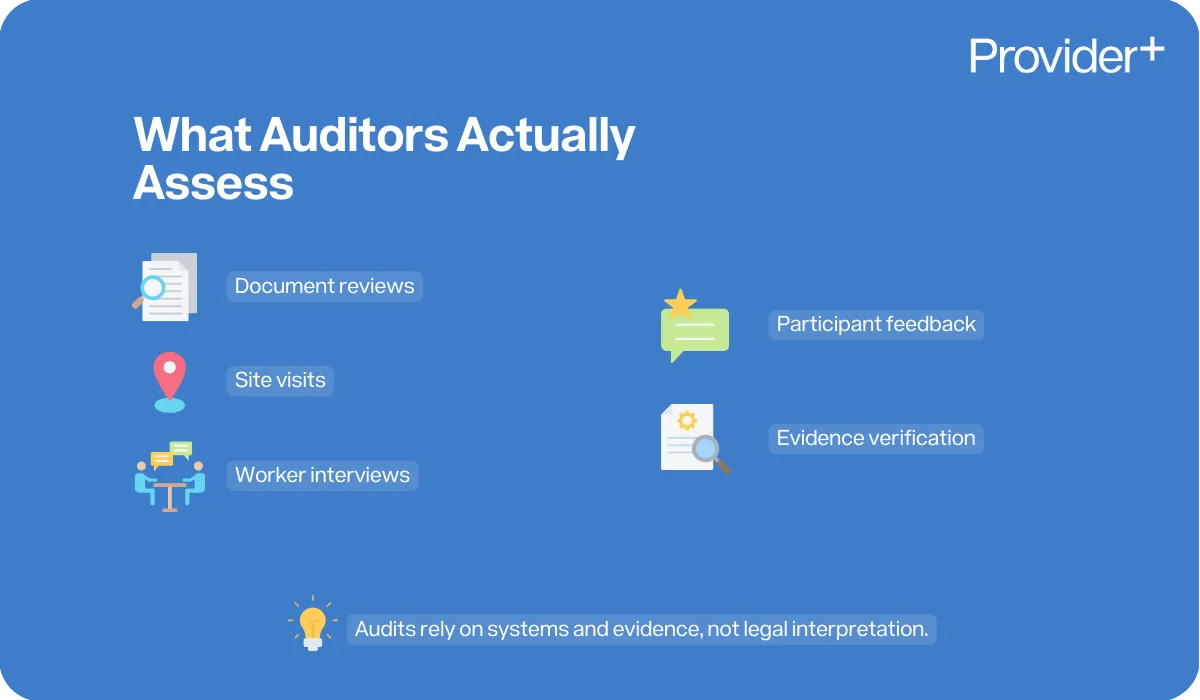
NDIS auditors evaluate provider conformance with the NDIS Practice Standards through:
- Document reviews: Examining policies, procedures, and documented systems
- Site visits: Observing actual operational practices and environments
- Worker interviews: Verifying implementation and understanding of systems
- Participant feedback: Assessing service delivery outcomes
- Evidence verification: Confirming that documented systems are genuinely implemented
The NDIS Commission's Principles for Audit Reports explicitly require "comprehensive details of evidence reviewed" including "traceable policies, procedures, processes, practice observations, environmental observations, interviews with participants and staff." This is operational and systems expertise, not legal analysis.
Evidence Requirements vs Legal Interpretation
Critically, the Commission makes clear that auditors assess whether organisational systems achieve intended outcomes, not whether they comply with legal technicalities. The Practice Standards require providers to demonstrate:
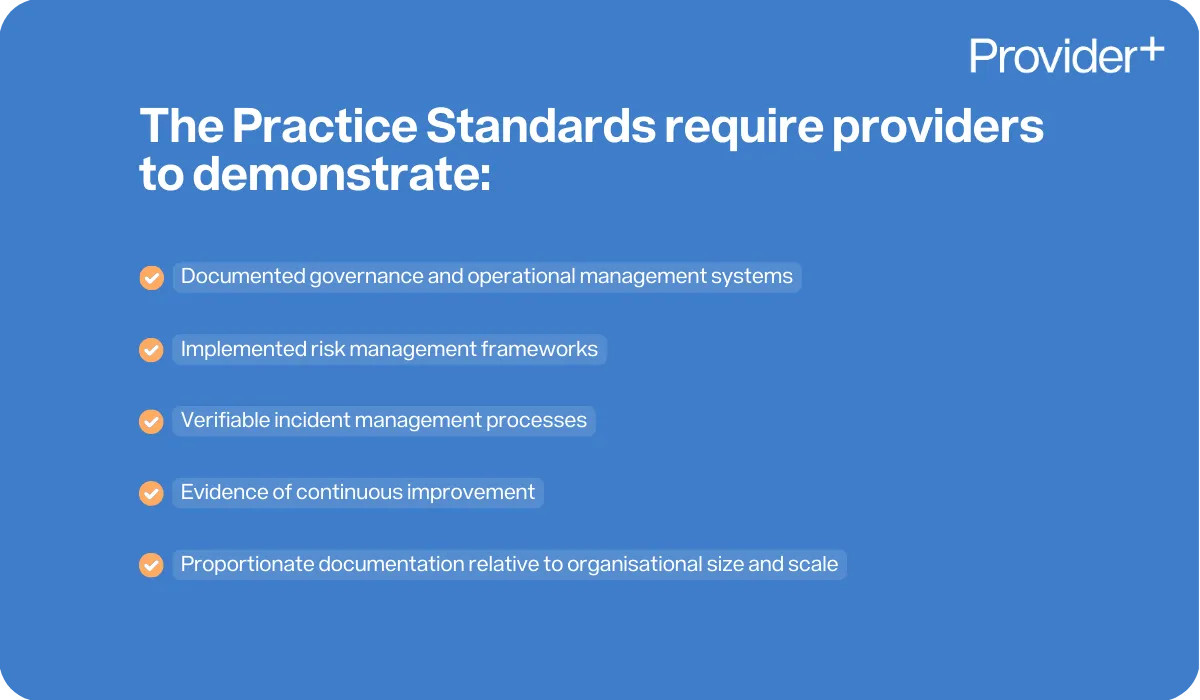
- Documented governance and operational management systems
- Implemented risk management frameworks
- Verifiable incident management processes
- Evidence of continuous improvement
- Proportionate documentation relative to organisational size and scale
These requirements demand practical understanding of how systems work in practice, not theoretical knowledge of legal obligations.
How Audit Experience Translates Into Stronger Consulting Outcomes
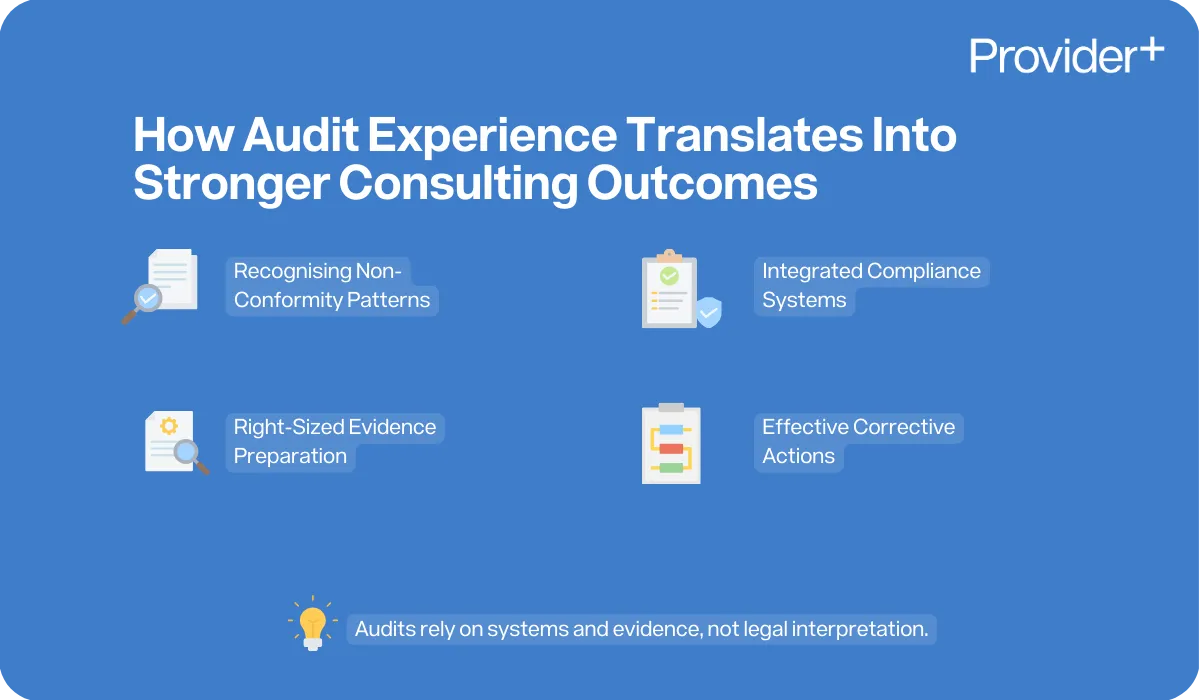
Understanding Non-Conformity Patterns
Former auditors have observed failure patterns across hundreds of audits. The most common reasons providers fail NDIS audits include poor documentation, inadequate governance systems, insufficient risk management frameworks, and inability to demonstrate implementation of policies. This experiential knowledge enables former auditors to proactively address weaknesses before they become non-conformities during actual audits.
Proportionate Evidence Preparation
The NDIS Practice Standards require evidence "proportionate to the size and scale of the provider organisation." Former auditors understand this proportionality principle intimately, having assessed organisations ranging from sole traders to large multi-site providers. They guide clients to prepare exactly the right level of documentation, avoiding both under-preparation (leading to non-conformities) and over-preparation (wasting resources).
Systems Integration Expertise
The NDIS Core Module explicitly requires that "support delivery is linked to a risk management system which includes incident management, complaints management, work health and safety, human resource management, financial management, information management, and governance." Former auditors understand these interdependencies and design integrated compliance systems rather than disconnected policies that fail during assessment.
Corrective Action Effectiveness
When providers receive non-conformities, they must submit Corrective Action Plans within seven calendar days and implement them successfully. Consulting firms employing former auditors report high success rates in converting failed audits into successful outcomes because they understand what constitutes adequate corrective action from an auditor's perspective.
The Role of ISO 19011, JAS-ANZ and the NDIS Practice Standards
ISO 19011: The Foundation of NDIS Auditing
The NDIS auditing methodology draws directly from ISO 19011:2018 Guidelines for Auditing Management Systems, which establishes seven core principles:
- Integrity: Professional and ethical conduct
- Fair presentation: Truthful and accurate reporting
- Due professional care: Diligence and judgment in auditing
- Confidentiality: Security of information
- Independence: Impartiality and objectivity
- Evidence-based approach: Rational method for reaching reliable conclusions based on verifiable evidence
- Risk-based approach: Consideration of risks and opportunities
The evidence-based approach is particularly relevant. ISO 19011 defines this as "the rational method for reaching reliable and reproducible audit conclusions in a systematic audit process" where "audit evidence is verifiable" and "based on objective samples of the information available."
JAS-ANZ Accreditation
To become an NDIS-approved quality auditor, individuals must demonstrate specific competencies to their accredited JAS-ANZ approved quality auditor:
- Audit Training and Certification: Completion of lead auditor courses (BSBSS00128 Lead Auditor Skill Set)
- NDIS-Specific Knowledge: Comprehensive understanding of Practice Standards through mandatory Commission training, demonstrated sector experience and demonstrated knowledge which they are deemed competent against by their approved quality auditor
- Disability Sector Expertise: Cultural awareness training covering disability from a participant perspective
- Operational Assessment Skills: Ability to evaluate governance frameworks and management systems
These competencies are directly transferable to effective consulting practice, providing former auditors with unique insight into what assessors will examine.
Practice Standards as Operational Frameworks
The NDIS Practice Standards comprise the Core Module and relevant Supplementary Modules, each requiring specific operational systems and verifiable evidence. Former auditors understand these requirements not as abstract concepts but as practical systems they have assessed countless times. They know exactly what evidence auditors will seek and how systems must function to demonstrate conformance.
When Legal Advice Still Matters
While former auditors offer superior expertise for registration and audit preparation, legal consultation remains valuable in specific circumstances:
Appropriate Uses of Legal Consultation
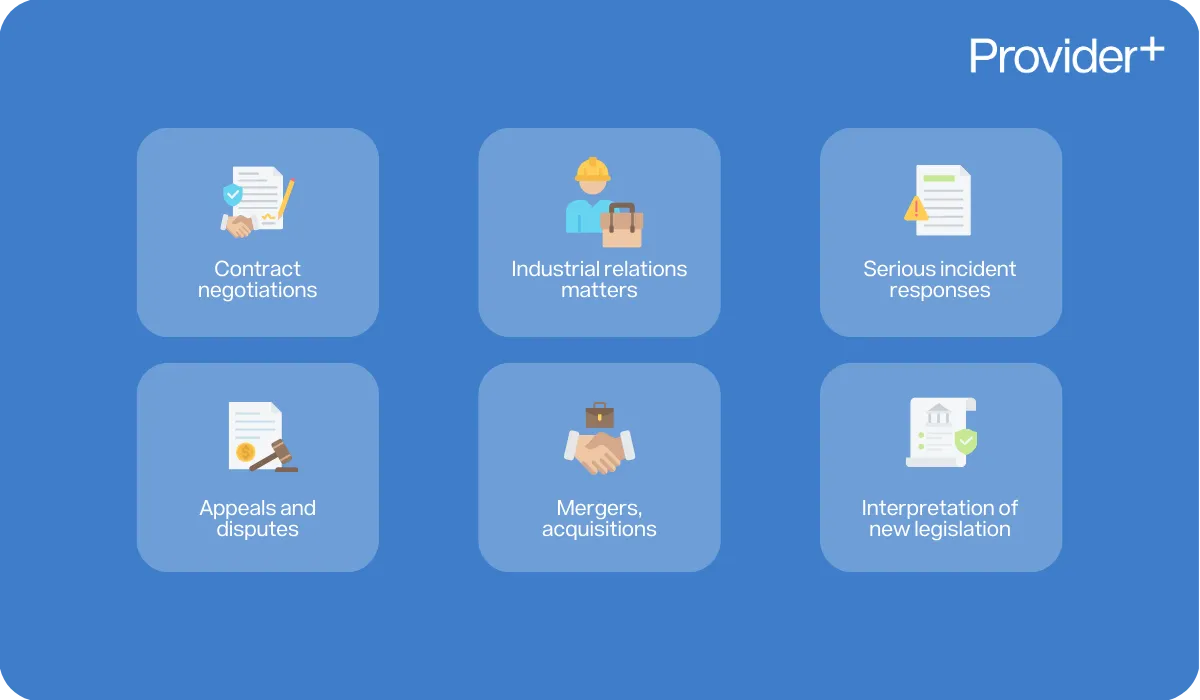
- Contract negotiations with participants, staff, or suppliers
- Industrial relations matters and employment disputes
- Serious incident responses involving potential liability
- Appeals and disputes with the NDIS Commission
- Mergers, acquisitions, and corporate structuring
- Interpretation of new legislation affecting the sector
Complementary Rather Than Competing Expertise
The most effective approach often involves both types of expertise working complementarily. Legal consultants can clarify legislative obligations and manage legal risks, while former auditors ensure operational systems meet registration requirements. However, for the core task of achieving and maintaining NDIS registration, audit expertise remains primary because registration decisions are based on operational assessment, not legal interpretation.
Conclusion
Former NDIS-approved quality auditors provide the most relevant consulting expertise for provider registration because they understand exactly what the registration process assesses: documented, implemented, and verifiable compliance systems. Their training in ISO 19011 evidence-based methodology, intimate knowledge of the NDIS Practice Standards and the approval process to become a NDIS auditor enable them to guide providers through registration with precision and confidence.
While legal expertise has its place in the NDIS sector, particularly for contractual and dispute matters, the registration process itself is an operational conformity assessment that demands audit expertise. Former auditors bring direct experience of what constitutes adequate evidence, how systems must function to demonstrate conformance, and what corrective actions succeed when non-conformities arise.
Providers seeking registration or audit readiness support benefit most from consultants who have evaluated these exact systems from an auditor's perspective. This practical, evidence-based approach, grounded in direct auditing experience, provides greater value for NDIS registration than theoretical legal knowledge that does not address the operational realities of conformity assessment.
Summary
Former NDIS auditors offer superior consulting expertise for provider registration because the NDIS registration process is an evidence-based conformity assessment, not a legal interpretation exercise. These consultants bring direct experience in evaluating operational systems, understanding ISO 19011 audit methodology, and knowing exactly what JAS-ANZ accredited auditors assess against the NDIS Practice Standards. While legal consultants focus on legislative interpretation and risk management, former auditors provide practical, systems-based expertise that directly addresses what the NDIS Commission actually evaluates: documented, implemented, and verifiable compliance frameworks proportional to provider size and scale.
Provider+ offers expert NDIS registration and audit readiness support from former NDIS-approved quality auditors who understand exactly what the Commission assesses. Learn more about our registration support services.
References
Australian Government NDIS Quality and Safeguards Commission. (2023, April 19). Information for quality auditors. https://www.ndiscommission.gov.au/provider-registration/apply-registration/information-quality-auditors
Australian Government NDIS Quality and Safeguards Commission. (2023, April 19). The quality audit process. https://www.ndiscommission.gov.au/provider-registration/apply-registration/types-audits
Australian Government NDIS Quality and Safeguards Commission. (2024, November 30). Apply for registration. https://www.ndiscommission.gov.au/provider-registration/apply-registration
Australian Government NDIS Quality and Safeguards Commission. (2024, November 30). NDIS Practice Standards. https://www.ndiscommission.gov.au/rules-and-standards/ndis-practice-standards
Australian Government NDIS Quality and Safeguards Commission. (2024, November 30). Provider governance and operational management. https://www.ndiscommission.gov.au/rules-and-standards/ndis-practice-standards/core-module-provider-governance-and-operational
Australian Government NDIS Quality and Safeguards Commission. (2022, December). Principles for Audit Reports delivered following audits undertaken in accordance with the National Disability Insurance Scheme (Approved Quality Auditor Scheme) Guidelines 2018. https://www.ndiscommission.gov.au/sites/default/files/2022-12/Principles%20for%20Audit%20Reports.pdf
Ausmed. (2024, July 14). NDIS Governance and Operational Management. https://www.ausmed.com/learn/articles/governance-and-operational-management-responsibilities
BSI Group. (2025). NDIS Practice Standards Certification: Client Guidebook (Revision 5). https://www.bsigroup.com/siteassets/pdf/en/insights-and-media/insights/brochures/au-grp-cross-insgt-nss-hsw-nsp-mp-01pp1318ndiscertificationandverificationguidebook-0025-img.pdf
Certaintysoftware. (2023, May 8). ISO 19011: A Guide to Quality Management Auditing. https://www.certaintysoftware.com/iso-19011/
Certpro. (2025, March 24). Understanding iso 19011: the core guidelines for auditing management systems. https://certpro.com/understanding-iso-19011-auditing-management-system/
Department of Social Services. (2018). National Disability Insurance Scheme (Approved Quality Auditors Scheme) Guidelines 2018. https://nds.org.au/images/resources/NDIS_Approved_Quality_Auditors_Scheme_Guidelines_2018_Draft_30_May_2018.pdf
Engels Floyd Quality Consulting. (2025, July 8). Learn from the experts in NDIS provider training. https://engelsfloyd.com/trainings/
Gomez, T. (2024, February 21). NDIS Compliance Challenges: Common Pitfalls and How to Overcome Them. Tania Gomez Consulting. https://taniagomez.com.au/ndis-compliance-challenges-common-pitfalls-and-how-to-overcome-them/
Ironclad Law. (2025, July 3). Exploring the Role of Compliance Attorneys in Today's Business Landscape. https://ironclad.law/compliance-attorney/
JAS-ANZ. (2023, October 31). Health & Human Services Sector Case Study. https://www.jasanz.org/case-study/health-human-services-sector-case-study
JAS-ANZ. (2025, March 6). Suspension of applications for accreditation under the NDIS Approved Quality Auditor (AQA) Scheme. https://www.jasanz.org/stories/suspension-of-applications-for-accreditation-under-the-ndis-approved-quality-auditor-aqa-scheme
Johner Institute. (2025, May 18). ISO 19011: Audit management for medical device manufacturers. https://blog.johner-institute.com/regulatory-affairs/iso-19011/
National Disability Services. (n.d.). NDIS Practice Standards Interpretive Guide. https://nds.org.au/images/resources/NDIS-Practice-Standards-Interpretive-Guide_singlepages.pdf
National Disability Services. (n.d.). NDIS Practice Standards Interpretive Guide (NEW-2022). https://nds.org.au/images/NDIS_Practice_Standards_Interpretive_Guide_NEW-2022_003.FINALpdf.pdf
Provider+. (2025, July 21). NDIS Provider Compliance & Registration Renewal 2025 Ultimate Guide. https://www.providerplus.com.au/post/ultimate-guide-to-ndis-provider-compliance-registration-renewal
Provider+. (2025, July 27). Understanding the NDIS Close Out Audit & Non-Conformances (2025 Update). https://www.providerplus.com.au/post/ndis-close-out-audit-non-conformances
Qsource. (2025, June 11). Navigating Regulatory Compliance in Nursing Homes. https://www.qsource.org/blog/navigating-regulatory-compliance-in-nursing-homes
Riddleinsights. (2025, August 27). Legal Consulting vs. Compliance Consulting: Where They Intersect and Why It Matters. https://riddleinsights.com/legal-consulting-vs-compliance-consulting-where-they-intersect-and-why-it-matters/
ShiftCare. (n.d.). Common Findings in NDIS Audits and How to Avoid Them. https://shiftcare.com/blog/common-findings-in-ndis-audits-and-how-to-avoid-them
The Fold Legal. (2022, June 19). Who you gonna call? Lawyers vs Compliance consultants. https://www.thefoldlegal.com.au/blog/who-you-gonna-call-lawyers-vs-compliance-consultants
ZenGRC. (2025, January 20). What is ISO 19011? https://www.zengrc.com/blog/what-is-iso-19011/
Need help with the NDIS?
Fill in the form below to get started.
FAQs
NDIS-approved auditors must complete BSBSS00128 Lead Auditor Skill Set certification, mandatory NDIS Commission auditor training on Practice Standards, disability cultural awareness training, and demonstrate competency in ISO 19011 auditing principles. They also require practical experience in evaluating management systems and operational frameworks. These qualifications provide direct insight into conformity assessment that legal training does not cover.
While lawyers can study the Practice Standards, understanding them differs from knowing how auditors assess them in practice. Former auditors have evaluated hundreds of providers, observing what evidence satisfies requirements, how systems must integrate, and what causes non-conformities. This experiential knowledge of proportionate documentation, evidence verification, and systems implementation cannot be gained through theoretical study alone.
Use legal consultation for contract disputes, employment matters, serious incident liability issues, appeals against Commission decisions, corporate restructuring, or interpreting new legislation. These situations require legal interpretation and risk assessment rather than operational systems expertise. However, for registration preparation and audit readiness, former auditors provide more relevant guidance.
Request evidence of their auditor qualification, NDIS Commission auditor training completion, and specific audit experience. Genuine former auditors can discuss specific Practice Standards modules, quality indicators, and common non-conformity patterns from direct experience. They should demonstrate detailed knowledge of Stage 1 and Stage 2 audit processes and corrective action requirements.
While specific statistics vary, consulting firms employing former NDIS auditors consistently report higher first-time registration success rates and more effective corrective action outcomes. Research from comparable sectors shows audit-preparation consulting produces superior compliance outcomes because consultants understand exactly what assessors evaluate and can prepare proportionate, integrated evidence that meets requirements efficiently.

Understand exactly why registration takes 6–12+ months
.webp)


