



Still Delivering SIL Unregistered? What You Need to Do Before the 1 October 2026 Deadline
- Existing unregistered SIL providers can continue delivering Supported Independent Living (SIL) during the transition period only if they lodge a valid NDIS registration application by 1 October 2026. You do not need to be fully registered by that date, but your application must be valid and submitted on time.
- Providers must apply directly for Registration Group 0138 (Assistance with Supported Independent Living). All applications are assessed through a full certification audit against the new SIL Practice Standards that commenced on 1 July 2026.
- Missing the 1 October 2026 lodgement deadline means you must stop providing SIL services. Continuing to deliver SIL without the required registration or a valid transition application may breach the NDIS Act and result in significant penalties.
If you deliver SIL without registration and you haven't applied yet, there is one date that matters more than any other for you, and it is 1 October 2026. Everything in this guide comes back to it.
Before the mechanics, it helps to know where you stand. You are in a tighter spot than providers who applied earlier, and if you run a small operation or work as a sole trader, taking all of this on can feel like a great deal at once. That feeling is fair. It is also manageable when you break it into steps, and there is a clear, legitimate path through that keeps you delivering and keeps your participants supported. Laying out that path, plainly, is what the rest of this guide is for.
Why does this deadline exist?
It is easier to act on a rule when you understand the thinking behind it, so it is worth a moment under the hood.
The reform needed a firm end date. A transition without one tends to drift, and providers and participants get left in limbo. So the Commission set clear markers: 1 July 2026, when the new rules begin, and 1 October 2026, the point by which providers already delivering SIL must have a valid application in to keep going.
The staged approach is deliberate as well. Providers who moved early, before 1 July, could face a lighter first audit. Providers applying later are assessed against the full new standards from the outset. In effect, the system gives an advantage to those who move early and asks more of those who leave it later. None of this is designed to catch you out. It is there to bring SIL under consistent oversight within a set timeframe, while still giving people a window to get there. Seen that way, the date stops feeling arbitrary and starts looking like what it is, which is a line you can plan towards.
Can I keep delivering SIL if I apply after 1 July?
Yes, and this is the reassuring part, though it comes with one firm condition. The Commission's transition arrangements let you keep delivering SIL while your application is processed, as long as you have lodged a valid application by 1 October 2026. So between 1 July and 1 October, you can keep supporting your participants while you get your application together.
One gentle caution: that window is time to act, not time to wait. Lodging takes preparation, and the weeks pass quickly. The providers who use this window well are the ones who start now rather than near the end of it.
What is the 1 October 2026 deadline?
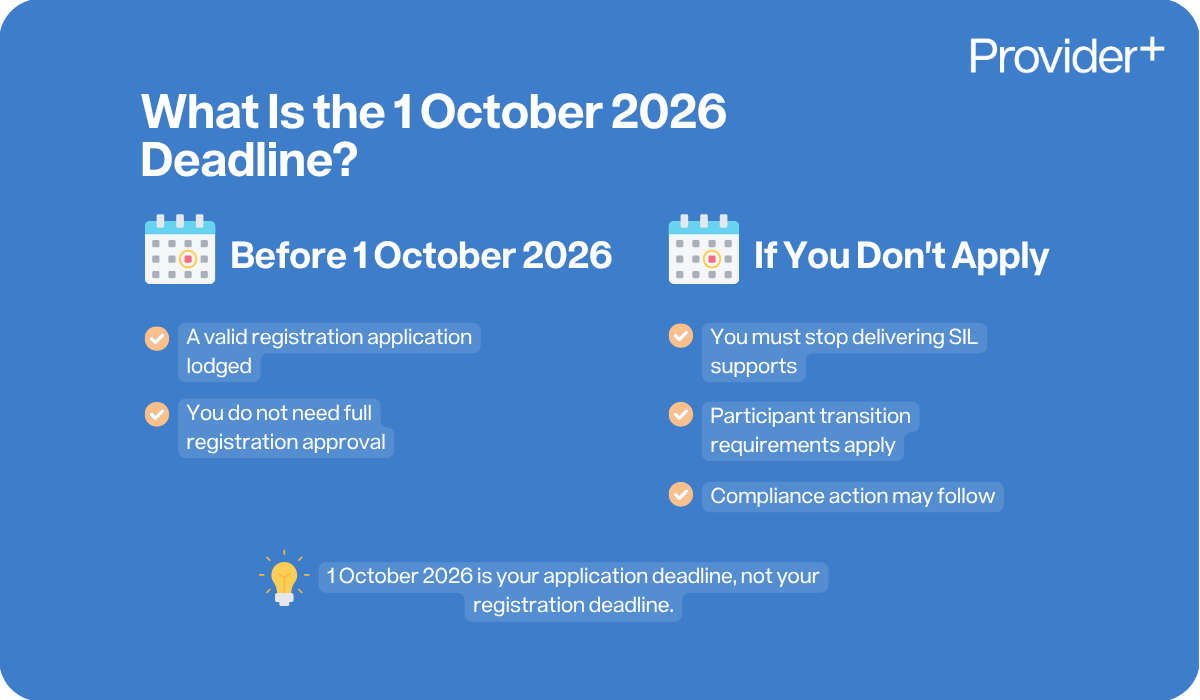
Think of 1 October as your lifeline, not your finish line. You do not need to be fully registered by then. You need a valid application lodged by then. That is a far more achievable target, and holding the two apart in your mind takes a lot of the pressure off.
It is only fair to be straight with you about what happens if the date passes without your application in, because the Commission is straight about it too. If you are currently delivering SIL and you choose not to apply, or you haven't applied by 1 October 2026, you must stop providing SIL supports. Delivering SIL without registration on or after 1 July 2026 may breach the NDIS Act, which the Commission describes as a serious offence, carrying a maximum penalty of up to two years' imprisonment, a fine of 120 penalty units, or both. And if you do have to stop, you are not simply walking away. You must follow the Commission's notification and participant-transition steps so the people you support are handed over safely.
That is the hard part, and there is no softening the facts of it. The encouraging news is that none of it comes into play if you lodge a valid application in time, which is well within reach from where you sit today.
What do I apply for?
You apply directly for registration group 0138 (Assistance with supported independent living), along with any other registration groups that match the supports you deliver. You apply directly for Registration Group 0138 (Assistance with Supported Independent Living), together with any other applicable registration groups.
Will my audit include the new SIL Practice Standards?
Yes, always, and it helps to understand why, because it shapes how you prepare. Your certification audit assesses your organisation against the SIL Practice Standards in full. There is no reduced audit scope under this pathway.
There is also no "conditions for additional audits later" outcome in your case, which applied only to those early, pre-1-July audits. Your audit is full-scope from the start. The practical message is plain, and not unkind: prepare against the new standards as your baseline, rather than as something to grow into later. It is a higher bar, but it is a clear one, and a clear bar is something you can prepare for properly.
What will I be audited against?
The SIL Practice Standards are built around four key outcomes. In an audit, the evidence for each is drawn from four places: your documents, your records, what the auditor observes in the service environment, and what your workers and participants say when asked. This is the part worth dwelling on, because it is where preparation actually happens. Policies on their own will not carry you. The auditor is looking for your everyday practice to match what your policies promise.
- Supported decision-making. Decisions about a participant's home, routines and relationships are made by them, not for them, with a trail showing how a decision was reached and who was involved.
- Safeguarding. How you prevent, identify and respond to harm: incidents, complaints, risk and restrictive practices, with a working incident register rather than events buried in shift notes.
- Practice governance. Whether your policies, supervision and training describe what actually happens, version-controlled and reviewed.
- Agreements about tenancy, housing and support. Separating the tenancy agreement from the service agreement where you are both landlord and provider, and treating the home as the participant's home first.
These sit on top of the Core Module. Most SIL providers also need the high intensity daily personal activities module, and the implementing behaviour support module if restrictive practices apply. Every worker in a risk-assessed role needs a valid NDIS Worker Screening Check clearance, and clearances take weeks to process, so it is worth lodging those early.
What does it cost and how long does it take?
Let us talk plainly about money and time, since both shape your planning. The NDIS Commission charges no fee for the application itself. The real costs sit with the auditor, insurance, worker screening and your own preparation. You engage an Approved Quality Auditor directly, and because SIL sits in the more thorough certification pathway, audit fees run higher than for low-risk verification. The Commission does not set those fees, so they vary by auditor and by the size and complexity of your service, which is why getting more than one quote is worth your time. Worker screening checks carry a per-worker fee set by your state or territory, and you will need appropriate insurance in place before your registration is approved.
On timing, full registration commonly takes six to twelve months from start to certificate. Hold that against your deadline for a moment. You do not need to be registered by 1 October, only to have lodged a valid application by then. The audit and review still take months afterward, and you can only keep delivering through that period if your application went in on time. The auditor queue tightens as more providers move, so the sooner you begin, the safer your lodgement date.
What if I miss the deadline or my application isn't approved?
Both situations lead to the same difficult place: you would not be able to deliver SIL. If you miss the 1 October lodgement cutoff, you lose the protection that lets you keep delivering while you register. If you apply in time but are not approved, you also cannot deliver, because there is no partial approval to fall back on. The reassuring part is that the same preparation guards against both. Lodge a strong, valid application well before 1 October, make sure your evidence stands up at audit, and you take both risks off the table.
What should I do now?
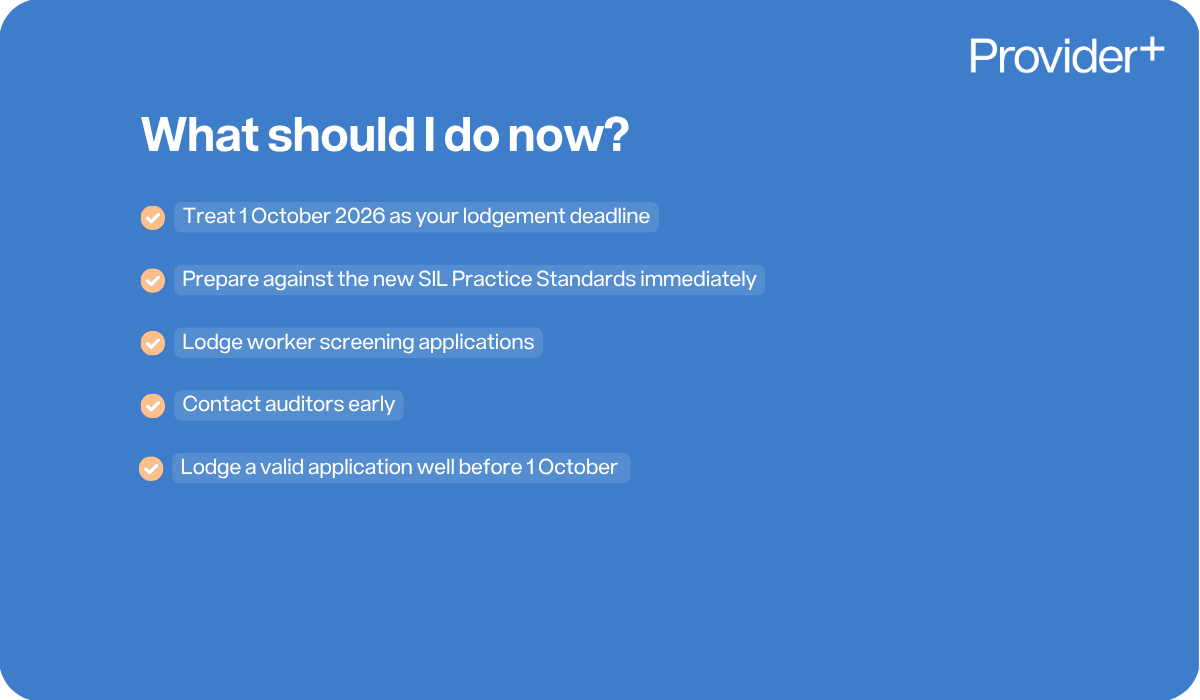
- Treat 1 October 2026 as your lodgement deadline and work backwards from it.
- Prepare against the new SIL Practice Standards immediately, since your audit will include them in full.
- Lodge worker screening applications for any workers without current clearance.
- Contact auditors early for availability and quotes, before the queue tightens.
- Lodge a valid application well before 1 October to keep delivering and to protect your participants.
How Provider+ can help
Provider+ helps unregistered SIL providers register against the deadline: the policies and evidence an auditor expects, auditor introductions, and a plan that gets a valid application in before 1 October.
Book a Call
This guide is general information for SIL providers. It is not legal advice and is not a substitute for the NDIS Practice Standards, the NDIS Act, or guidance from your approved quality auditor. For the authoritative and current position, see the NDIS Commission Reform Hub.
We strive to keep our content accurate and up to date; however, NDIS Commission rules and requirements can change. For the latest information, visit the NDIS Quality and Safeguards Commission website or contact our team.
FAQs
Yes, but only if you lodge a valid application by 1 October 2026. The Commission's transition arrangements let you keep delivering while your application is processed, provided it was lodged by that date.
It is the cutoff for currently-delivering, unregistered providers to have a valid application lodged in order to keep operating. You do not need to be fully registered by 1 October, only to have a valid application in.
You apply directly for Registration Group 0138 (Assistance with Supported Independent Living) together with any other applicable registration groups. After submitting your application, the NDIS Commission issues a Scope of Audit, and you must engage an Approved Quality Auditor to complete a certification audit against the applicable NDIS Practice Standards.
Yes. Certification audits under this pathway assess providers against the SIL Practice Standards in full.
You must stop delivering SIL. Delivering SIL without registration on or after 1 July 2026 may breach the NDIS Act and is described by the Commission as a serious offence, with a maximum penalty of up to two years' imprisonment, a fine of 120 penalty units, or both. If you stop, you must follow the Commission's notification and participant-transition steps.

Understand exactly why registration takes 6–12+ months
.png)