What Are the New NDIS SIL Practice Standards Under Module 5A?
- Module 5A is mandatory from 1 July 2026 for all registered Supported Independent Living (SIL) providers under Registration Group 0138.
- Module 5A introduces four SIL-specific Practice Standards that apply in addition to the NDIS Practice Standards Core Module.
- The standards focus on Supported Decision-Making, Safeguarding, Practice Governance, and Agreements about Tenancy, Housing and Support Arrangements.
- The new standards place greater emphasis on participant outcomes and everyday practice rather than policies alone.
From 1 July 2026, Supported Independent Living (SIL) becomes a dedicated NDIS registration category under Registration Group 0138 – Assistance with Supported Independent Living.
NDIS Commission's SIL registration guidance: https://www.ndiscommission.gov.au/about-us/ndis-commission-reform-hub/mandatory-registration/mandatory-registration-SIL
As part of this reform, the NDIS Quality and Safeguards Commission introduced Module 5A: Assistance with Supported Independent Living, which contains four Practice Standards designed specifically for registered SIL providers.
Official reform information: https://www.ndiscommission.gov.au/about-us/ndis-commission-reform-hub/ndis-practice-standards-reform
Unlike the Core Module, which applies to all registered providers, Module 5A focuses on the unique responsibilities involved in supporting participants within their homes.
These standards establish the minimum expectations for how registered SIL providers should deliver safe, person-centred and high-quality supports.
Whether you're an existing SIL provider, applying for registration or expanding your registration to include SIL, understanding these standards is essential for compliance and audit readiness.
Why Were New SIL Practice Standards Introduced?
Supported Independent Living differs from many other NDIS supports.
Workers often provide support every day, sometimes twenty-four hours a day, within a participant's home.
Participants may also share their home with other people receiving supports.
These living arrangements create unique responsibilities that were not fully addressed under the existing Practice Standards.
The NDIS Commission introduced Module 5A to:
- strengthen participant rights
- improve consistency across SIL services
- enhance safeguarding
- support evidence-informed practice
- strengthen workforce capability
- protect tenancy rights
- improve participant outcomes.
Rather than introducing entirely new compliance concepts, Module 5A expands existing principles so they better reflect how quality SIL should operate in practice.
How Are the New SIL Practice Standards Different From the Core Module?
The Core Module establishes the governance systems every registered provider should have.
Module 5A builds on those systems by focusing specifically on Supported Independent Living.
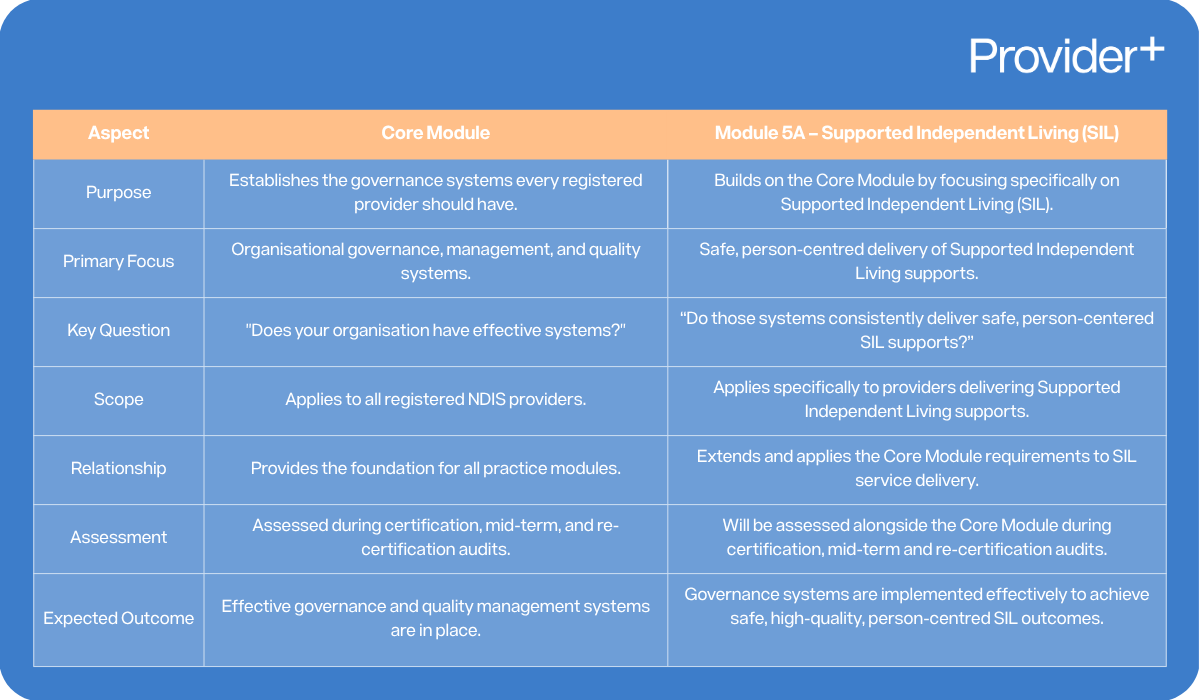
The Core Module establishes the governance and quality systems that every registered provider must have. Module 5A builds on this foundation by ensuring those systems are applied consistently to deliver safe, high-quality, person-centred Supported Independent Living (SIL) services. Both modules are complementary and will be assessed together during certification, mid-term audits, and re-certification audits.
The Four New NDIS SIL Practice Standards
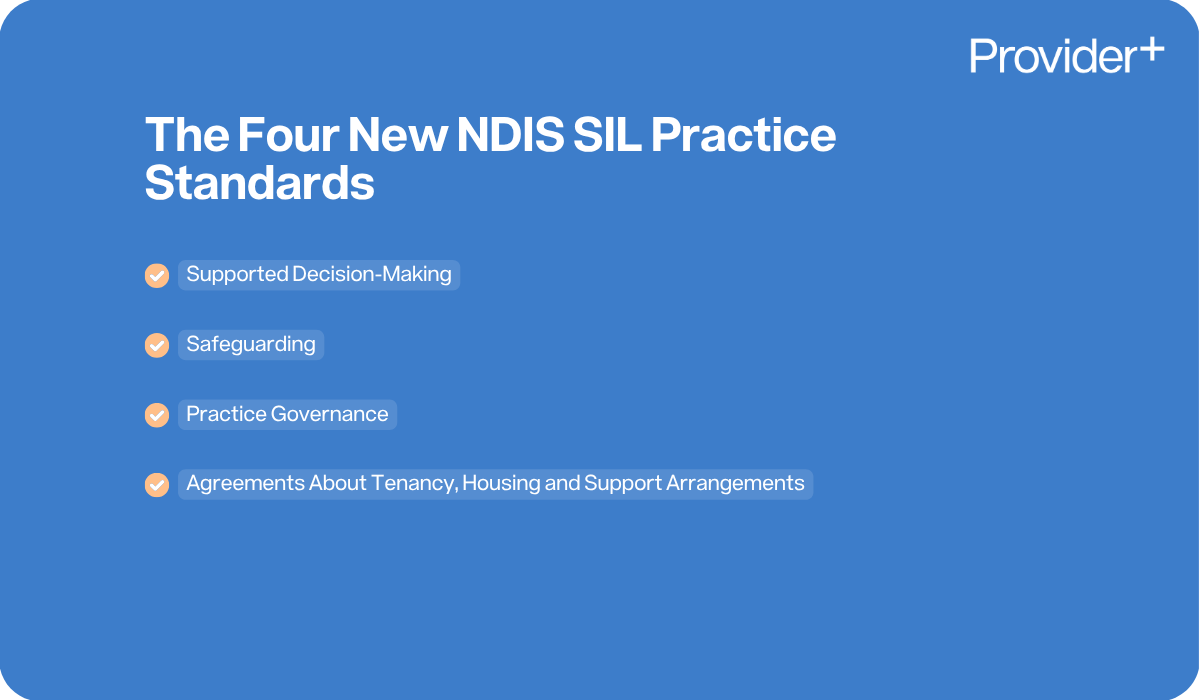
SIL Practice Standards: https://www.ndiscommission.gov.au/rules-and-standards/ndis-practice-standards/sil
The remainder of this guide explains each standard in more detail and what providers should expect during implementation.
1. Supported Decision-Making
The first Practice Standard requires providers to actively support participants to make their own decisions.
Decision-making should occur throughout everyday life rather than only during planning meetings.
Workers should provide:
- accessible information
- communication support
- sufficient time to consider options
- opportunities for participants to express their preferences
- support that reflects individual communication needs.
The emphasis is on enabling participants to direct their own lives rather than making decisions on their behalf.
What auditors may assess
Auditors may review:
- Supported Decision-Making policies
- communication profiles
- participant support plans
- staff interviews
- participant interviews
- supervision records
- examples demonstrating participant choice.
The objective is to confirm that participant decisions genuinely influence service delivery.
2. Safeguarding
Safeguarding focuses on creating environments where participants feel safe while maintaining their right to make informed choices.
Because SIL frequently involves shared living environments, providers should identify and manage risks before harm occurs.
Safeguarding responsibilities include:
- abuse prevention
- neglect prevention
- financial exploitation
- conflict between co-tenants
- emergency preparedness
- community safety
- privacy
- visitor management.
Importantly, safeguarding should support—not replace—participant autonomy.
Providers should demonstrate how they balance safety with dignity of risk.
What auditors may assess
Evidence may include:
- safeguarding policies
- incident reviews
- risk assessments
- emergency plans
- worker training
- supervision documentation
- continuous improvement activities.
3. Practice Governance
The Practice Governance Standard recognises that high-quality Supported Independent Living does not happen by chance. It requires providers to demonstrate that leadership, workforce systems and continuous improvement processes work together to produce consistent participant outcomes.
Rather than focusing solely on organisational policies, the standard asks providers to show how governance influences everyday practice across every SIL home.
This includes ensuring workers receive appropriate induction, ongoing supervision, mentoring and competency assessment so they can safely support participants.
Practice Governance also expects organisations to regularly review service quality, monitor workforce performance and use participant feedback to improve practice over time.
Key areas of Practice Governance include:
- workforce planning
- competency-based recruitment
- induction programs
- supervision and mentoring
- practice observations
- continuing professional development
- evidence-informed practice
- quality improvement
- leadership oversight.
Strong governance creates consistency across the organisation rather than relying on individual staff experience.
What auditors may assess
Evidence commonly reviewed includes:
- governance frameworks
- management review meetings
- supervision records
- competency assessments
- workforce development plans
- internal audits
- quality improvement registers
- participant feedback
- corrective actions.
Providers should be able to explain how governance decisions translate into improved participant outcomes.
4. Agreements About Tenancy, Housing and Support Arrangements
The fourth Practice Standard focuses on protecting participant rights where housing and support are connected.
If an organisation provides both Supported Independent Living and housing, participants should clearly understand that these are separate arrangements.
The purpose of this standard is to reduce conflicts of interest and strengthen participant choice.
Participants should know:
- the difference between their tenancy agreement and service agreement
- their legal tenancy rights
- that they can change support providers without automatically losing their home (where applicable)
- how to raise concerns
- how to access independent advocacy or legal advice if required.
The standard also encourages providers to communicate these arrangements using language and formats participants can easily understand.
What auditors may assess
Auditors may review:
- tenancy agreements
- service agreements
- participant information
- conflict of interest procedures
- participant interviews
- evidence showing participants understand their rights.
For providers that deliver both housing and SIL, this standard is likely to receive particular attention during certification and mid-term audits.
How Should Providers Prepare?
Whether you're an existing provider, applying for registration or expanding into SIL, early preparation is the most effective approach.
Rather than waiting until an audit is scheduled, review your systems against each Practice Standard.
A practical readiness review might include:
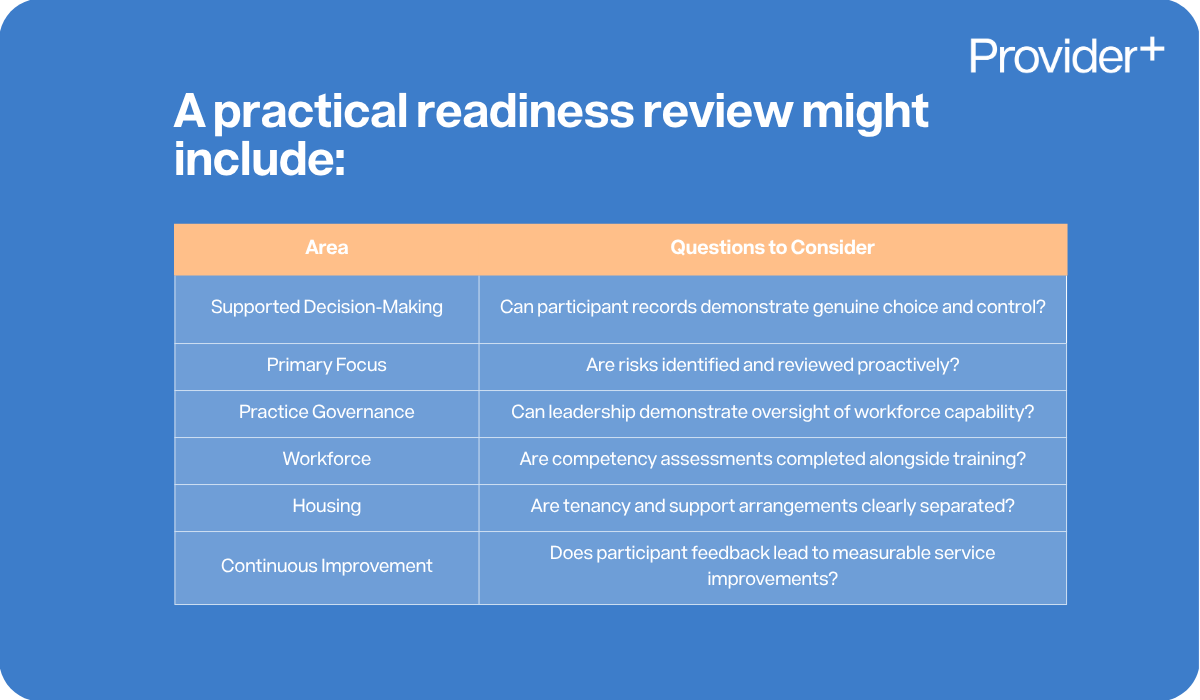
Common Areas Providers Should Review
As providers prepare for Module 5A, reviewing key organisational systems before applying for registration or attending an audit can help identify areas that may require strengthening.
Demonstrating Practice, Not Just Policies
Many providers already have comprehensive policies and procedures in place.
Under Module 5A, providers will also need to demonstrate that these policies are consistently implemented across day-to-day SIL supports. This means showing how governance systems translate into safe, person-centred practice rather than relying on documentation alone.
Demonstrating Workforce Capability
Training records are important, but they are only one part of workforce capability.
Providers should also consider how they assess worker competence through supervision, mentoring, practice observations and ongoing professional development to demonstrate that staff can apply their knowledge in real-world settings.
Reviewing Participant Documentation
Participant records should accurately reflect how supports are delivered in practice.
When reviewing documentation, consider whether records clearly demonstrate:
- supported decision-making
- individual communication preferences
- participant gols and outcomes
- safeguarding considerations
- regular reviews and updates to supports.
Well-maintained participant records can help demonstrate that services are person-centred and responsive to changing needs.
Embedding Continuous Improvement
Continuous improvement should form part of everyday organisational practice rather than being limited to responding to complaints or incidents. Providers should have systems that regularly review service quality, analyse participant feedback, identify opportunities for improvement and monitor the effectiveness of changes over time.
How Provider+ Can Help
Need help registering as an SIL provider? Provider+ guides you through the NDIS registration process, providing the policies, and expert support you need to prepare for your audit and submit your application before 1 October.
Conclusion
The introduction of Module 5A marks an important step in strengthening quality and consistency across Supported Independent Living services.
Rather than viewing the four new Practice Standards as additional compliance obligations, providers should see them as a framework for delivering safer, more person-centred supports.
By embedding Supported Decision-Making, proactive Safeguarding, strong Practice Governance and clear Tenancy and Housing Arrangements into everyday operations, organisations will be better positioned for both future audits and improved participant outcomes.
We strive to keep our content accurate and up to date; however, NDIS Commission rules and requirements can change. For the latest information, visit the NDIS Quality and Safeguards Commission website or contact our team.
FAQs
No. Module 5A is an additional Practice Module that applies specifically to registered SIL providers. Providers must continue complying with the Core Module.
No. Module 5A applies only to providers delivering Supported Independent Living under Registration Group 0138.
All four standards work together. Supported Decision-Making, Safeguarding, Practice Governance and Tenancy Arrangements each address different aspects of high-quality SIL.
Yes. Providers delivering both housing and SIL should ensure tenancy arrangements remain separate from support arrangements.
Evidence may include governance records, supervision documentation, competency assessments, participant records, safeguarding documentation and continuous improvement activities.
Yes. Early preparation allows organisations to strengthen systems and build evidence gradually rather than immediately before certification or mid-term.

Understand exactly why registration takes 6–12+ months

.webp)