



What Does an NDIS SIL Registration Consultant Do?
From 1 July 2026, every provider delivering Supported Independent Living supports in Australia must be registered with the NDIS Quality and Safeguards Commission or transitioning to registration. This is not optional. Providers currently operating without registration under plan-managed or self-managed arrangements will need to complete the full registration process or cease delivering SIL supports.
For many providers, the process is unfamiliar. SIL registration sits under Tier 1 Advanced Registration, the highest and most rigorous tier in the NDIS registration framework. It requires a certification audit, compliance with the NDIS Practice Standards, documented policies and procedures, and worker screening checks for all staff. It takes longer than most providers expect, and the consequences of getting it wrong are significant.
An NDIS SIL registration consultant manages this process. This article explains what that involves, what the registration process requires, and what separates a competent consultant from one who will cost you time and money.
Why SIL Registration Is More Complex Than General NDIS Registration
SIL is classified as a high-risk support category under the NDIS. Participants typically receive 24/7 care in shared accommodation settings, often with complex needs. The NDIS Review, the Disability Royal Commission, and the NDIS Provider and Worker Registration Taskforce all identified SIL as requiring stronger regulatory oversight. Mandatory registration is the result.
SIL registration falls under Tier 1 Advanced Registration in the new graduated risk-proportionate framework introduced as part of the broader NDIS reforms. This places it alongside Specialist Disability Accommodation and behaviour support involving restrictive practices as the support categories with the most comprehensive audit and compliance requirements.
What this means in practice for providers seeking SIL registration:
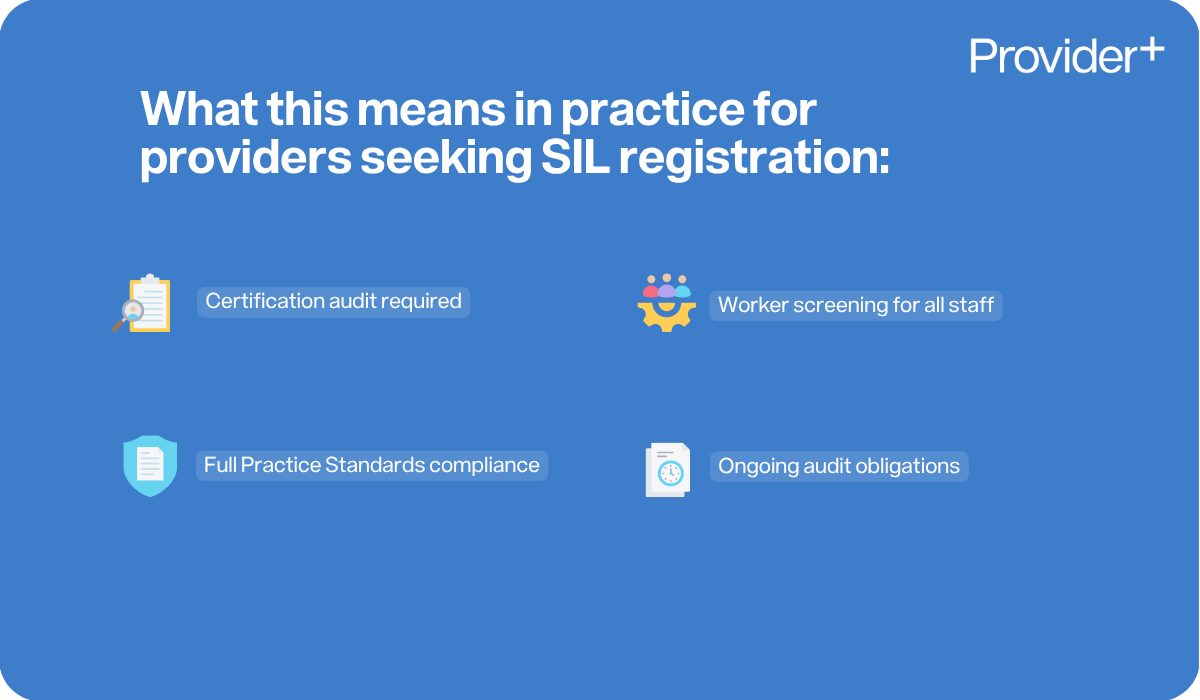
Certification audit required. SIL registration requires a certification audit conducted by an NDIS Commission-approved quality auditor. This is more extensive than a verification audit. It involves a Stage 1 document review and a Stage 2 on-site assessment that includes interviews with staff and direct contact with participants receiving SIL supports.
Full Practice Standards compliance. Providers must demonstrate compliance with the NDIS Practice Standards Core Module and all applicable supplementary modules. New SIL-specific Practice Standards are currently being developed by the NDIS Commission. These will focus on quality and safety in shared accommodation settings and will introduce additional requirements once released.
Worker screening for all staff. Every worker delivering SIL supports through a registered provider must hold a current NDIS Worker Screening Check clearance. This is a mandatory requirement, not a recommendation.
Ongoing audit obligations. Once registered, SIL providers face mid-term audits at 18 months and full recertification every three years. Registration is a continuous compliance obligation, not a one-time approval.
What an NDIS SIL Registration Consultant Does
An NDIS SIL registration consultant guides providers through each stage of the registration process. The scope varies between consultants, but a complete engagement should cover the following.
Eligibility and Readiness Assessment
Before submitting a Commission application, a provider needs to know whether it is genuinely ready to register, and if not, what needs to change. A consultant assesses Key Personnel suitability, existing policies and procedures, staff qualifications and experience, and the operational model against the requirements of the NDIS Practice Standards. Starting the application before these fundamentals are in order wastes time and can result in non-conformances during the audit that could have been avoided.
Commission Application Preparation
The NDIS Commission application requires detailed documentation covering the organisation, its services, Key Personnel, and compliance systems. It must be completed accurately and submitted within required timeframes. Applications that are not completed within 60 days are deleted and the process must start again. A consultant manages this to ensure nothing is missed and the application reflects the provider's actual operations.
Policy and Procedure Development
This is where most providers need the most help. Passing a SIL certification audit requires documented policies and procedures covering each applicable NDIS Practice Standard. For SIL providers, this typically includes policies addressing:
- Incident management, including reportable incident procedures
- Participant rights and engagement
- Feedback and complaints handling
- Risk management
- Support planning and delivery
- Worker screening and recruitment
- Governance and business continuity
- Emergency and disaster management
- Safe handling of participant information and privacy
One critical point: the NDIS Commission has published guidance stating that policies must accurately reflect how an organisation actually delivers supports. The NDIS Commission has flagged concerns about providers submitting documentation that does not reflect how their organisation actually operates. This is the distinction that matters: policies need to be implemented and owned by the organisation, not simply filed. A good consultant will provide you with a strong policy framework and work with you to make sure it accurately reflects your operations, your staffing model, and your service delivery approach. What auditors are looking for is evidence that your team understands and uses the documentation, not just that it exists.
Audit Preparation
The certification audit is the most consequential part of the process. A competent consultant prepares providers for both stages.
Stage 1 is a document review: the auditor assesses whether policies, procedures, and supporting evidence meet the NDIS Practice Standards. Stage 2 is the on-site assessment: the auditor visits the service, interviews workers, and speaks directly with participants.
Auditors can issue non-conformances. Minor non-conformances can usually be resolved quickly. Major non-conformances require significant remediation and may require a follow-up audit, adding cost and time to the process. A consultant with direct experience in SIL audits will know where providers commonly fall short and help close those gaps before the auditor arrives.
Non-Conformance Response
If non-conformances are issued, they must be addressed formally within specified timeframes. A consultant should support the provider through this process, clarifying what the auditor requires and preparing the formal response.
Ongoing Compliance Support
Registration does not end the compliance obligation. Mid-term audits, registration renewal, and the incoming SIL-specific Practice Standards all require ongoing attention. The best consultants offer continued support after initial registration rather than treating it as a transactional engagement.
The July 2026 Deadline: Why Starting Now Matters
The NDIS Commission has confirmed 1 July 2026 as the commencement date for mandatory SIL registration. Transitional arrangements are still being finalised, but providers should not treat this uncertainty as a reason to wait.
There are several practical reasons to begin the process as early as possible.
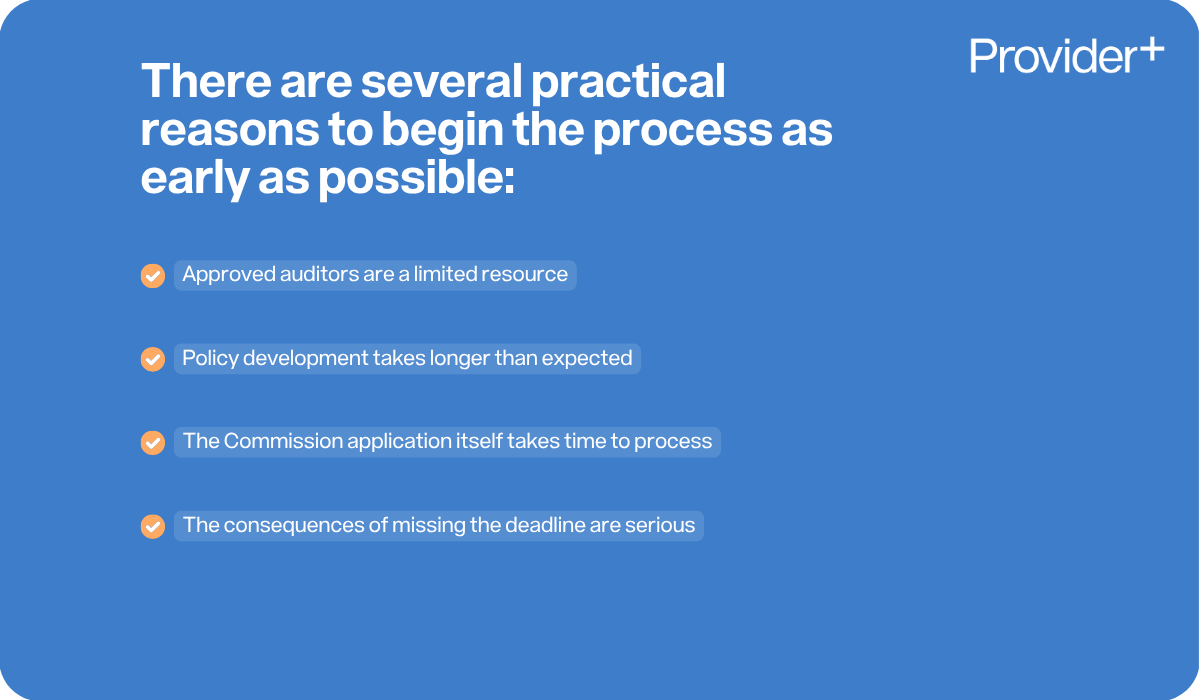
Approved auditors are a limited resource. There are a finite number of NDIS Commission-approved quality auditors operating in Australia. As the July 2026 deadline approaches, thousands of SIL providers will be competing for audit appointments simultaneously. Providers who delay will find audit slots difficult to secure, potentially pushing their registration past the deadline.
Policy development takes longer than expected. Providers who have not previously been through a certification audit consistently underestimate how much documentation is required. Building a compliant policy suite from scratch takes weeks. Revising it in response to auditor feedback takes more time on top of that.
The Commission application itself takes time to process. Once submitted, the application must be assessed by the Commission before the provider can engage an auditor and proceed. There is no expedited pathway.
The consequences of missing the deadline are serious. Providers who are not registered by the end of the transition period may be required to stop delivering SIL supports until registration is approved. This means direct loss of SIL revenue, disruption to participant care, and potential loss of staff.
Providers currently delivering SIL supports without registration should begin the process in the first half of 2026 at the latest. Providers starting from scratch in the second quarter of 2026 are taking a significant risk.
How to Choose an NDIS SIL Registration Consultant
The NDIS registration consulting market includes a wide range of operators. Not all of them are equipped to handle SIL specifically, and some practices in this market have attracted direct attention from the NDIS Commission.
When assessing a consultant, consider the following.
Are they based in Australia and working within the Australian regulatory environment? The NDIS Commission has made clear that providers are responsible for the content of their applications, and that consultants who supply the same or similar documentation to multiple clients risk those applications being refused. A number of low-cost offshore consulting operations produce generic, templated documentation that does not reflect an individual organisation's operations. The Commission can and does impose additional audit conditions when it identifies this pattern. Your consultant needs to understand the Australian regulatory context, have direct relationships with the NDIS Commission's processes, and produce documentation specific to your organisation.
Do they have SIL-specific experience? General NDIS registration experience is useful but not sufficient. SIL has particular requirements around shared accommodation settings, 24/7 support delivery, and the incoming SIL-specific Practice Standards. A consultant without direct SIL compliance experience may not know what auditors are looking for or where providers in this category typically fall short.
Do they have auditing experience or direct auditor relationships? Consultants who have worked as approved auditors, or who have worked closely with auditors on SIL certification assessments, are better positioned to prepare providers for what they will actually face. The audit is where applications succeed or fail. Preparation needs to be grounded in how auditors actually assess compliance, not just in what the standards say on paper.
What is the full scope of their service? Some consultants produce a policy package and consider their role complete. That is not enough. Audit preparation, application management, and non-conformance response are equally critical parts of the engagement. Confirm what is and is not included before engaging.
Can they demonstrate outcomes? Ask for evidence of SIL providers they have successfully registered. Ask about typical timeframes. Ask whether any clients have had audits fail or been required to address major non-conformances. A credible consultant will answer these questions directly.
Are they current on regulatory changes? The SIL Practice Standards are still being developed. A consultant who is not actively monitoring NDIS Commission updates may prepare providers for outdated requirements. Ask specifically how they are tracking the incoming standards.
The Provider+ Team
The Provider+ Team
Provider+ is an Australian NDIS registration and compliance consultancy. Our team includes consultants with direct, hands-on experience across SIL compliance, certification auditing, and NDIS operational management.
Jayde Farrow, Compliance Manager
Jayde has 16 years of experience across NDIS, aged care, ADHAC, DCJ, and complex mental health. She began her career in frontline mental health before moving into compliance, which gives her direct understanding of both how services operate and what compliance looks like in practice. Jayde leads Provider+'s compliance and consulting teams and works closely with the policy team to ensure clients' documentation reflects the latest NDIS requirements.
Yvette Clark, Senior NDIS Consultant
Yvette brings more than 33 years in disability services, starting as a support worker in 1991 and progressing through team leader, senior manager, and Interim CEO roles. She is a former Lead NDIS Auditor with experience conducting certification audits and technical reviews across all NDIS registration groups, giving her a thorough understanding of exactly what auditors look for. Yvette specialises in SIL, Respite, Module 2A, and Positive Behaviour Support, and holds Diplomas in Quality Auditing, Business, and Case Management, with specialist IABA training in Positive Behaviour Support. She is trusted by providers for practical, fast guidance through audit preparation and audit day attendance.
Gillian Collis, Senior NDIS Consultant
Gillian has more than 20 years of experience in compliance, quality management, and leadership across the NDIS and aged care sectors. She has worked as both a provider executive and an NDIS Lead Auditor, conducting Verification, Certification, and SDA audits across multiple modules. Gillian has held executive leadership responsibility for HR, WHS, and compliance for an NDIS and aged care provider, and has led organisations through compliance with ISO 9001, NDIS Practice Standards, and Aged Care Quality Standards. At Provider+, she guides providers through every stage of registration, audit preparation, and ongoing compliance.
Cynthia Ly, NDIS Consultant
Cynthia has over seven years of experience in compliance, quality assurance, and service delivery. She previously worked as a National Quality Assurance and Compliance Manager across SIL, SDA, and specialist care programmes, and has extensive experience in regulated restrictive practices, incident reporting, and compliance frameworks.
Provider+ provides clients with a comprehensive policy framework and works with each client to ensure it accurately reflects their operations, staffing model, and service delivery approach. Auditors assess whether your team understands and uses the documentation in practice, and our consultants work with you to make sure that standard is met.
Provider+ has supported more than 8,200 NDIS providers across Australia and holds a 4.9-star rating with more than 6,800 successful applications.
Book a free 30-minute consultation to get a clear picture of where you stand and what SIL registration will require for your organisation.
Provider+ is an Australian NDIS registration and compliance consultancy. This article provides general information about the SIL registration process and does not constitute compliance or legal advice. For advice specific to your organisation, contact our team directly.
This article was published on 1/05/2026. We strive to keep our content accurate and up to date; however, NDIS Commission rules and requirements can change. For the latest information, visit the NDIS Quality and Safeguards Commission website or contact our team
Need help with the NDIS?
Fill in the form below to get started.
FAQs
All providers delivering Supported Independent Living supports must be registered with the NDIS Quality and Safeguards Commission from 1 July 2026. This includes providers who have previously operated without registration under plan-managed or self-managed arrangements. There are no exemptions for small providers or those who have operated informally.
SIL registration requires a certification audit conducted by an NDIS Commission-approved quality auditor. A certification audit involves a Stage 1 document review and a Stage 2 on-site assessment that includes staff interviews and direct contact with participants. This is more comprehensive than a verification audit, which applies to lower-risk support categories.
Providers should allow a minimum of several months for the complete process: eligibility assessment, policy development, Commission application processing, audit scheduling, the audit itself, and the Commission's registration determination. Providers starting from scratch with limited documentation in place should allow more time. Beginning the process in the first half of 2026 is strongly advisable.
Providers who have not completed mandatory registration by the end of the transition period may be required to stop delivering SIL supports until registration is approved. This results in loss of SIL revenue, potential disruption to participants' living arrangements, and possible loss of staff. The NDIS Commission has made clear it will enforce the mandatory registration requirement.
Providers who are already registered with the NDIS Commission and whose registration covers the SIL registration group are not required to re-register as a result of the mandatory registration changes. However, once the new SIL-specific Practice Standards are finalised and released, registered providers will need to ensure their systems and documentation meet the updated requirements.
Costs include the fee charged by the approved quality auditor, which varies based on the size and complexity of the organisation, and the cost of consultant support. Certification audits for SIL providers typically cost several thousand dollars. Policy development and consultant fees are separate. Contact Provider+ for an assessment of likely costs for your specific organisation.
Providers can apply for registration without consultant support. However, the certification audit process is demanding and providers who have not previously been through it routinely underestimate the documentation requirements. Non-conformances that could have been avoided extend the process and add cost. Engaging a consultant with SIL-specific experience is a practical risk management decision as much as a compliance one.
The NDIS Commission is currently developing Practice Standards specifically for SIL providers. These are expected to focus on quality and safety in shared accommodation settings, participant safeguarding, worker training requirements, and the conduct of SIL audits. They have not yet been released. Providers should ensure their consultant is actively tracking their development and can update documentation when the standards are finalised.
The NDIS Commission has published explicit guidance warning that consultants supplying the same or similar documentation to multiple providers may cause those applications to be refused or subjected to additional audit conditions. A number of offshore consulting operations produce generic policy documents that do not reflect individual organisations' operations and do not meet the Commission's requirements. An Australian-based consultant with direct knowledge of the NDIS regulatory environment, NDIS Commission processes, and approved auditors is better placed to produce documentation that will withstand scrutiny.

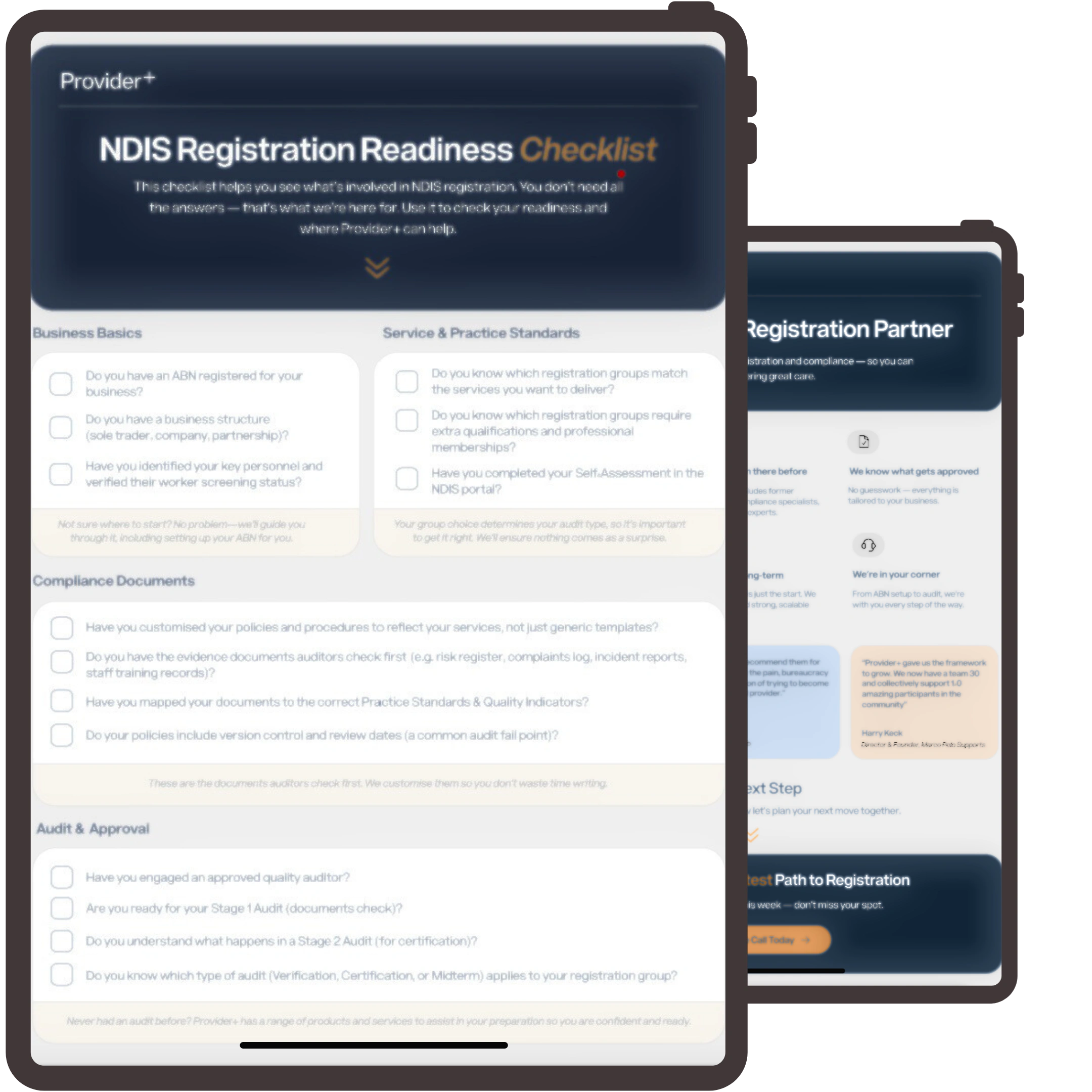
Understand exactly why registration takes 6–12+ months


