


What Happens If You Don't Register for SIL by July 2026?
- SIL registration becomes mandatory from 1 July 2026 under the NDIS Quality and Safeguards Commission with no exemptions.
- All SIL providers must be registered or have an application in progress to continue delivering services.
- New registration group 0138 is introduced for all SIL supports.
- Unregistered providers risk losing the ability to deliver SIL after the transition period.
- Non-compliance can lead to fines, bans, and enforcement action by the regulator.
As of 1 July 2026, mandatory SIL registration has commenced. Every provider delivering SIL supports must now be registered, or have an application underway, with the NDIS Quality and Safeguards Commission. There are no ex s emptions from the requirement. Unregistered providers currently providing SIL will be permitted to continue delivering SIL supports while their application is processed, but this is subject to transitional requirements. As part of the reforms, a new registration group, 0138 – Assistance with Supported Independent Living (SIL) will be introduced from 1 July 2026.
If you are currently delivering SIL without registration, this article explains exactly what happens if you do not register, what it means for your participants, and what enforcement the NDIS Commission can take.
The Minister for the NDIS has been direct: providers who cannot meet registration requirements will need to "shape up or ship out."
The Hard Deadline: What 1 July 2026 Means
On 1 July 2026, the transition to mandatory SIL registration commences. From this date:
- All SIL providers must hold formal NDIS registration or be transitioning to NDIS registration
- Existing providers not registered for SIL but wanting to add 0138, must complete an application for variation
- Existing providers with SIL will automatically transition to 0138
- Unregistered providers currently providing SIL will need to submit an application by the 1st October 2026 to continue delivering SIL supports
- New providers will not be able to provide SIL until the NDIS Commission has granted registration for 0138
- Certification audit will be mandatory
- Providers will be subject to ongoing regulatory monitoring
Refer to the NDIS Commission for further information on transition arrangements:
What Happens If You Continue Delivering SIL Without Registration?
If you continue delivering SIL supports after the transition period without being registered, you face serious consequences.
You Cannot Claim NDIS Payments
Unregistered providers can continue claiming NDIS payments for SIL under code 0138 while their registration application is being assessed — but only if that application is lodged by 1 October 2026. Providers who don't apply by that date can only claim for services delivered up to 30 September 2026; after that, plan managers are directed to reject their invoices. This applies regardless of how the participant's funding is managed:
- Agency-managed participants can only use registered providers (this is already the case)
- Plan-managed participants can currently use a provider that is registered or has an application in progress (lodged by 1 October 2026); once that grace period ends, only registered providers can be used.
- Plan-managed participants will only be able to use registered SIL providers after mandatory registration commences
- Self-managed participants will only be able to use registered SIL providers for SIL supports
NDIS Commission Enforcement Action
The NDIS Quality and Safeguards Commission has enforcement powers it can use against providers operating without required registration. These include:
Compliance notices The Commission can issue a notice requiring you to stop delivering SIL supports immediately.
Infringement notices The Commission can issue fines for breaches of the NDIS Act, including delivering supports without registration when registration is required.
Banning orders The Commission can ban individuals from providing NDIS supports entirely. A banning order can apply to company directors, key personnel, or the organisation itself.
Court action In serious cases, the Commission can pursue civil penalties through the courts.
The Commission has stated it wants "providers to meet clear and consistent standards so participants can feel confident about the supports they receive" and that "registration isn't a once-off exercise, providers must continuously meet quality standards or be held accountable."
Reputational Damage
Operating without required registration signals to participants, families, support coordinators, and the sector that you are unwilling or unable to meet quality and safety standards. This damages your reputation and makes it harder to attract participants, staff, and referrals in the future.
What Happens to Your Participants?
If you do not register, your participants will need to transition to a registered provider. This is disruptive and potentially distressing, particularly for participants with complex needs who rely on continuity of support.
Participants Must Find a New Provider
Participants currently receiving SIL from unregistered providers will need to:
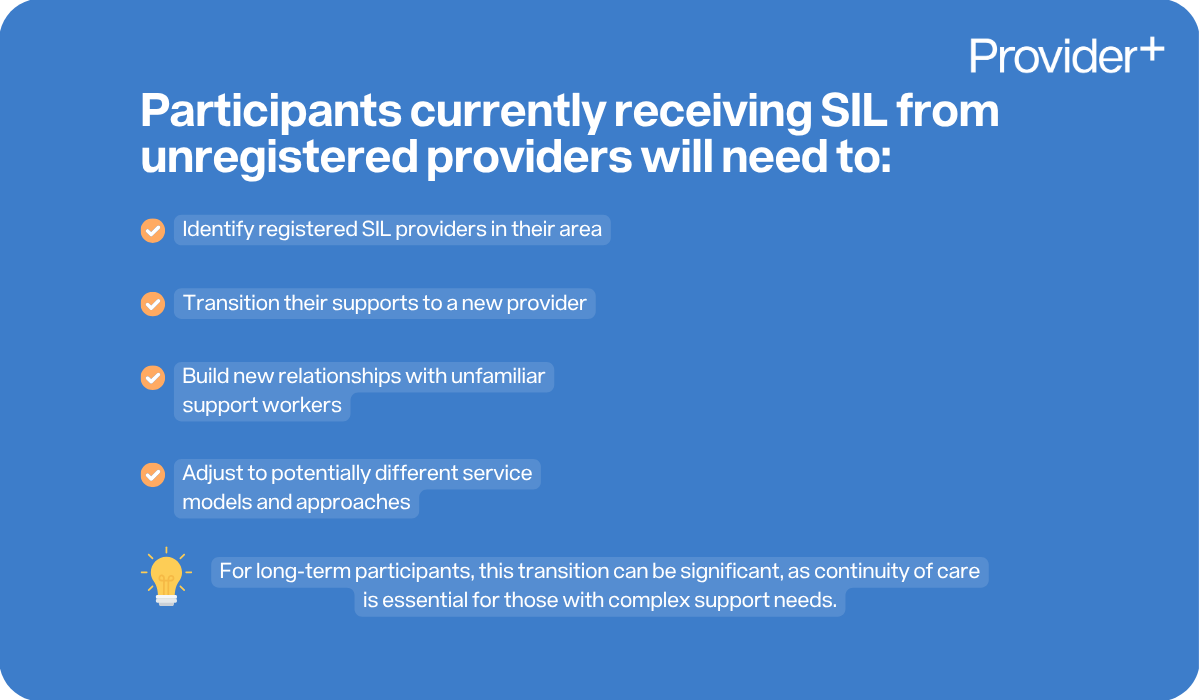
- Identify registered SIL providers in their area
- Transition their supports to a new provider
- Build new relationships with unfamiliar support workers
- Adjust to potentially different service models and approaches
For participants who have been with you for years, this transition can be significant. Continuity of care is important for people with complex support needs.
Risk of Service Gaps
If there are limited registered providers in your area, participants may face service gaps while transitioning. This is a particular concern in rural and regional areas where provider choice is already limited.
Participant Funding Is Not Affected
It is important to note that mandatory registration does not affect participant funding. Participants' NDIS plans, SIL funding, and eligibility remain the same. This is a provider requirement, not a funding change.
However, participants can only spend their SIL funding with registered providers after mandatory registration commences.
Why Some Providers Will Not Make It
The government has acknowledged that not every currently unregistered SIL provider will successfully transition to registration. Some will exit the market.
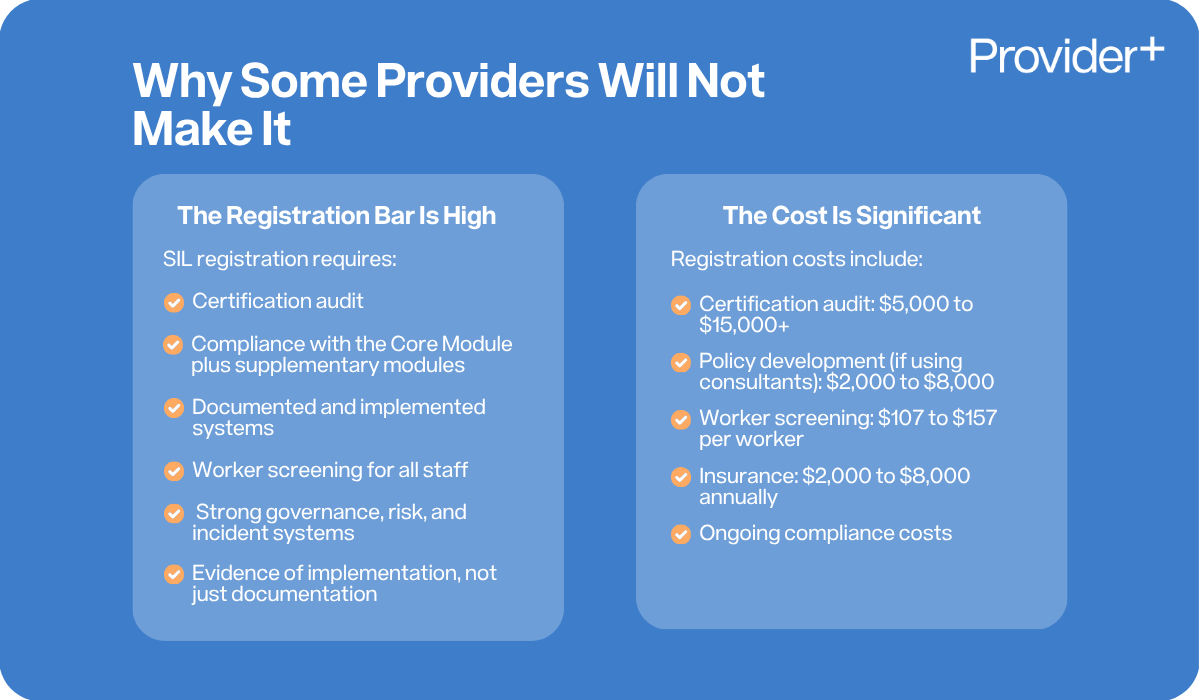
The Registration Bar Is High
SIL registration requires:
- Certification audit (the most comprehensive NDIS audit pathway)
- Compliance with the Core Module, SIL NDIS Practice Standards plus supplementary modules
- Documented policies and procedures that reflect your actual operations
- Worker screening for all staff
- Governance, risk management, and incident management systems
- Evidence of implementation, not just documentation
Providers who have operated without oversight may find significant gaps between their current operations and what registration requires.
The Cost Is Significant
Registration costs include:
- Certification audit: $5,000 to $15,000+
- Policy development (if using consultants): $2,000 to $8,000
- Worker screening: $107 to $157 per worker
- Insurance: $2,000 to $8,000 annually
- Ongoing compliance costs
For smaller providers operating on tight margins, these costs may be prohibitive.
The Preparation Takes Time
Preparation for registration — including internal review, policy development, and audit readiness — can take 6 to 12 months. The formal registration process itself, from application to Commission decision, typically takes 3 to 6 months. If you haven't started preparation, you are already behind.
Some Providers Should Not Be Registered
The Minister has been explicit: "It's likely there are some unregistered providers currently operating who wouldn't meet the high standards required of registered providers."
The intent of mandatory registration is to raise the bar for SIL services. Providers who cannot meet that bar are expected to exit. This is a feature of the policy, not a flaw.
What About Transition Arrangements?
The NDIS Commission has now released transition arrangements.
However, providers should not assume transition arrangements will allow extended unregistered operation. Based on the Commission's public statements, the transition period is intended to allow providers to complete registration, not to continue operating indefinitely without it.
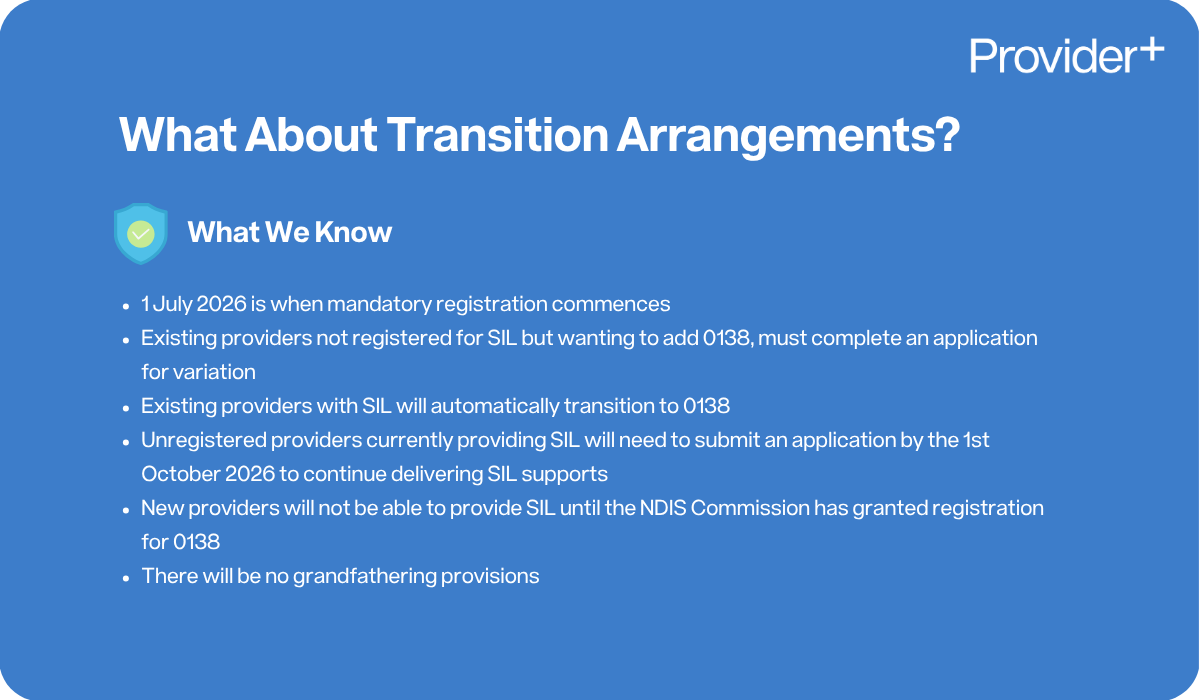
What We Know
- 1 July 2026 is when mandatory registration commences
- Existing providers not registered for SIL but wanting to add 0138, must complete an application for variation
- Existing providers with SIL will automatically transition to 0138
- Unregistered providers currently providing SIL will need to submit an application by the 1st October 2026 to continue delivering SIL supports
- New providers will not be able to provide SIL until the NDIS Commission has granted registration for 0138
- There will be no grandfathering provisions
What About Independent Support Workers?
If you are an independent support worker delivering SIL-funded supports directly to participants, you face the same requirement.
After 1 July 2026, independent workers delivering SIL supports must work under a registered SIL provider organisation. You cannot continue delivering SIL-funded supports independently without registration.
Options for independent workers include:
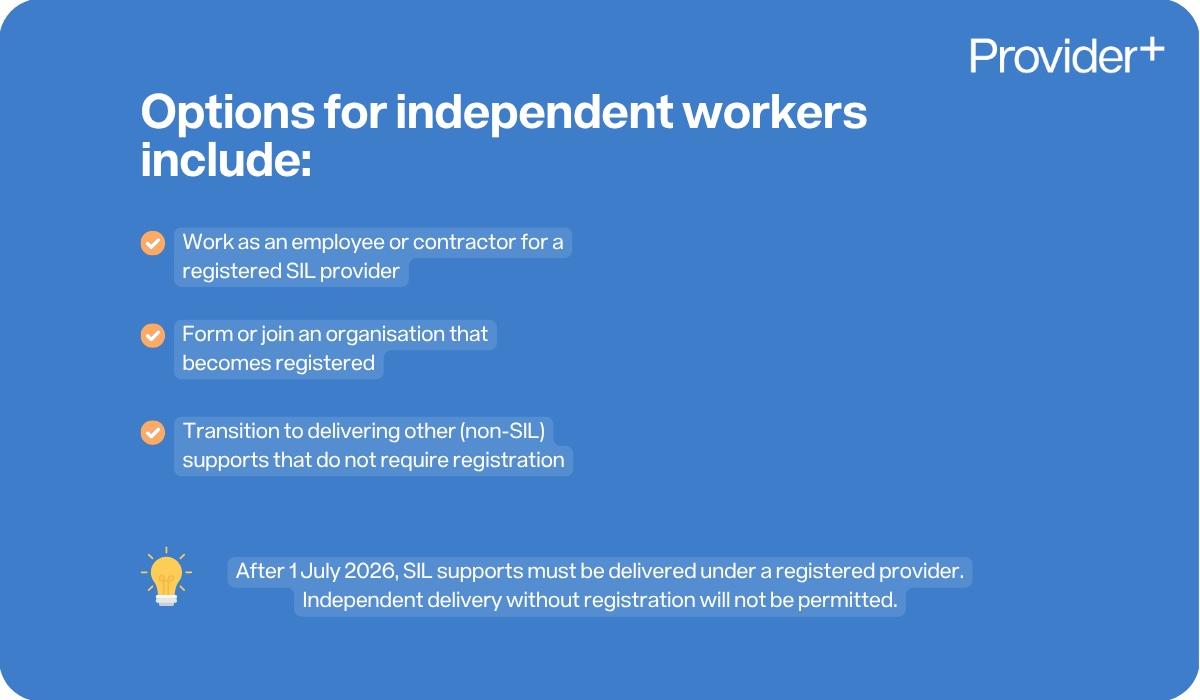
- Work as an employee or contractor for a registered SIL provider
- Form or join an organisation that becomes registered
- Transition to delivering other (non-SIL) supports that do not require registration
Regional and Rural Concerns
The mandatory registration requirement has raised concerns about provider choice in regional and rural areas, where there are already fewer providers.
If smaller, unregistered providers in regional areas cannot afford registration or choose not to pursue it, participants in those areas may have even fewer options.
The NDIS Commission has acknowledged this concern and committed to a "considered transition period" to ensure continuity of support. However, the registration requirement itself will not be waived for regional providers.
If you operate in a regional area, the case for registering is arguably stronger. Participants in your area may have limited alternatives if you exit the market.
What You Should Do Now
If you are currently delivering SIL without registration, you have a decision to make.
Option 1: Register
Begin the registration process immediately and submit your application by 1 October 2026. This means:
- Conduct a gap analysis against the NDIS Practice Standards and the SIL Practice Standards
- Develop or update policies and procedures
- Implement systems and train staff
- Lodge worker screening applications for all workers
- Submit your NDIS registration application
- Book and complete your certification audit
The process takes 6 to 12 months. If you have not started, you are already behind.
Option 2: Exit SIL
If you determine that registration is not viable for your organisation, whether due to cost, capability, or choice, you need to plan your exit responsibly.
This means:
- Communicating early with your participants about your intentions
- Working with support coordinators to identify alternative providers
- Supporting participants through the transition
- Providing adequate notice so participants are not left without supports
Exiting abruptly and leaving participants stranded is not acceptable and could still attract Commission attention.
Option 3: Merge or Partner
If you cannot afford registration independently, consider whether partnering with or merging with a registered provider makes sense. Some smaller providers are choosing to operate under the auspices of larger registered organisations rather than pursuing independent registration.
The Bottom Line
Mandatory SIL registration is happening. The government has made clear that providers who cannot meet the standard will exit the market. The NDIS Commission has enforcement powers to ensure compliance.
If you want to continue delivering SIL supports, you must register. If you do not register, you will not be able to deliver SIL, you will not be paid, and you may face enforcement action.
The time to act is now.
How Provider+ Can Help
Provider+ has helped thousands of providers get registered, pass audits, and maintain compliance. We understand the urgency of the July 2026 deadline and the specific requirements for SIL certification.
We offer:
Dedicated Expert Consultant. A specialist NDIS registration and compliance expert is assigned to guide you 1:1 through your entire registration process, answering your questions and advising you every step of the way.
NDIS Policies, Forms and Procedures. All the policies, forms and procedures required for your registration, designed to pass audit and be practically implemented in your business.
Personal Audit Coach. A structured 6-step program working 1:1 with you to fully prepare for your certification audit, tackling each audit area in sequence from required documents to the questions auditors will ask.
PQM Pro. Our Quality Management System keeps your documentation centralised, version-controlled, and always audit ready.
Start Up Club. Training and support to get your NDIS business operational once registration is complete.
Provider+ Community. An exclusive provider-only platform with live workshops, Q&As, Audit School, and ongoing NDIS business support.
Book a free 30-minute call with our team to clarify the process, confirm you have everything in place, and map out your pathway to registration.
FAQs
Yes, as long as your application is submitted by 1 October 2026 for existing unregistered providers.
After mandatory registration commences, self-managed participants will only be able to use registered providers for SIL supports. The funding management type does not exempt you from the registration requirement.
Yes. The Commission has enforcement powers including compliance notices, infringement notices, banning orders, and court action. The Commission has stated it wants to ensure participants receive safe, quality supports and will hold providers accountable.
Your participants will need to transition to a registered provider. This is disruptive for participants, particularly those with complex needs. If you decide not to register, give your participants as much notice as possible and support them through the transition.
No. There are no exemptions or grandfathering provisions. All providers delivering SIL supports must register. The only way to continue delivering SIL is to complete registration.
Total costs typically range from $8,000 to $25,000+ depending on your organisation's size. This includes the certification audit ($5,000 to $15,000+), insurance, worker screening checks (fee varies by state, confirm current costs on your state portal), policy development, and optional consultant support. The NDIS Commission application itself is free.
If registration is not financially viable, you will need to exit SIL service delivery. Consider whether partnering with or working under a registered provider is an alternative. If you must exit, do so responsibly by supporting your participants to transition to other providers.
Yes. If independent registration is not viable, you can work as an employee or contractor for a registered SIL provider organisation. Your workers can continue supporting participants, just under a registered entity rather than independently.
The Commission has used its enforcement powers in various cases, including banning orders against individuals and compliance action against providers. With mandatory registration for SIL, expect increased enforcement focus on providers operating without required registration.
We strive to keep our content accurate and up to date; however, NDIS Commission rules and requirements can change. For the latest information, visit the NDIS Quality and Safeguards Commission website or contact our team.

Understand exactly why registration takes 6–12+ months


