



What Happens If You "Fail" an NDIS Audit? (Non-Conformities Explained)
What Happens If You "Fail" an NDIS Audit? (Non-Conformities Explained)
You typed "what happens if you fail an NDIS audit" into Google. Thousands of providers do the same thing every month, especially those facing their first certification audit or bracing for a mid-term audit.
Here's what the NDIS Commission won't tell you upfront: technically, you can't "fail" an NDIS audit. That word doesn't appear in their guidelines. What actually happens is you receive a non-conformity. That's the official term for a gap between how you're operating and what the NDIS Practice Standards require.
But when an auditor sits across from you and says there's a problem with your systems, it feels like failing. And what you do next will determine the potential impact on your registration.
The Short Version
Got a non-conformity? You have 7 calendar days to submit a Corrective Action Plan to your auditor.
If it's a minor non-conformity, you get 18 months to fix it. The auditor will check your progress at your next scheduled audit.
If it's a major non-conformity, you have 3 months. A follow-up audit (sometimes called a close-out audit) is required before your auditor can submit their recommendation to the NDIS Commission.
What's the Difference Between Minor and Major?
The type of non-conformity you receive changes everything: your timeline, your workload, and how worried you should actually be.
Minor Non-Conformity
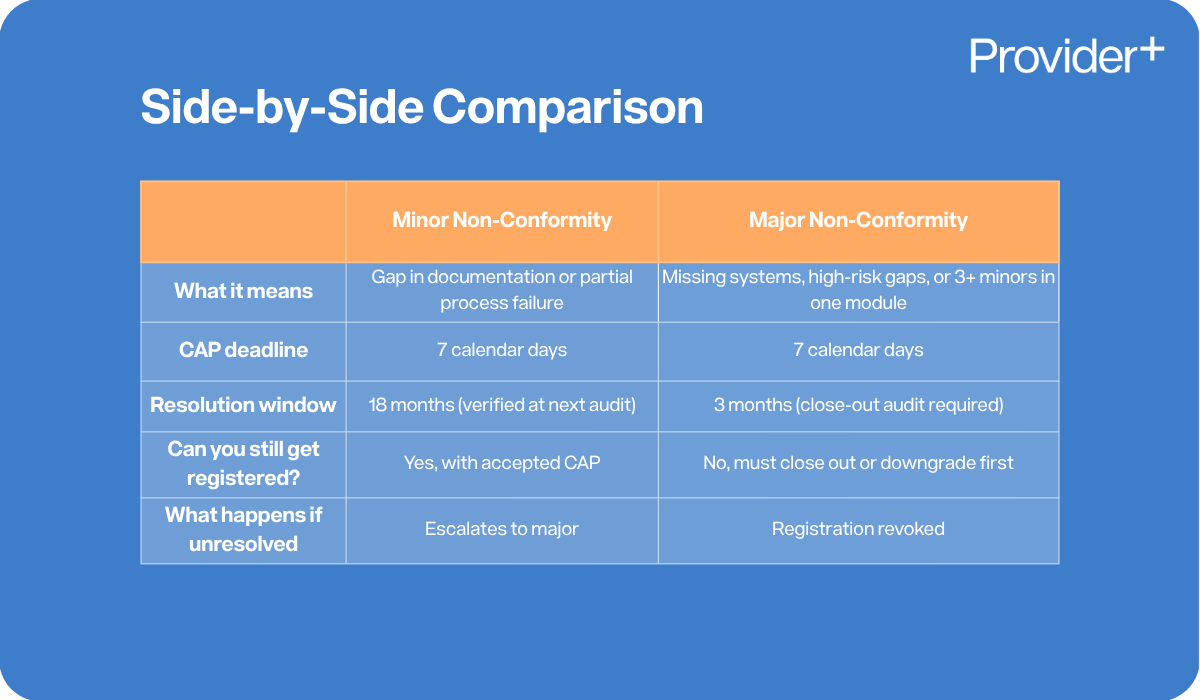
A minor means there's a gap, but participants aren't at serious risk. You might have a policy that exists but lacks the documentation to back it up. Or a process that's partly in place but hasn't been reviewed in a while. Maybe your evidence shows you're doing the right thing sometimes, but not consistently.
With a minor, your auditor can still recommend you for certification and registration. You'll need to submit a Corrective Action Plan within 7 calendar days, then you have 18 months to sort it out properly. They'll verify it at your next mid-term or recertification audit.
One thing catches providers off guard: if you don't close out a minor within 18 months, it automatically becomes a major. And once that happens, you can't get it downgraded back. You'll have 3 months to fix it or face potential impacts to your registration.
Major Non-Conformity
A major is different. It means one of three things:
You can't demonstrate that you have the processes, systems, or structures to meet the required outcomes. Or the gaps you have present a high risk to participants. Or you've racked up three or more minors within the same module.
When you get a major, your auditor cannot recommend you for registration. Full stop. The issue has to be closed out entirely, or at minimum downgraded to a minor, before they can proceed. That means a follow-up audit within 3 months.
If the major isn't resolved or downgraded in that window, you risk the NDIS Commission revoking your registration.
Side-by-Side Comparison
The Corrective Action Process: What Actually Happens
Whether you've received a minor or major, the process kicks off the same way. You need to submit a Corrective Action Plan.
What Goes in a Corrective Action Plan?
Your CAP needs to cover four things:

- The correction. How will you fix the immediate issue?
- Root cause analysis. Why did this happen in the first place?
- The corrective action. What will you change so it doesn't happen again?
- Timeframes and responsibilities. Who's doing what, and by when?
Auditors aren't looking for a perfect document. They want to see that you understand the problem and have a realistic plan to address it. Generic responses that could apply to any provider are a warning sign. Your plan should be specific to your situation.
Timeline for a Minor Non-Conformity
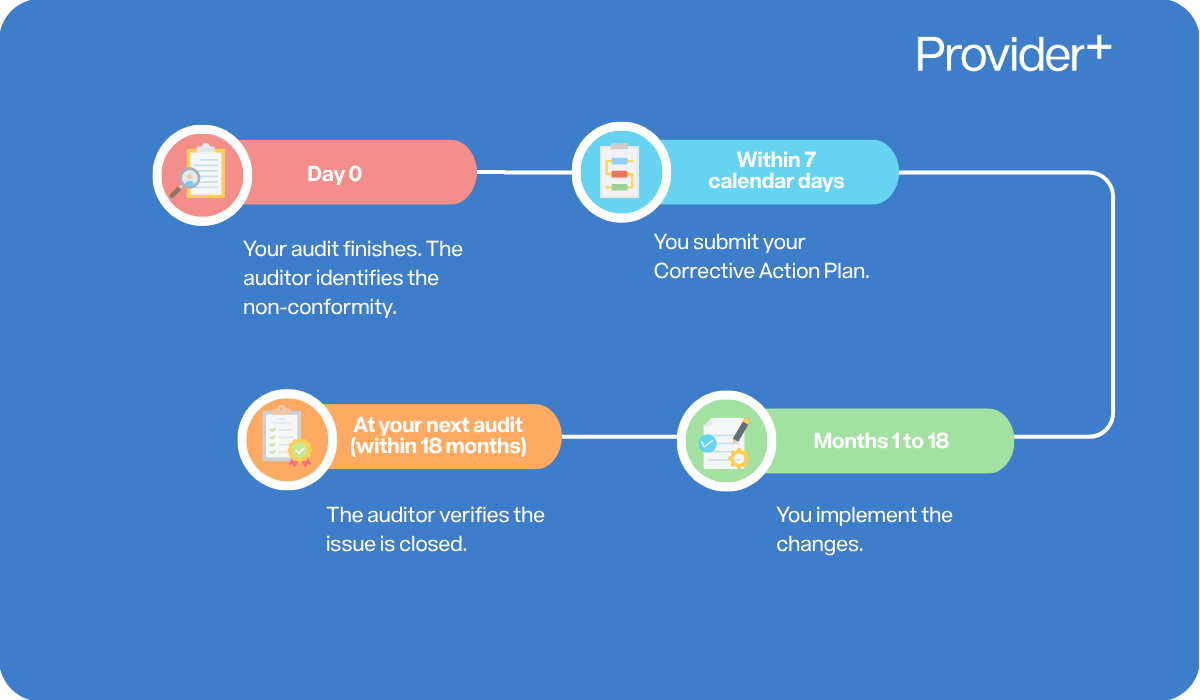
Day 0: Your audit finishes. The auditor identifies the non-conformity. Within 7 calendar days: You submit your Corrective Action Plan. Months 1 to 18: You implement the changes. At your next audit (within 18 months): The auditor verifies the issue is closed.
Timeline for a Major Non-Conformity
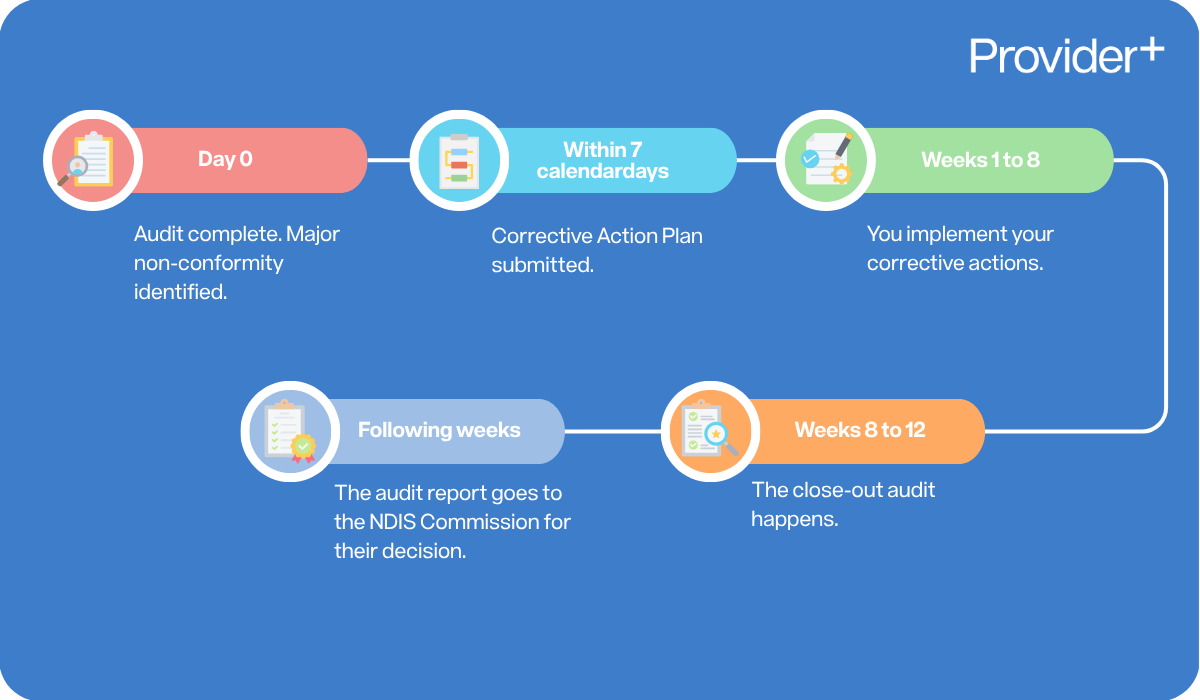
Day 0: Audit complete. Major non-conformity identified. Within 7 calendar days: Corrective Action Plan submitted. Weeks 1 to 8: You implement your corrective actions. Weeks 8 to 12: The close-out audit happens. Following weeks: The audit report goes to the NDIS Commission for their decision.
When a Major Gets Downgraded
Sometimes a major non-conformity gets downgraded to a minor at the follow-up audit. You've made enough progress that the high-risk element is gone, but there's still work to do.
Here's the part that trips people up: you don't get a fresh 18 months. The clock started when you received the original finding. You have 12 months from that date to fully close it out. If your downgrade happened at month 3, you have 9 months left.
Miss that 12-month window and your registration may get revoked.
Where Providers Usually Come Unstuck
If you're going through your first certification audit, or you're moving from unregistered to registered, these are the areas where auditors most commonly find problems.
Incident Management
Having an incident register isn't enough. Auditors want to see that you're actually using it. Are incidents being logged? Investigated? Are you making improvements based on what you learn?
A register that's empty raises questions. A register that hasn't been reviewed in months raises more.
Worker Screening
Every worker delivering NDIS supports needs a valid NDIS Worker Screening Check. They also need to have completed the NDIS Worker Orientation Module. The common issues here are expired clearances, missing documentation, and no system for tracking when renewals are due.
Complaints Handling
You need a documented complaints process that participants and families can access. Auditors will look for evidence that complaints are logged, investigated, and reported to your governing body. If you can't show that trail, expect a finding.
Risk Management
Generic risk registers bought off a template are a common problem. Your risk register should identify risks specific to your service. It should show how you're managing them. It should demonstrate regular review. If it looks like it hasn't been touched since you downloaded it, auditors notice.
Governance
Who's responsible for compliance in your organisation? How do you know your systems are actually working? Auditors want to see clear governance structures and evidence of internal review. Policies sitting in a folder don't cut it.
What If You Don't Fix It?
The NDIS audit process is designed to give providers a chance to improve. But ignoring the opportunity has consequences.
A minor that's unresolved within 18 months automatically escalates to a major.
A major that's unresolved within 3 months may result in the NDIS Commission revoking your registration.
Continued non-compliance leads to the NDIS Commission assessing whether you're suitable to continue operating as an NDIS provider. That can mean registration refusal or cancellation.
Failing a close-out audit is serious. It's not necessarily the end. But it does mean the Commission will look closely at whether you can meet the requirements to deliver safe, quality supports.
Avoiding Non-Conformities Before They Happen
The providers who get through audits smoothly aren't the ones with perfect systems. They're the ones who treat compliance as ongoing work, not a scramble in the weeks before an auditor arrives.
Review your policies, procedures, and evidence against the NDIS Practice Standards before your audit. Work through each area systematically. Find what's missing and address it before the auditor arrives.
Run an internal audit. Walk through your own systems the way an external auditor would. Check your incident register. Check your training records. Check your participant files. If you find gaps, you can address them on your own terms.
Stop relying on generic templates. Auditors can tell when a provider has bought off-the-shelf policies that don't match how they actually operate. Your documentation should describe what you do in practice, not what a template says you should do.
Keep your evidence organised. Auditors have limited time. If they can't find proof of compliance quickly, it creates doubt. Even if the evidence exists somewhere, a disorganised system makes everything harder. Make it easy for them.
Talk to Someone Who's Been on the Other Side
Most providers don't realise how much they're missing until they're sitting across from an auditor. If you've received a non-conformity, or you want to make sure you don't, it helps to get advice from someone who knows what auditors actually look for.
At Provider+, our consultants include former Lead NDIS Auditors who've conducted hundreds of certification audits across every registration group.
Yvette Clark has over 33 years' experience in the disability sector. She's conducted certification audits and technical reviews across all NDIS registration groups. She holds Diplomas in Quality Auditing, Business, and Case Management, with specialist training in Positive Behaviour Support.
Gillian Collis brings 20+ years' experience across NDIS and aged care, including time as a Lead Auditor for Verification, Certification, and SDA audits. She's also held executive leadership roles overseeing compliance for NDIS and aged care providers.
When you work with us, you're getting advice from people who've sat in the auditor's chair. They know the questions. They know the red flags. They know what separates a clean audit from a painful one.
This article was published on 28/04/2026. We strive to keep our content accurate and up to date; however, NDIS Commission rules and requirements can change. For the latest information, visit the NDIS Quality and Safeguards Commission website or contact our team.
Need help with the NDIS?
Fill in the form below to get started.
FAQs
You can't technically "fail" an NDIS audit. What happens is you receive a non-conformity, either minor or major. You then have 7 calendar days to submit a Corrective Action Plan. Minor non-conformities give you 18 months to fix the issue. Major non-conformities require resolution within 3 months, with a follow-up close-out audit.
A major non-conformity means you can't demonstrate the processes, systems, or structures needed to meet the NDIS Practice Standards. It can also mean the gaps you have present high risk to participants. Three or more minor non-conformities in the same module can also add up to a major.
You must submit a Corrective Action Plan within 7 calendar days. For minors, you have 18 months to implement the fix, which gets verified at your next audit. For majors, you have 3 months, and a close-out audit is required.
Yes, if it's a minor and you've submitted an acceptable Corrective Action Plan. Your auditor can recommend registration while the minor is still open. But if you have a major, registration cannot be recommended until the issue is closed out or downgraded.
A close-out audit happens when you have a major non-conformity at your audit. It's conducted within 3 months to verify that you've implemented your corrective actions and the issue is resolved.

Understand exactly why registration takes 6–12+ months


.png)
.png)