



Already an NDIS Provider and Want to Add SIL? The Registration Variation Pathway
If you already hold NDIS registration and you are thinking about adding SIL to what you offer, you are starting from a comfortable position. You are already known to the Commission, already audited, already operating under the Core Practice Standards. The system does not ask you to begin again. It asks you to extend what you already have.
This guide explains how that extension works, the one question that decides how much audit work is involved, and the timing that suits you best. Because you are planning to start SIL rather than already delivering it, the rules are a little different from those facing current SIL providers, and we will be clear about where.
Do I need a whole new registration to add SIL?
No, and this is the part that saves you the most effort. You apply to vary your existing registration to add the relevant SIL registration group, rather than lodging a fresh application as a new provider would. Your existing registration stays in place. The SIL scope is added to it.
You do not need to submit a new registration application. Instead, you apply to vary your existing NDIS registration by adding Registration Group 0138 (Assistance with Supported Independent Living), together with any other applicable registration groups. Your existing registration remains in place while the NDIS Commission assesses your variation.
Why is this a variation and not a new application?
It is worth a moment under the hood, because understanding the logic makes the process feel less daunting.
A new provider has to prove themselves from scratch, against the full set of standards, before the Commission will let them deliver anything. You have already done that. You are inside the system, meeting the Core Practice Standards and subject to oversight. So rather than making you repeat all of that, the Commission lets you add a new support type to your existing registration through a variation. It is the same principle as adding a qualification to a licence you already hold, instead of sitting the whole licence again. The work that remains is focused on the new thing you want to do, which in this case is SIL.
Will I need an audit to add SIL?
This is the question that decides how much is involved, and the honest answer is: it depends, and the decision sits with the Commission. When you apply to vary, the Commission may require an out-of-cycle audit at its discretion, depending on your current scope. Neither we nor your auditor can predict whether they will ask for one.
An out-of-cycle audit simply means an audit that happens outside your normal scheduled audit timetable, brought on specifically to assess you for the new group. If one is required, you engage an Approved Quality Auditor to conduct it. Either way, there is a constant you should plan around: If the NDIS Commission requires an out-of-cycle audit, it will assess your organisation against the published SIL Practice Standards together with the applicable NDIS Practice Standards. If an out-of-cycle audit is not required, compliance with the SIL Practice Standards will be assessed at your next scheduled audit.
Can I deliver SIL while my variation is being processed?
No, and this is the most important difference between you and a provider who already delivers SIL. Because you are not currently delivering SIL, there is nothing to continue. You cannot start delivering SIL until your variation is approved. There is no transitional allowance to begin early, and no 1 October lifeline, because those exist only to protect providers who are already supporting participants. Plan your start date around your approval, not the other way around.
What will I be audited against?
The new SIL Practice Standards rest on four outcomes, and an auditor draws evidence from four places: your documents, your records, what they observe in the service environment, and what your workers and participants say. Since you are adding a new support type, this is where your preparation should concentrate.
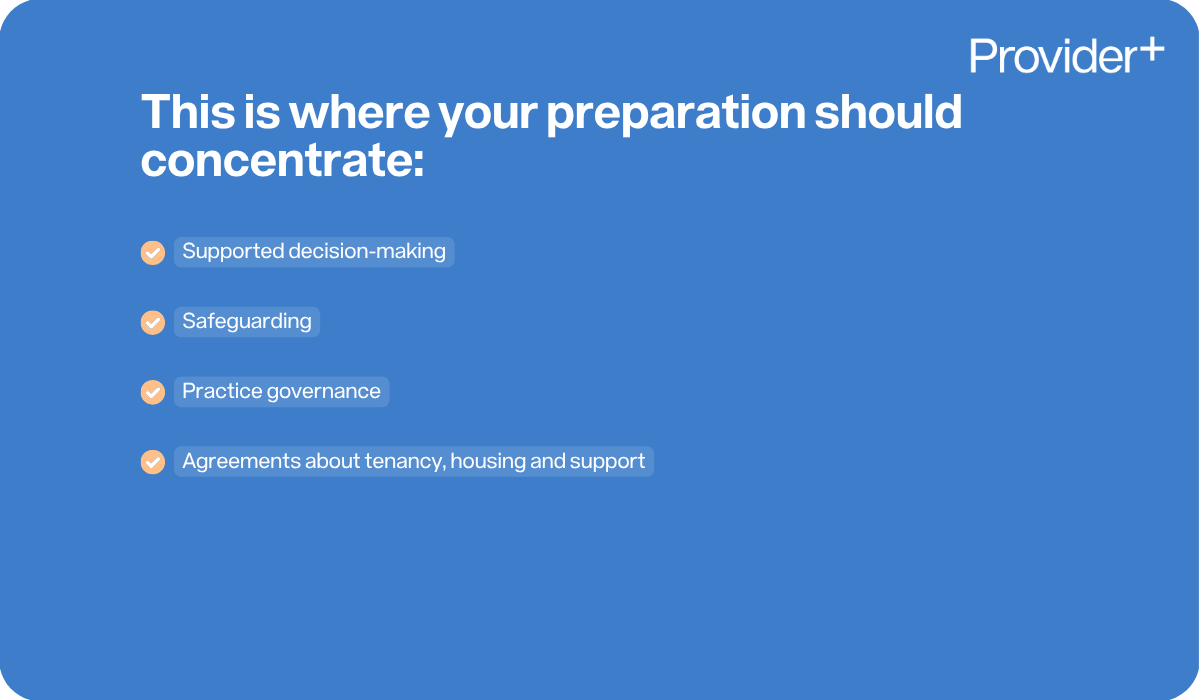
- Supported decision-making. Decisions about a participant's home, routines and relationships are made by them, not for them, with a trail showing how a decision was reached and who was involved.
- Safeguarding. How you prevent, identify and respond to harm: incidents, complaints, risk and restrictive practices, with a working incident register rather than events buried in shift notes.
- Practice governance. Whether your policies, supervision and training describe what actually happens, version-controlled and reviewed.
- Agreements about tenancy, housing and support. Separating the tenancy agreement from the service agreement where you are both landlord and provider, and treating the home as the participant's home first.
These sit on top of the Core Module you already work under. Most SIL providers also need the high intensity daily personal activities module, and the implementing behaviour support module if restrictive practices apply. Workers in risk-assessed SIL roles need a valid NDIS Worker Screening Check clearance, so check your team's coverage early.
What does it cost and how long does it take?
The good news for your position is that adding a group by variation is generally lighter work than registering from scratch, because your core systems are already in place. The NDIS Commission charges no fee for the variation itself. Where costs arise, they sit with the auditor if an out-of-cycle audit is required, plus any new policies, evidence and worker screening specific to SIL. Auditor fees are set by the auditor rather than the Commission and vary by scope, so it is worth understanding what your auditor's assessment will involve.
On timing, a variation can move faster than a full new registration, but it is still not instant, and if an out-of-cycle audit is needed you should allow time for it. Since you cannot deliver SIL until approval, the sensible approach is to begin the variation well ahead of when you want to start.
What if my variation isn't approved?
If your variation is not approved, you cannot deliver SIL. Your existing registration for your other supports is unaffected, so this is not a risk to your current business, but it does mean SIL stays off the table until you can satisfy the requirements. The way to avoid that outcome is the same as for any provider: prepare properly against the new standards and put strong evidence in front of your auditor.
What should I do now?
- Confirm the SIL registration group you need for the supports you intend to deliver.
- Engage an Approved Quality Auditor to discuss your variation, and be ready for an out-of-cycle audit if the Commission requires one.
- Prepare against the four SIL Practice Standards, focusing on the practice that is new for you.
- Begin the variation well ahead of your intended start date, since you cannot deliver SIL until it is approved.
How Provider+ can help
Provider+ helps registered providers add SIL through variation: confirming the right registration group, preparing against the new SIL Practice Standards, and getting your evidence and policies ready for the auditor's assessment.
This guide is general information for SIL providers. It is not legal advice and is not a substitute for the NDIS Practice Standards, the NDIS Act, or guidance from your approved quality auditor. For the authoritative and current position, see the NDIS Commission Reform Hub.
We strive to keep our content accurate and up to date; however, NDIS Commission rules and requirements can change. For the latest information, visit the NDIS Quality and Safeguards Commission website or contact our team.
FAQs
No. If you are already a registered NDIS provider without group 0115, you apply to vary your existing registration to add the SIL group, rather than lodging a new application.
Possibly. The Commission may require an out-of-cycle audit at its discretion, depending on your current scope. If one is required, you engage an Approved Quality Auditor to conduct it. Either way, you will be assessed against the new SIL Practice Standards at your next audit after the variation.
No. Because you are not already delivering SIL, you cannot start until your variation is approved. There is no transitional allowance to begin early.
Registered NDIS providers apply to vary their existing registration to add Registration Group 0138 (Assistance with Supported Independent Living) together with any other applicable registration groups.
You cannot deliver SIL, though your existing registration for other supports is unaffected. Preparing thoroughly against the new standards is how you avoid that outcome.

Understand exactly why registration takes 6–12+ months
.png)
