


New to SIL? Registering as a SIL Provider After 1 July 2026
In short: If you plan to start delivering Supported Independent Living (SIL) and you are not already registered, applying after 1 July 2026 means you apply directly for registration group 0138, and your audit always includes the new SIL Practice Standards. You cannot deliver SIL until your registration is approved. There is no transitional allowance to begin early, because that only protects providers already delivering.
Status update, 10 June 2026: The new SIL Practice Standards are in final draft, with the final version expected before 1 July 2026. Your audit will include them, so prepare against the draft now. We'll update this guide when the final standards land. Last updated: 10 June 2026.
If you are planning to move into SIL and you expect to apply after 1 July 2026, the picture is actually a little simpler than it is for those racing the deadline, and it helps to understand why. By the time you apply, the new system is fully in place. You are not navigating a transition. You are joining the scheme as it now stands. This guide lays out what that looks like, step by step, and where your one real choice sits.
Whether you are an unregistered provider adding SIL or completely new to the NDIS, the route is the same. For the wider context and the reasons behind the reform, see our main guide to SIL mandatory registration.
Does this pathway apply to me?
This guide is for you if you plan to start delivering SIL, you are not already registered for it, and you expect to apply after 1 July 2026, in either of these situations:
- You are an unregistered provider, perhaps delivering other supports, and you want to add SIL.
- You are not currently an NDIS provider at all, and you are entering the market as a new SIL provider.
Both situations follow the same route, because neither involves an existing registration to vary. If you are already a registered provider, your path is a lighter variation instead, covered in our variation pathway guide.
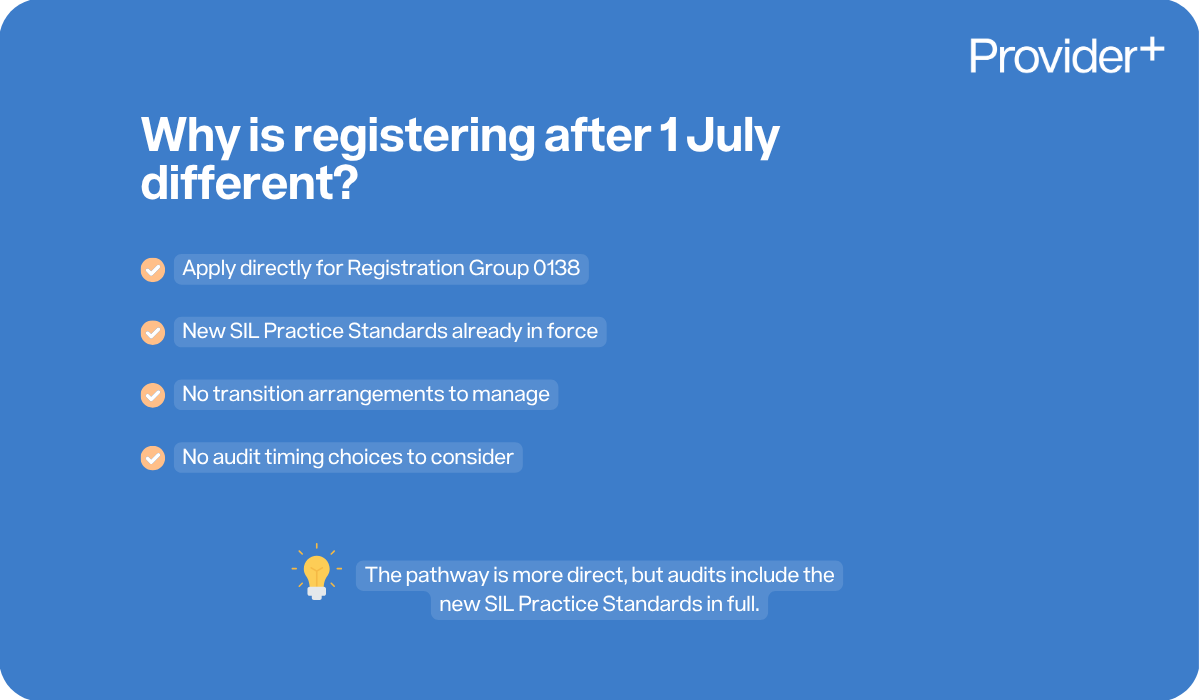
Why is registering after 1 July different?
A short look under the hood makes the rest of this guide click into place.
Before 1 July 2026, the new SIL registration group and the new standards are still arriving, so providers applying in that window deal with a transition: they apply under the old group, get the new one added, and may have an audit that predates the new standards. After 1 July, all of that has settled. The new group exists, the new standards are in force, and you simply apply into the system as it is. That is why your path is more direct. There is no transition to manage, because the transition is over by the time you arrive.
The trade-off is that you also miss the one concession the transition offered, which was the chance of a lighter, pre-standards audit. We will come back to that.
What do I apply for?
You submit a valid registration application directly for group 0138 (Assistance with supported independent living), together with any other support classes you intend to deliver. Because the new group already exists after 1 July, there is no 0115-to-0138 step to think about. You apply for 0138 from the outset. Once your application is lodged, you receive a scope of audit setting out what you will be assessed against.
Will my audit include the new SIL Practice Standards?
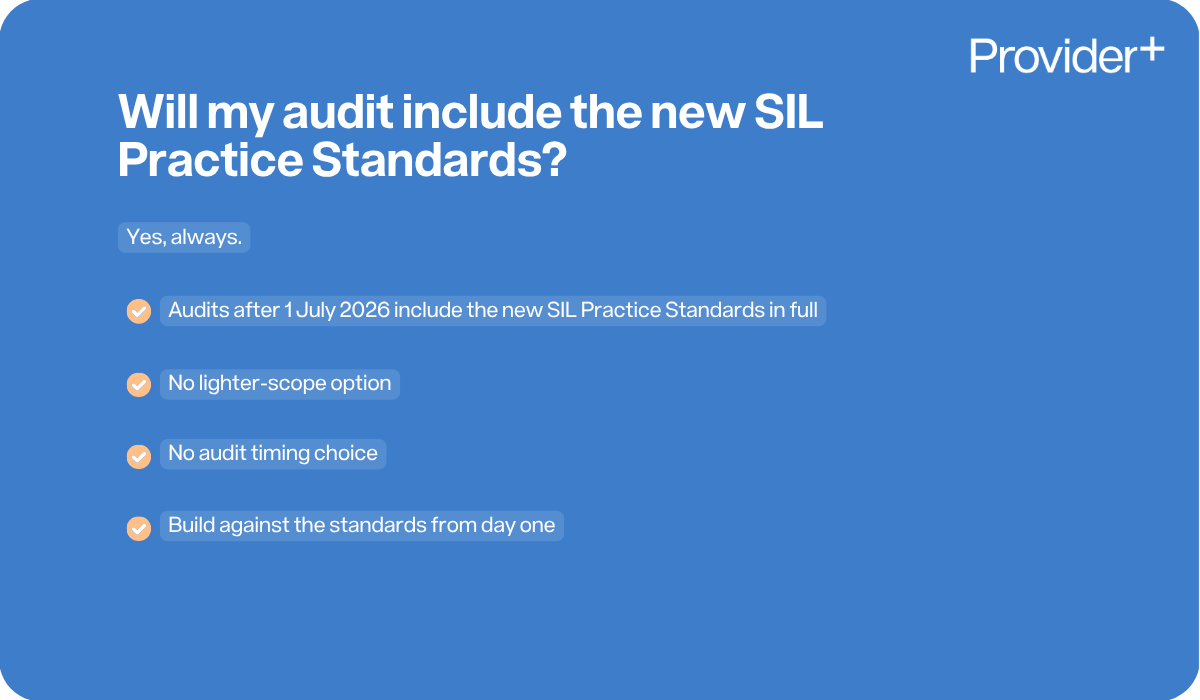
Yes, always. Since your audit takes place after the standards are in force, it includes the new SIL Practice Standards in full, every time. There is no lighter-scope option and no audit-timing choice to weigh, which in one sense makes your planning easier: you know exactly what you are being assessed against, so you can build towards it from day one rather than wondering which version of the audit you will get.
Can I deliver SIL while I wait?
No. Because you are not already delivering SIL, there is nothing to continue, and there is no transitional allowance that lets you begin before approval. You also do not have a 1 October deadline, and it is worth being clear about why: that date exists to protect providers who are already supporting participants and need to keep going while they register. You are not in that position, so it does not apply to you. Your situation is simpler and stricter at once. You cannot deliver SIL until your registration is approved, full stop. Plan your launch and your first participants for after that approval.
What will I be audited against?
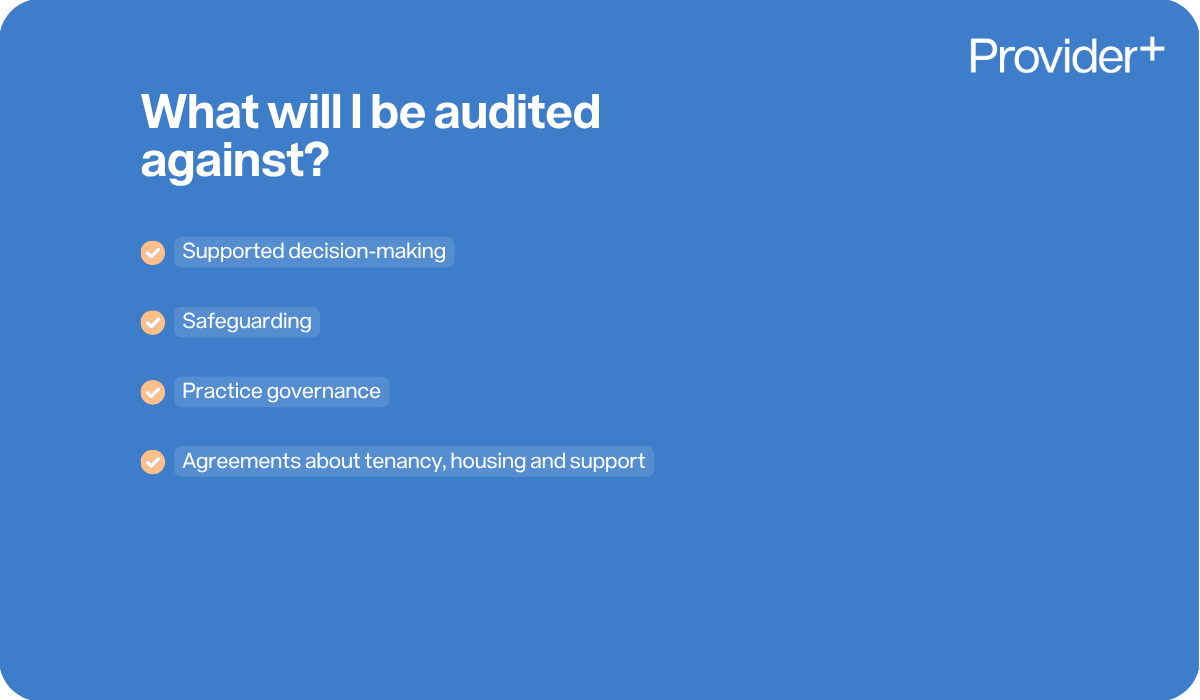
The draft SIL Practice Standards rest on four outcomes, and an auditor draws evidence from four places: your documents, your records, what they observe in the service environment, and what your workers and participants say. As a new SIL provider, this is where to concentrate, because you are building these from the ground up.
- Supported decision-making. Decisions about a participant's home, routines and relationships are made by them, not for them, with a trail showing how a decision was reached and who was involved.
- Safeguarding. How you prevent, identify and respond to harm: incidents, complaints, risk and restrictive practices, supported by a working incident register.
- Practice governance. Whether your policies, supervision and training describe what actually happens, version-controlled and reviewed.
- Agreements about tenancy, housing and support. Separating the tenancy agreement from the service agreement where you are both landlord and provider, and treating the home as the participant's home first.
These sit alongside the Core Module, which as a new provider you are assessed against too. Most SIL providers also need the high intensity daily personal activities module, and the behaviour support module if restrictive practices apply. Every worker in a risk-assessed role needs a valid NDIS Worker Screening Check clearance, and clearances take weeks, so start them early.
Is it better to apply before 1 July instead?
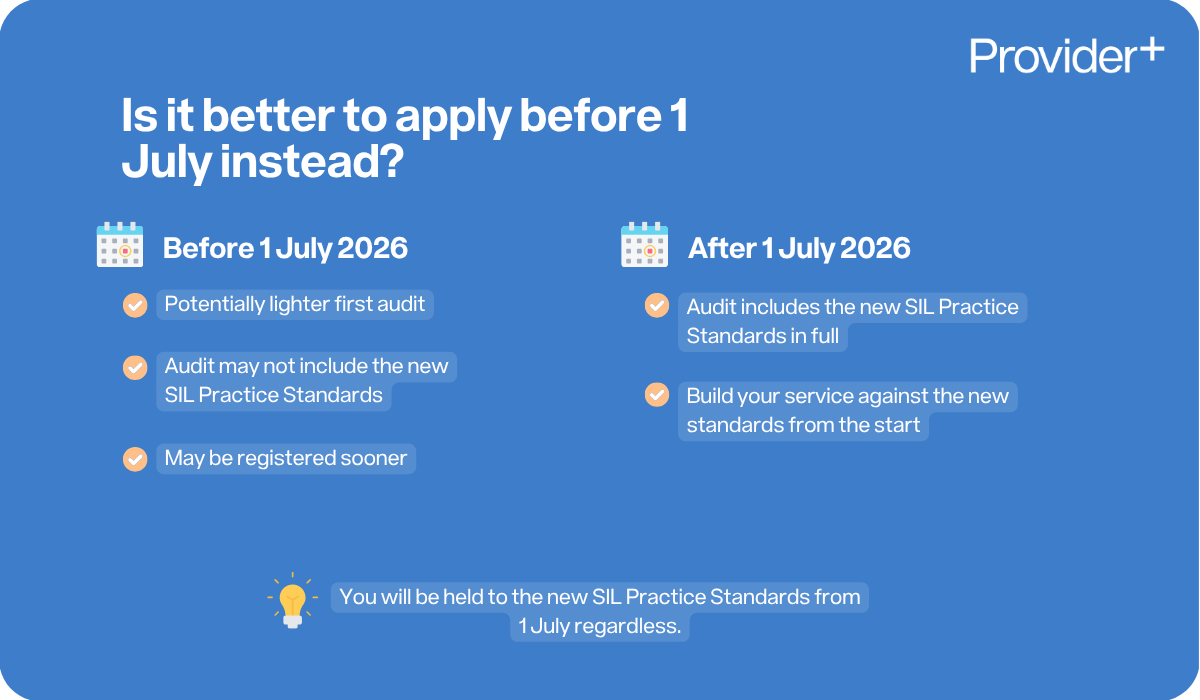
This is the one genuine choice in front of you, and it deserves an honest answer rather than a nudge. Nothing forces a new provider to apply after 1 July. If your plans allow, applying before it can mean a lighter first audit that does not include the new standards, which may get you registered a little sooner.
That said, the advantage is smaller than it looks. You will be held to the new SIL Practice Standards from 1 July regardless, so the work of meeting them does not go away, it only shifts in time. For many new providers, building the service properly against the new standards from the start is cleaner than chasing an earlier audit and then catching up. The right call depends on how ready you are and how soon you want to open your doors.
What does it cost and how long does it take?
The NDIS Commission charges no fee for the application itself. The real costs sit with the auditor, insurance, worker screening and your own setup. Because SIL requires the more thorough certification pathway, audit fees run higher than for low-risk verification, and as a new provider you are also building policies, systems and insurance from scratch. The Commission does not set audit fees, so they vary by auditor and by the size and complexity of your planned service, which makes getting more than one quote worthwhile.
On timing, allow six to twelve months end to end, from starting preparation to holding a certificate. Since you cannot deliver SIL until approval, that timeline is your runway to launch, so the earlier you begin preparing, the sooner you can take on participants.
What if I'm not approved?
If your application is not approved, you cannot deliver SIL, as there is no partial approval. For a new provider this is a delay to your launch rather than a threat to an existing business, but it is still worth avoiding. Strong policies, real evidence and a genuine grasp of the four standards are what get you approved the first time.
What should I do now?
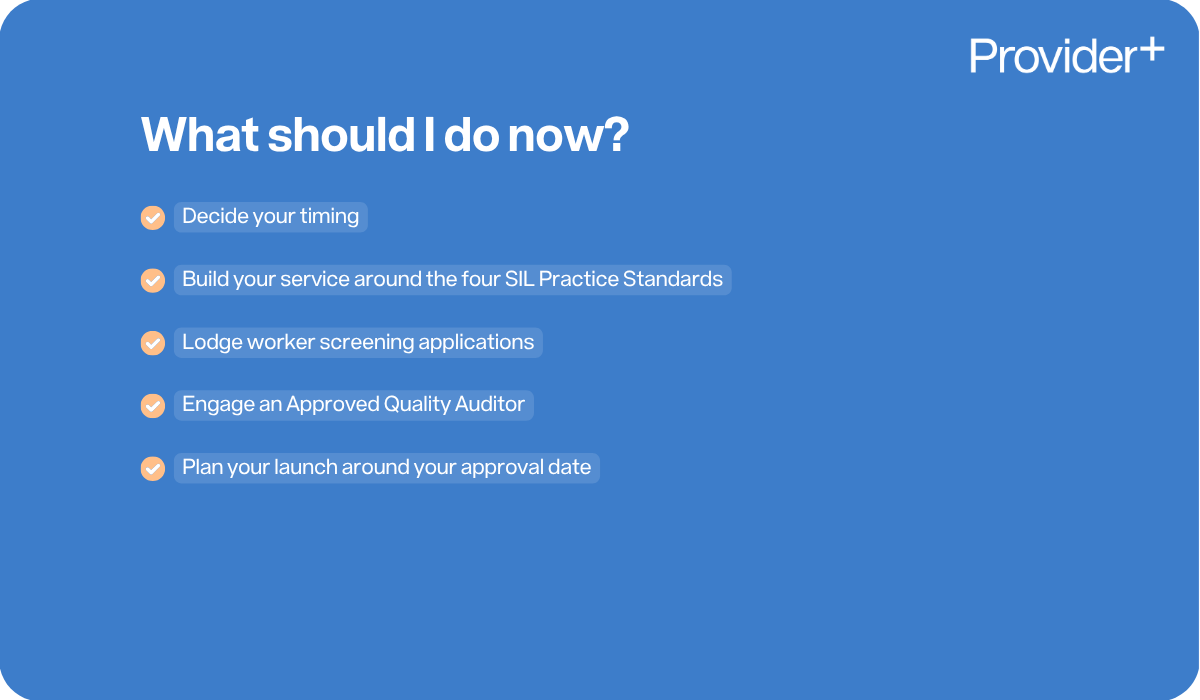
- Decide your timing, weighing an after-1-July application against applying earlier.
- Build your service around the four SIL Practice Standards from the start, since your audit will include them in full.
- Lodge worker screening applications for your team early.
- Engage an Approved Quality Auditor and confirm your scope of audit.
- Plan your launch around your approval date, not before it.
How Provider+ can help
Provider+ helps new and unregistered providers register to deliver SIL: building the policies, systems and evidence the new SIL Practice Standards require, confirming the right registration groups, and guiding you through the audit so you launch on solid ground.
Frequently asked questions
I'm new to SIL and applying after 1 July. What do I apply for? You apply directly for registration group 0138 (Assistance with supported independent living), plus any other relevant support classes. Because the new group already exists after 1 July, there is no 0115-to-0138 transition step.
Will my audit include the new SIL Practice Standards? Yes. Because your audit takes place after 1 July 2026, it always includes the new SIL Practice Standards in full. There is no lighter-scope option for applicants after this date.
Can I deliver SIL while my application is processed? No. Because you are not already delivering SIL, there is no transitional allowance to begin early. You must wait until your registration is approved.
Is there a 1 October deadline for me? No. The 1 October 2026 date applies to providers already delivering SIL who need to keep operating while they register. As a new provider, it does not apply to you; you simply cannot deliver SIL until your registration is approved.
Should I apply before 1 July instead? You can. Applying before 1 July may give you a lighter first audit that excludes the new standards, but you will be held to those standards from 1 July regardless. Whether an earlier application is worth it depends on your readiness and how soon you want to start.
This guide is general information for SIL providers. It is not legal advice and is not a substitute for the NDIS Practice Standards, the NDIS Act, or guidance from your approved quality auditor. For the authoritative and current position, see the NDIS Commission Reform Hub.
This article was published on 19/06/2026. We strive to keep our content accurate and up to date; however, NDIS Commission rules and requirements can change. For the latest information, visit the NDIS Quality and Safeguards Commission website or contact our team.

Understand exactly why registration takes 6–12+ months
.webp)
.webp)
