Who Can Deliver NDIS Early Intervention Support? Module 3, Registration 0118 & Eligibility
- Registration Group 0118 - Early Intervention Supports for Early Childhood applies to providers delivering early childhood intervention supports to children younger than nine years of age.
- Providers registered for 0118 must also demonstrate compliance with Module 3 of the NDIS Practice Standards.
- Early childhood intervention is delivered using a family-centred, evidence-informed and transdisciplinary approach, rather than isolated therapy.
- Early Childhood Teachers, Developmental Educators and allied health professionals each have an important role in supporting children's development.
- A Key Worker acts as a central point of contact, bringing together families and the transdisciplinary team to ensure supports are coordinated, consistent and focused on the child's goals.
Early Childhood Intervention Is About More Than Therapy
When most people think about early childhood intervention, they immediately think of therapy sessions.
In reality, early childhood intervention is much broader than this.
For children younger than nine years of age, early childhood supports are designed to help children participate in everyday life by building their communication, learning, independence, relationships and social participation. Rather than focusing on one professional or one therapy discipline, the NDIS encourages a collaborative approach where families, educators and health professionals work together to achieve meaningful outcomes for the child.
This is why the NDIS created Registration Group 0118 – Early Intervention Supports for Early Childhood.
Providers registered under 0118 deliver supports that are specifically designed for young children with developmental delay or disability and their families. These providers must also meet the additional requirements contained within Module 3 of the NDIS Practice Standards, recognising that early childhood intervention requires a different approach to many other NDIS supports.
What is Registration Group 0118?
Registration Group 0118 – Early Intervention Supports for Early Childhood allows registered NDIS providers to deliver early childhood intervention services to children younger than nine years of age.
These supports are not limited to clinic-based therapy. Instead, they are designed to help children develop functional skills within the environments where they naturally live, learn and play, including:
- the family home;
- early childhood education settings;
- community environments; and
- other everyday settings that support participation and development.
Unlike many disability services, early childhood intervention recognises that families are central to a child's development. Parents and carers are active participants in the support process and are supported to build the skills and confidence to continue implementing strategies between professional visits.
Choice and Control: Choosing the Right Early Childhood Provider
One of the fundamental principles of the NDIS is that children and their families should have genuine choice and control over the supports they receive. Choosing an early childhood provider is about more than finding someone who can deliver a service—it is about finding a team that understands your child, respects your family's goals and works collaboratively to achieve meaningful outcomes.
Every child and family is different. The right provider for one family may not be the right fit for another. Families should feel empowered to ask questions, understand how supports will be delivered and decide whether the provider's approach aligns with their child's individual needs, communication style, routines and family values.
How Your NDIS Plan Affects Provider Choice
While the NDIS promotes choice and control, the providers a participant can engage will depend on how their NDIS funding is managed.
Agency-managed funding
Where funding is managed by the NDIA, supports that require a registered provider must generally be delivered by an NDIS-registered provider. Families seeking Early Intervention Supports for Early Childhood under Registration Group 0118 will therefore usually need to engage a provider that holds the appropriate NDIS registration.
Plan-managed funding
Participants whose funding is plan managed generally have greater flexibility and can choose to engage either registered or unregistered providers, provided the supports are consistent with their NDIS plan and the applicable NDIS rules.
Self-managed funding
Self-managed participants generally have the broadest level of choice and control and can usually engage either registered or unregistered providers, provided the supports meet the requirements of the NDIS.
Finding the Right Fit
Choosing an early childhood provider should never be based solely on availability. Families should feel confident that the provider can deliver supports in a way that reflects their child's strengths, goals and individual needs.
When selecting a provider, families may wish to consider:
- the provider's experience supporting children with similar developmental needs;
- whether their approach is family-centred and evidence-informed;
- how they involve parents and carers in planning and decision-making;
- whether they use a Key Worker approach and collaborate effectively with the transdisciplinary team;
- how they communicate with families and other professionals;
- whether they can provide continuity of supports; and
- whether the child and family feel comfortable and supported by the professionals delivering services.
A strong relationship between the child, family and provider is one of the most important factors in achieving positive early childhood outcomes.
Changing Providers
Choice and control also means families can make decisions when a provider is no longer the right fit.
There may be many reasons why a family chooses to change providers, including changing support needs, relocation, differences in service delivery, availability of specialised expertise or simply finding a provider whose approach better aligns with the family's goals and preferences.
A quality provider should support this process professionally by:
- working collaboratively with the incoming provider;
- ensuring appropriate consent is obtained before sharing information;
- providing timely clinical handover information and relevant reports;
- minimising disruption to the child's supports;
- supporting continuity of care; and
- placing the child's best interests at the centre of all transition planning.
Provider transitions should be viewed as an opportunity to maintain continuity of supports rather than a disruption to the child's development. Effective collaboration between providers helps ensure families continue to receive high-quality, coordinated early childhood intervention throughout the transition.
Supporting Choice Through Collaboration
High-quality early childhood intervention is built on partnerships. Providers should work alongside families, recognising that parents and carers know their child best and play the most important role in supporting their child's development.
Supporting choice and control means listening to families, respecting their decisions, adapting supports as the child's needs change and working collaboratively with other professionals to achieve shared goals.
When families are empowered to make informed decisions and providers work together respectfully, children are more likely to receive consistent, coordinated and meaningful supports that build their confidence, independence and participation in everyday life.
Why Module 3 Matters
Registration Group 0118 is only one part of becoming a registered provider.
Providers delivering Early Intervention Supports for Early Childhood must also comply with Module 3 of the NDIS Practice Standards.
Module 3 recognises that quality early childhood intervention is fundamentally different from many other disability services. Rather than focusing solely on the child, providers must demonstrate that their services are:
- family-centred;
- evidence-informed;
- collaborative;
- outcome-focused;
- delivered in everyday environments; and
- designed to build the capacity of both the child and their family.
These additional requirements ensure providers deliver coordinated supports that promote long-term developmental outcomes rather than isolated interventions.
Module 3 sits alongside the Core Module of the NDIS Practice Standards. For a closer look at what the Practice Standards cover more broadly, see our guide: What Are the NDIS Practice Standards and Why Do They Matter?
The Key Worker: The Conduit Between the Child, Family and Transdisciplinary Team
One of the defining features of Registration Group 0118 is the Key Worker approach.
The Key Worker acts as a central point of contact, ensuring everyone involved in the child's supports is working towards the same goals. The Key Worker may be an Early Childhood Teacher or an allied health professional, depending on the child's needs and the service's approach. For example, an Occupational Therapist may provide therapy while also taking on the Key Worker role.
Rather than families having to coordinate multiple professionals independently, the Key Worker helps bring the team together, promotes consistent communication and supports the implementation of strategies across the child's everyday environments.
The Key Worker acts as the conduit between:
- the child;
- parents and carers;
- Early Childhood Teachers;
- Developmental Educators;
- Occupational Therapists;
- Speech Pathologists;
- Physiotherapists;
- Psychologists; and
- other professionals involved in the child's supports.
A Transdisciplinary Approach
Early childhood intervention uses a transdisciplinary approach, where professionals work across disciplinary boundaries to develop a shared language and framework for supporting the child and family.
Unlike a multidisciplinary approach, where professionals from different fields typically maintain their own disciplinary perspectives and boundaries, a transdisciplinary approach encourages professionals to share knowledge, collaborate across disciplines and work towards common goals.
This approach can help reduce duplication, improve communication and ensure strategies are implemented consistently across the child's home, education and community environments.
The Key Worker may be one of the professionals delivering direct support and does not necessarily have a separate coordination role. Depending on the child's needs and the service model, an Early Childhood Teacher or allied health professional may take on the Key Worker role while also providing their professional support.
Importantly, a Key Worker is not the same as a Support Coordinator.
While a Key Worker helps coordinate the child's transdisciplinary team as part of early childhood intervention, Support Coordination is a separate NDIS support with different registration requirements and funding arrangements.
The Role of an Early Childhood Teacher
Early Childhood Teachers have specialist knowledge of child development, learning and participation. Within early childhood intervention, their role extends far beyond teaching. They work alongside families and other professionals to build children's skills through play-based, evidence-informed strategies that promote participation across home, early learning environments and the community.
Working collaboratively with families and the transdisciplinary team, they develop strategies that support children to:
- participate in learning;
- build communication skills;
- develop social relationships;
- improve independence; and
- achieve meaningful developmental outcomes through play-based learning.
For NDIS claiming purposes, an Early Childhood Teacher must also meet the professional qualification and registration requirements specified within the NDIS Pricing Arrangements.
The Role of a Developmental Educator
Developmental Educators bring a unique perspective to early childhood intervention by supporting children's development across multiple domains rather than focusing on a single therapy discipline. Their role is to help children develop the practical skills needed to participate successfully in everyday life while supporting families to implement strategies that continue outside formal intervention sessions.
Like Early Childhood Teachers, Developmental Educators must meet the qualification and professional requirements applicable to their NDIS support items.
A Transdisciplinary Approach in Practice
Each professional brings their own expertise while working collaboratively across disciplinary boundaries. Rather than operating in isolation, the team shares knowledge and strategies to develop a more consistent approach around the child and family.
Depending on the child's goals, the transdisciplinary team may include:
- Early Childhood Teachers
- Developmental Educators
- Occupational Therapists
- Speech Pathologists
- Physiotherapists
- Psychologists
- Social Workers
- Dietitians
- Exercise Physiologists
- Music Therapists
- Art Therapists
- Therapy Assistants
The Key Worker may be one of these professionals, depending on the child's needs and the service model. For example, an Occupational Therapist may provide occupational therapy while also acting as the child's Key Worker.
This collaborative approach helps ensure supports remain coordinated and consistent across the child's home, education and community environments.
Which early childhood professionals can deliver these supports?
The NDIS Pricing Arrangements and related pricing guidance specify professional categories and requirements for early childhood intervention support items.
Depending on the applicable support item, these can include:
- Early Childhood Teachers or Educators
- Early Childhood Special Education Teachers
- Developmental Educators
- Dietitians
- Occupational Therapists
- Physiotherapists
- Psychologists
- Speech Pathologists
- Social Workers
- Exercise Physiologists
- Counsellors
- Music Therapists
- Art Therapists
- Orientation and Mobility Specialists
- Podiatrists
- Other Early Childhood Intervention Professionals
- Therapy Assistants at the applicable level
For teaching roles specifically, the relevant categories include Early Childhood Teacher or Educator and Early Childhood Special Education Teacher.
Developmental Educators have a separate professional definition and support item requirements.
Always check the current NDIS Pricing Arrangements and the individual support item before claiming, because professional definitions and claiming requirements can change.
Professional Qualifications Matter
One of the most common misconceptions is that all Early Childhood Educators can claim the same NDIS support items. This is not the case. Eligibility to claim depends on the professional qualifications, registration or accreditation requirements specified within the NDIS Pricing Arrangements.
The NDIS pricing guidance defines an Early Childhood Teacher or Educator as a person who has a bachelor's degree or higher in Early Childhood Education or Special Education, with current registration or accreditation with the relevant state or territory professional body where applicable.
This means job titles should not be treated as interchangeable.
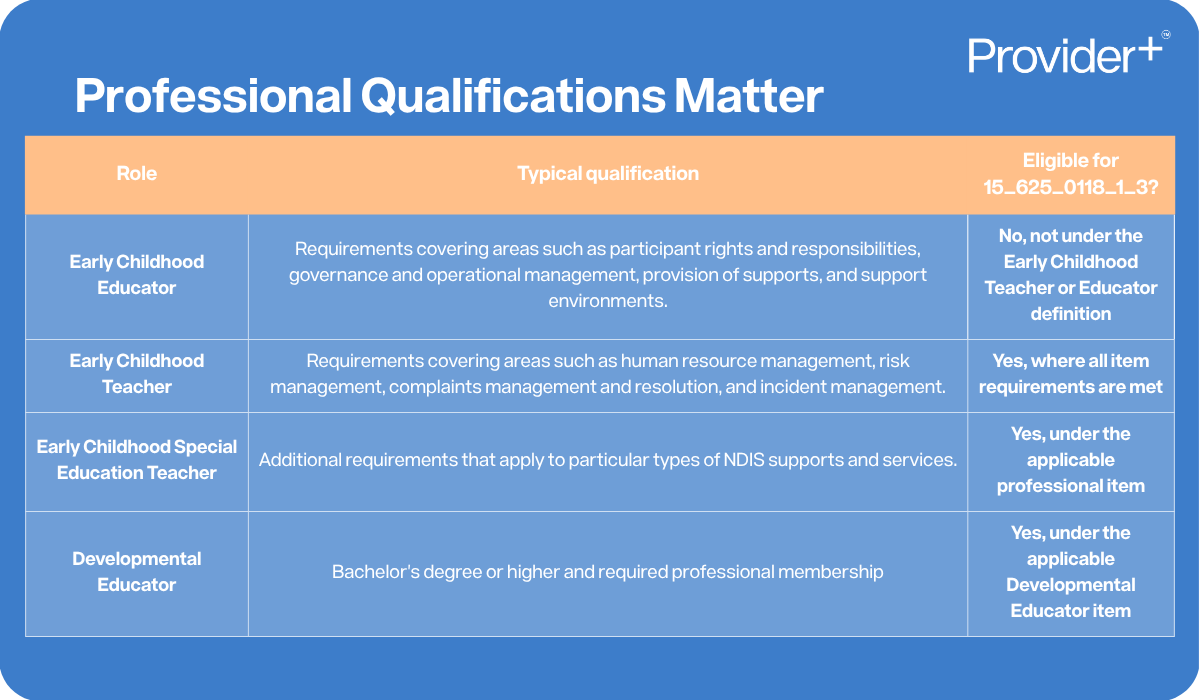
A Certificate or Diploma-qualified early childhood educator is not necessarily excluded from working in an early childhood intervention service. However, they cannot simply claim the Early Childhood Teacher or Educator item because their job title is similar.
A suitably qualified person may instead be able to work as a therapy assistant, where the requirements for the relevant therapy assistant item, including appropriate delegation and supervision, are met.
Building a Capable Workforce
Registration under 0118 is about more than employing appropriately qualified professionals. Providers must also demonstrate they have appropriate governance, workforce capability, supervision and systems to safely deliver early childhood intervention services.
For the provider, registration group 0118 and the applicable Practice Standards requirements determine what the organisation needs to demonstrate through the registration and audit process.
For individual workers, the relevant support item definition determines whether they meet the professional requirements for claiming that item.
In practice, providers should be prepared to evidence matters such as:
- A bachelor's degree or higher where required for the relevant professional category
- Current professional registration or accreditation where applicable
- Relevant professional membership where required
- A Working with Children Check or equivalent state/territory requirement
- An NDIS Worker Screening Check where required
- Relevant experience in early childhood intervention
- Experience working with children with disability or developmental delay
- Capability to work within a transdisciplinary or collaborative framework
- Appropriate continuing professional development
- Appropriate supervision, delegation and competency arrangements for therapy assistants
State and territory professional registration is not one national system. For example, teaching registration requirements differ between jurisdictions.
The relevant authority depends on where the professional works and whether registration or accreditation applies to that specific role. Providers should confirm the current requirements with the relevant state or territory authority.
What does Module 3 require you to demonstrate?
Module 3 recognises that successful early childhood intervention depends on much more than professional qualifications. Providers must demonstrate that they deliver family-centred, collaborative and evidence-informed services that improve outcomes for children and their families.
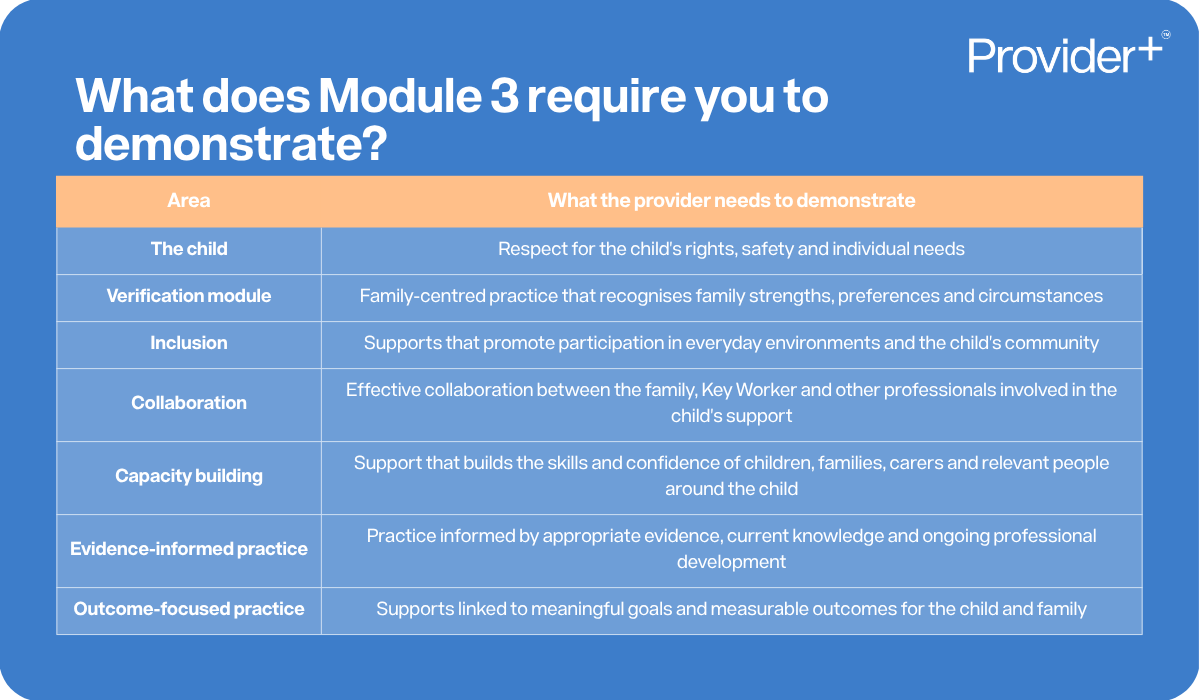
Through our Audit Coaching Support, our expert consultants can guide you on how to demonstrate all above areas and more. If you want our support or have questions, book a free consultation today.
How does NDIS funding work for early childhood supports?
Many providers assume there is a dedicated "early childhood budget" within an NDIS plan. In practice, funding is allocated across different support categories, with Early Intervention Supports for Early Childhood commonly funded through Capacity Building – Improved Daily Living where the support meets the NDIS requirements.
Core Supports
Core funding can cover eligible supports such as assistance with daily living, social and community participation, consumables or other approved Core supports.
Capacity Building – Improved Daily Living
This is a key funding category for early childhood intervention. The NDIS pricing guidance includes Early Intervention Supports for Early Childhood in this category, as well as various assessment, therapeutic, training, strategy development and capacity-building supports.
Capital Supports
Capital funding can cover approved higher-cost items such as certain assistive technology or home modifications where these have been included in the participant's plan.
The exact funding arrangements depend on the participant's plan and how funding has been allocated.
Is the funding split by profession?
Not necessarily.
There is not automatically a separate NDIS budget for occupational therapy, speech pathology or early childhood teaching.
A participant may have funding available under Capacity Building – Improved Daily Living, with providers claiming against the relevant support items for the services they deliver.
For example, an eligible occupational therapist may claim an applicable occupational therapy early childhood item, while an eligible early childhood teacher may claim 15_625_0118_1_3.
The important distinction is:
The participant's plan determines the available funding and funding categories; the applicable NDIS support item determines what the provider can claim for the support delivered.
Providers should always check the participant's current plan, funding management type, service agreement and the current Pricing Arrangements before delivering or claiming supports.
What can an Early Childhood Teacher or Educator claim?
For the 2026–27 NDIS Pricing Arrangements, the price limits for 15_625_0118_1_3 – ECI Professional: Early Childhood Teacher or Educator are:
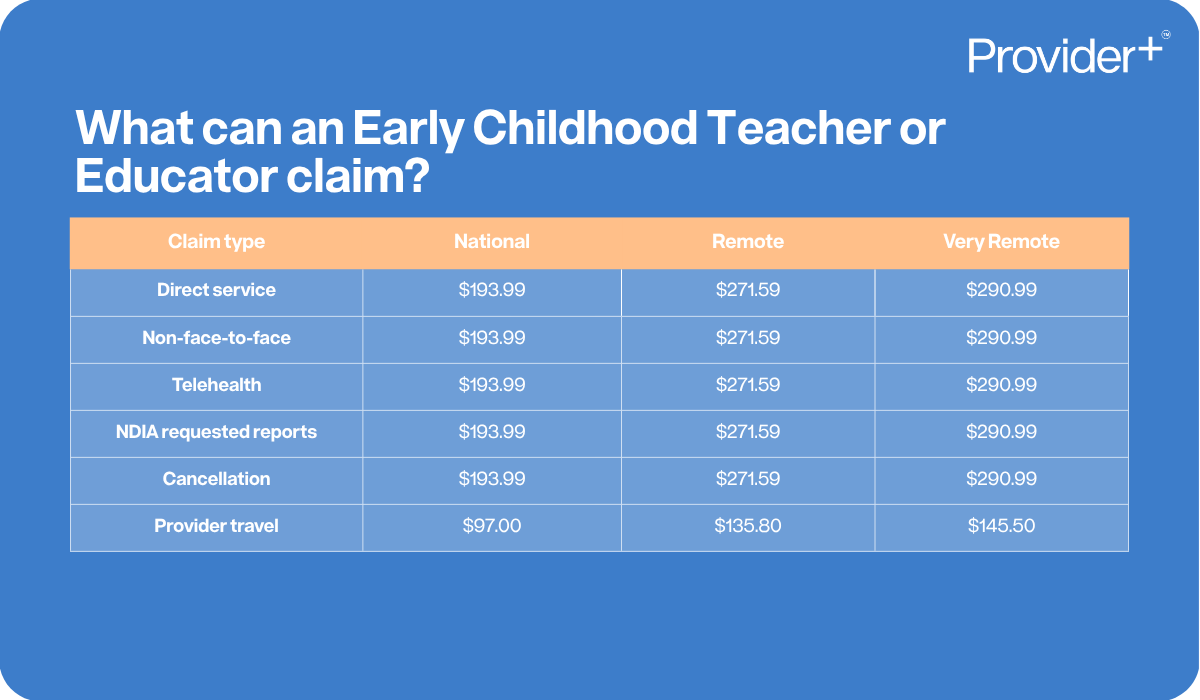
Provider travel is limited to 50% of the applicable direct service price limit under the relevant pricing rules.
Short Notice Cancellations and other claim types are subject to the specific requirements in the current NDIS Pricing Arrangements.
Providers must claim against the support item that most accurately reflects the support delivered. Where the NDIS provides a specific professional item, providers should not substitute a different professional category simply because it has a similar description or price.
For example, an eligible Early Childhood Teacher or Educator should claim against the applicable Early Childhood Teacher or Educator item rather than using an “Other Early Childhood Intervention Professional” item simply because it is available.
Final Thoughts
Registration Group 0118 is about much more than delivering therapy to children younger than nine years of age. It is about creating a collaborative, family-centred service where Early Childhood Teachers, Developmental Educators, allied health professionals and a Key Worker work together to support meaningful outcomes for children and their families.
Providers considering registration under 0118 need more than appropriately qualified professionals. They need strong governance, evidence-informed practice, effective transdisciplinary collaboration and systems that support families throughout their early childhood intervention journey.
Understanding how Registration Group 0118, Module 3, professional eligibility and participant funding fit together is the first step towards delivering high-quality early childhood supports that make a lasting difference.
What should you check before you register?
Before applying for registration group 0118, work through the following checklist:
1. Define the service
Confirm that your organisation will deliver Early Intervention Supports for Early Childhood and that the service is appropriate for the children and families you intend to support.
2. Select registration group 0118
Apply for Registration Group 0118 – Early Intervention Supports for Early Childhood.
If your organisation is already registered, check whether you need to apply for a variation to add the registration group.
3. Confirm the applicable audit pathway
Prepare for the audit pathway applicable to registration group 0118 and ensure your systems address both the Core Module and the applicable Module 3 requirements.
4. Define your professional roles
Clearly identify whether workers are:
- Early Childhood Teachers or Educators
- Early Childhood Special Education Teachers
- Developmental Educators
- Other Early Childhood Intervention Professionals
- Allied health professionals
- Therapy assistants
- Other relevant workers
5. Check each support item
Match each professional's qualifications, registration or membership requirements to the NDIS support item they intend to claim.
6. Check state or territory requirements
Confirm professional registration, accreditation and Working with Children requirements applicable to each worker's jurisdiction and role.
7. Check worker screening
Ensure workers meet the relevant NDIS Worker Screening Check and other screening requirements that apply to their role.
8. Check experience and competency
Ensure the workforce has appropriate early childhood intervention experience and can work collaboratively across disciplines and everyday environments.
9. Build Module 3 systems
Develop policies, procedures, records and evidence that address the applicable Module 3 requirements.
10. Match supports to participant funding
Before delivering supports, understand the participant's funding arrangement and which plan budget and support item applies.
11. Document the service arrangement
Use an appropriate service agreement and schedule of supports that clearly identifies the services being provided, applicable rates and funding arrangements.
Need help getting registered for Module 3? We’ve guided thousands of providers through registration and audit. Let’s discuss what it will look like for you. Book a free consultation today.
Need help with the NDIS?
Fill in the form below to get started.
FAQs
No. Module 3 is part of the NDIS Practice Standards for providers delivering Early Intervention Supports for Early Childhood under Registration Group 0118. Capacity Building – Improved Daily Living is a participant funding category that can fund eligible early childhood intervention supports.
A Diploma-qualified educator cannot claim the Early Childhood Teacher or Educator item because they work in an early childhood setting. A Diploma-qualified worker may be able to work in another capacity, such as a therapy assistant, where the relevant requirements are met.
Where applicable, yes. The relevant professional definition requires current registration or accreditation with the applicable state or territory professional body.
No. Registration Group 0118 covers Early Intervention Supports for Early Childhood and has supplementary requirements under Module 3. Registration Group 0128 – Therapeutic Supports is a separate registration group.
Registration Group 0118 covers Early Intervention Supports for Early Childhood for children younger than nine, including supports involving their families or carers.
A Key Worker is a professional who works closely with the child and family and helps coordinate the team around the child. The Key Worker may be an Early Childhood Teacher or an allied health professional, such as an Occupational Therapist, who may also provide therapy. A Key Worker is not the same as a Support Coordinator and does not create a separate NDIS registration group.
It depends on the participant's funding management arrangement and the specific support. Agency-managed participants generally need registered providers for supports that require registration, while plan-managed and self-managed participants may have greater choice.

Understand exactly why registration takes 6–12+ months
.png)