What Are NDIS Staff File Requirements? Records, Screening, Training and Supervision
- NDIS staff files should show that workers are suitable, qualified, trained, and supported to deliver safe and quality supports.
- Before an NDIS audit, providers should review staff records to make sure evidence is complete, accurate, and easy to access.
- Staff files generally include employment and role records, recruitment checks, worker screening, qualifications, induction, training and ongoing workforce management records.
- Staff file evidence does not fundamentally change because a provider undergoes a verification or certification audit.
- Additional evidence may apply depending on the worker's role, the registration groups and supports delivered, and requirements for qualifications, professional registration, competency or participant-specific training.
- Providers should have systems for monitoring expiry dates, refresher training and ongoing worker capability.
What Should Be Included in Staff Files for an NDIS Audit?
NDIS staff files should contain evidence that workers are suitable for their role and have the skills, knowledge, and support needed to provide NDIS supports.
Under the NDIS Practice Standards, providers must maintain records relating to worker qualifications, experience, induction, training, and workforce management processes.
A staff file should include:
Not every worker will require exactly the same evidence. The worker's role and the supports they deliver should determine the qualifications, registrations, screening, training and competency evidence required.
For example, a worker delivering a support requiring specific professional qualifications or registration will require evidence relevant to those requirements, while a disability support worker delivering different supports may have different training and competency requirements.
This guide focuses specifically on staff files. For the full picture of what an NDIS audit covers, see our guide: Preparing for Your NDIS Audit – A Provider's Guide.
Why Do NDIS Auditors Review Staff Files?
NDIS auditors review staff files to check whether a provider's workforce systems are operating effectively. Staff records help demonstrate that workers are appropriately recruited, trained, supervised, and supported.
The NDIS Practice Standards framework requires providers to ensure workers have the qualifications, experience, and skills needed for their roles. During an audit, an auditor may review evidence such as:
- Worker recruitment records.
- Qualifications and experience documents.
- Induction records.
- Training completion records.
- NDIS Worker Screening records.
- Supervision records.
- Performance management records.
A provider should be able to explain:
- How workers are selected.
- How worker suitability is checked.
- How workers are trained.
- How worker capability is monitored.
- How workforce risks are managed.
What Do NDIS Auditors Look For in Staff Files?
NDIS auditors check staff files to confirm that workforce processes are documented and followed in practice.
A well-organised staff file should allow an auditor to answer:
The NDIS Commission requires registered providers to identify risk-assessed roles and keep records relating to workers engaged in those roles. These records must be organised, accessible, and maintained appropriately.
Does Staff File Evidence Change by Audit Pathway?
No. The fundamental staff file evidence remains the same regardless of whether the provider is undergoing a verification or certification audit.
A worker does not require one type of staff file for verification and another for certification.
What changes is the scope of the audit and the requirements that apply to the provider and individual worker.
The evidence required in a particular worker's file will depend on factors such as:
- the worker's position and responsibilities;
- the supports they deliver;
- the provider's registration groups;
- applicable NDIS Practice Standards or supplementary modules;
- whether the role requires a particular qualification;
- professional registration or licensing requirements;
- NDIS Worker Screening requirements;
- state or territory requirements such as a WWCC;
- support-specific training;
- participant-specific training; and
- competency requirements associated with the supports being delivered.
Verification and Certification
Verification applies to providers delivering lower-risk, lower-complexity supports and services. The audit is a desktop review of documentary evidence against the Verification Module.
For staff files, this can include evidence such as:
- Worker identity and right-to-work records
- Pre-employment checks
- Relevant qualifications and experience
- Mandatory NDIS worker orientation
- Continuing professional development
- Required training and refresher training
- Other workforce records relevant to the provider's scope
The NDIS Commission's Verification Module specifically requires providers to maintain records demonstrating worker identity, right to work, pre-employment checks, qualifications and/or experience, mandatory NDIS orientation and continuing professional development.
The focus is on whether the required documentary evidence can demonstrate conformity with the applicable Verification Module requirements.
Certification: Documentary Evidence and Implementation
A verification audit is primarily a documentary assessment against the applicable verification requirements.
A certification audit assesses the provider against the Core Module and applicable supplementary modules and includes assessment of both the provider's systems and their implementation.
This difference in audit methodology does not mean the provider should maintain a different type of staff file.
For example, evidence of a worker's:
- identity;
- employment;
- qualifications;
- experience;
- screening;
- induction;
- training; and
- applicable professional credentials
should be maintained according to the worker's role regardless of audit pathway.
During a certification audit, however, the auditor may go further in testing how workforce systems operate in practice. This may include sampling worker files, interviewing workers and examining whether training, supervision and competency requirements are actually being implemented.
Registration Groups Can Change the Evidence Required
The more important question is not "Am I verification or certification?" but "What requirements apply to this worker and the supports they deliver?"
Certain registration groups and supports may require additional evidence relating to:
- qualifications;
- professional registration;
- licences;
- specialist competencies;
- high intensity support training;
- behaviour support or restrictive practice training;
- participant-specific training; or
- other specialised capabilities.
Providers should therefore develop a core staff-file structure that applies across the workforce and then identify additional role-specific requirements for each worker.
What Worker Screening Records Should Be Kept in NDIS Staff Files?
NDIS providers should keep worker screening records for workers who are required to have an NDIS Worker Screening Clearance. These records help demonstrate that the provider has met its obligations to manage worker suitability and participant safety.
Registered providers must identify risk-assessed roles and keep written records about workers engaged in those roles. These records must be organised, accessible, and maintained appropriately.
For workers in risk-assessed roles, staff files should include:
- Worker's full name.
- Date of birth.
- Risk-assessed role or roles performed.
- NDIS Worker Screening Check application reference number.
- NDIS Worker Screening Check number.
- Clearance expiry date.
- Any relevant screening decisions, such as suspension or exclusion information where applicable.
- Records of actions taken by the provider relating to worker screening matters.
Providers should also maintain a record of their organisation's risk-assessed roles. The NDIS Commission requires providers to record details such as the role title, why the role is considered risk-assessed, the date it was assessed, and who completed the assessment.
What Is the Difference Between NDIS Worker Screening and a WWCC?
NDIS Worker Screening and Working With Children Checks (WWCC) are different checks. NDIS Worker Screening applies specifically to certain roles within the NDIS, while WWCC requirements depend on state or territory child safety laws and the worker's role.
The NDIS Commission manages the NDIS Worker Screening requirements for registered providers. Workers in risk-assessed roles must have an NDIS Worker Screening Clearance unless an approved exception applies.
A WWCC is a separate child safety check. Providers may need to keep WWCC records when workers are required to hold one because of the supports they deliver or the state or territory where they operate.
Staff files should clearly separate these checks.
For a closer look at each of these checks individually, see our guides on the NDIS Worker Screening Check and the Working With Children Check (WWCC).
What Other Pre-Employment Checks Should Be Kept in NDIS Staff Files?
Providers should keep records of relevant recruitment and suitability checks completed before a worker begins delivering supports.
The NDIS Practice Standards require providers to have systems for managing workers, including processes relating to worker qualifications, experience, induction, and training. Depending on the worker's role and the provider's processes, staff files may include:
Providers should document how they assess worker suitability and make sure records are consistent across the workforce.
What Qualifications and Professional Records Should Be Maintained?
Providers should maintain evidence of qualifications, licences and professional registrations where these are required for the worker's role or the supports they deliver.
Evidence may include:
- qualifications and certificates;
- professional registration;
- practising certificates;
- licences;
- relevant experience; and
- competency evidence.
Where a qualification, registration or licence has an expiry or renewal requirement, the provider should have a process for monitoring it.
The important question is whether the worker has the qualifications, skills, knowledge and experience required for their actual role.
What Training Records Do You Need for an NDIS Audit?
NDIS providers should keep training records that show workers have the knowledge and skills needed for their roles, and these are the records an auditor will ask to see.
The NDIS Workforce Capability Framework describes the skills, knowledge, and behaviours expected from workers supporting people with disability. Providers can use this framework to support workforce planning, recruitment, training, and development. Training records may include:
Training records should clearly identify:
- the worker;
- training completed;
- completion date;
- provider/trainer where relevant;
- competency outcome where applicable; and
- renewal or refresher date where required.
A training certificate alone does not necessarily demonstrate worker capability. Where competency is important to the safe delivery of a support, providers should also consider how competency is assessed and maintained.
How Do You Demonstrate Worker Capability During an NDIS Audit?
Providers show worker capability by demonstrating how they recruit, train, supervise, and support workers.
The NDIS Workforce Capability Framework explains that capable workers need the right combination of attitudes, skills, and knowledge to support people with disability. Evidence may include:
- supervision;
- competency assessments;
- performance reviews;
- worker feedback;
- coaching;
- professional development;
- additional training following incidents or identified gaps; and
- performance or capability improvement processes.
The level and type of monitoring should be appropriate to the worker's role and the risks associated with the supports they deliver.
During an audit, providers should be able to explain how they make sure workers remain capable of performing their roles.
What Supervision and Performance Records Should Be Included?
Supervision and performance records should show how providers support workers after employment begins.
These records demonstrate that workforce management is ongoing and not limited to recruitment.
Examples include:
- Supervision meeting notes.
- Performance reviews.
- Feedback discussions.
- Coaching records.
- Development plans.
- Capability improvement actions.
Under the NDIS Practice Standards, providers are expected to have workforce systems that support worker capability and effective service delivery.
Common Staff File Gaps Auditors Find
Staff files can contain gaps that make it difficult for providers to demonstrate that workers are suitable, qualified, trained and capable of performing their roles.
Common areas to check include:
- Missing or outdated worker details
- Incomplete pre-employment checks
- Qualifications or experience records that have not been verified or updated
- Missing NDIS Worker Screening evidence where required
- Missing mandatory NDIS worker orientation records
- Training records that do not clearly show completion
- Missing refresher training records
- Incomplete induction records
- Position descriptions that do not reflect the worker's current role
- Missing supervision or performance records
- Training completed by a worker but not recorded in the provider's records
- Expired screening, registrations, licences or other credentials
- Records stored across different systems without a clear way to locate the evidence
These checks align with the NDIS Practice Standards, which require providers to maintain records of worker pre-employment checks, qualifications and experience, and have systems for induction, training, supervision and performance management.
Providers should review staff files against the requirements applicable to each worker's role and identify missing, outdated or inconsistent evidence before an audit.
It is also important to remember that having a training certificate alone may not demonstrate worker capability. The NDIS Commission states that providers remain responsible for ensuring workers have the capabilities required for their roles.
How to Keep Worker Checks, Training and Registrations Up to Date
Keeping worker records current is an ongoing responsibility. Providers should have a system for monitoring required checks, qualifications, registrations and training so they can identify when action is needed.
Depending on the worker's role and the supports they provide, this may include:
- NDIS Worker Screening Clearances
- Working With Children Checks (WWCC), where applicable
- Professional registrations and licences
- Mandatory training
- Refresher training
- Other role-specific checks, qualifications or credentials
The NDIS Practice Standards require providers to maintain records of worker pre-employment checks, qualifications and experience, and have systems for identifying, planning, recording and evaluating worker training and education.
Use an Employee Check Register
A central Employee Check Register can help providers monitor these requirements across their workforce. It provides an overview of what is current, what is approaching renewal and what requires follow-up.
The register should be reviewed regularly, with follow-up actions recorded where a check, registration or training requirement is approaching expiry or is overdue.
PQM Pro can serve as that register: it stores policies, procedures and staff records in one place, in a file structure built for audits, and lets you share documents with the auditor from the platform.
Monitor NDIS Worker Screening
Registered providers must keep records relating to workers in risk-assessed roles, including the worker's NDIS Worker Screening clearance expiry date where applicable. Providers can also check workers' current screening status through the NDIS Worker Screening Database.
An NDIS Worker Screening Check is valid for up to five years unless it is cancelled or revoked. Providers linked to workers in the Registered Provider Portal receive notifications when a worker's clearance is approaching expiry.
Keep Training Records Current
Training records should show what training a worker has completed and support the provider's process for identifying and managing ongoing training needs. This can include mandatory training, role-specific training and refresher training where required.
Providers should retain evidence of completed training and update their records when workers complete new or refresher training. The NDIS Commission also emphasises that providers are responsible for ensuring workers have the capability required for their roles.
An Employee Check Register does not replace the individual staff file. Instead, it provides a central way to monitor requirements while the supporting certificates, clearances, registrations and training records remain accessible in the worker's file.
What Staff File Checklist Should NDIS Providers Use Before an Audit?
Providers can use a staff file checklist to review whether each worker file contains the evidence an auditor may request.
NDIS Staff File Audit Checklist
How Do You Prepare Staff Files Before Audit Day?
Prepare staff files before audit day by reviewing each worker file and fixing missing evidence before the auditor requests it.
A practical preparation process is:
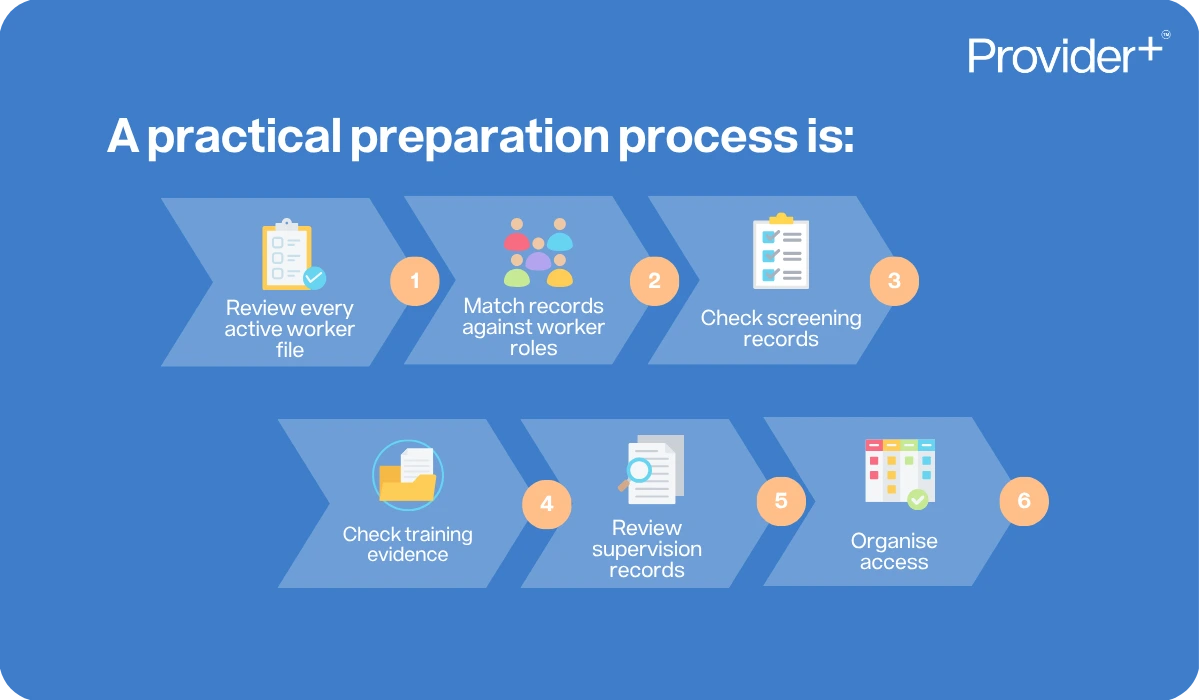
1. Review every active worker file
Check that every current worker has a complete and consistent file.
2. Match records against worker roles
Confirm that each worker's:
- Position description.
- Qualifications.
- Training.
- Screening requirements.
match the supports they provide.
3. Check screening records
Confirm NDIS Worker Screening records are available for workers in risk-assessed roles.
4. Check training evidence
Make sure completed training is recorded and easy to locate.
5. Review supervision records
Confirm supervisors can explain how worker performance and capability are monitored.
6. Organise access
Store files securely while ensuring authorised staff can provide evidence during an audit.
If you would rather not do that review alone, our NDIS audit support sessions go through your evidence, policies and procedures against the NDIS Practice Standards before the audit.
We strive to keep our content accurate and up to date; however, NDIS Commission rules and requirements can change. For the latest information, visit the NDIS Quality and Safeguards Commission website or contact our team.
Need help with the NDIS?
Fill in the form below to get started.
FAQs
An NDIS worker file should include employment records, position descriptions, qualifications, training records, worker screening evidence where required, and supervision records.
Yes. Auditors will review training records to confirm workers have the skills and knowledge needed for their roles.
Providers must keep records relating to risk-assessed roles and workers who require NDIS Worker Screening Checks.
Providers will need to keep WWCC records when required by the worker's role or state and territory child safety requirements. WWCC is separate from NDIS Worker Screening.
Yes. Missing records can make it harder for providers to demonstrate compliance with NDIS Practice Standards.
Evidence can include worker screening, qualifications, pre-employment checks, induction, NDIS Worker Orientation Module completion, training and supervision records. Auditors may sample staff files to check that the provider's workforce systems are being implemented in practice.
Registered providers must keep records for workers engaged in risk-assessed roles for 7 years. Records should be kept up to date, organised, accessible and legible.

Understand exactly why registration takes 6–12+ months