Can You Register an NDIS Business for Just One Participant? Understanding the “Service for One” Model
- You can register an NDIS business for one participant. There is no requirement for a minimum number of participants, but you must still meet all regulatory requirements for the supports you provide.
- A "Service for One" business should be assessed across three areas: eligibility to provide and claim supports, financial viability after operating costs, and whether you're prepared for the ongoing responsibilities of running an NDIS provider business.
- Special situations require extra care. If you're supporting a family member, NDIA approval may be required. If multiple providers are involved, especially for Supported Independent Living (SIL), confirm the arrangement directly with the NDIA before relying on a billing or business structure.
- Registration is the start of operating a compliant business, not the end of the process. Providers remain responsible for audits, record keeping, incident management, worker oversight, and ongoing compliance with NDIS requirements, including the mandatory SIL registration framework where applicable.
Yes, you can build an NDIS provider business around just one participant. There is no NDIS requirement that a provider must have a minimum number of participants before registering.
But supporting just one participant doesn't necessarily make running an NDIS business any simpler. In many cases, the same registration, governance and compliance obligations apply whether you support one participant or one hundred.
For many people, the journey begins with one person. The real question is often as simple as:
"How do I keep supporting this person as an NDIS provider?"
Whether it's a family member, someone you've supported for years, or a participant whose existing arrangements are changing, that simple question quickly leads to three others:
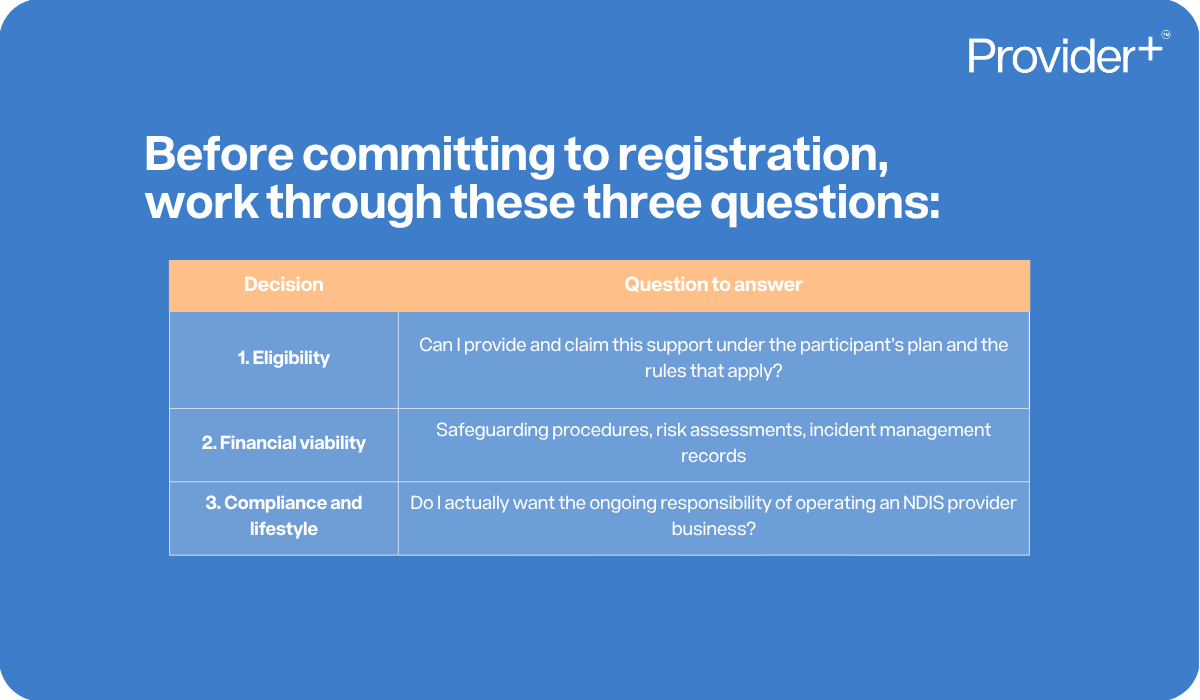
- Eligibility: Can I legally provide and claim the supports?
- Financial viability: Will the funding make the business financially sustainable?
- Compliance and lifestyle: Am I prepared for the ongoing responsibilities of operating an NDIS provider business?
In practice, these are the three questions every prospective provider should answer before deciding whether registration is the right pathway.
What does “Service for One” mean?
What is a Service for One?
A Service for One is simply an NDIS provider business built around supporting one participant instead of operating a traditional multi-participant service.
For some people, this means supporting one participant as a sole trader. For others, it involves a small company or a carefully selected team of workers who only support one person.
What makes it different isn't the registration process; it's the service model. The provider still needs to understand and meet the requirements that apply to the supports they deliver. One of the biggest misconceptions surrounding a Service for One model is that supporting only one participant somehow reduces or removes registration obligations. This is not the case.
The most important thing to understand is this: registration requirements are based on the supports you deliver, not on how many participants you support.
Supporting one participant does not mean the compliance requirements are proportionally smaller. The NDIS framework is designed to protect the participant receiving support, whether a provider supports one person or one hundred. The number of participants may change the scale of your business, but it does not reduce the importance of participant rights, safety, appropriate service delivery or effective governance.
For example:
- Providers delivering Supported Independent Living (SIL) must comply with the current SIL registration requirements, including the 0138 Assistance with Supported Independent Living registration group where applicable.
- Providers implementing regulated restrictive practices under a Behaviour Support Plan are also required to meet the relevant registration and regulatory obligations, regardless of whether supports are delivered to one participant or many participants.
- Other registration groups may also require registration depending on the supports provided.
The important point is that a Service for One is not an exemption from the NDIS Practice Standards or registration framework. If the support requires registration, those obligations continue to apply regardless of the service model.
1. Eligibility: Can you actually provide and claim the support?
Everything starts with the support. Before deciding how your Service for One model will operate, you need to understand exactly what supports you will provide, who you will provide them to, and what obligations apply to those supports.
Before building a Service for One business around a participant, consider the following questions:
- What support are you providing?
- Is that support funded in the participant’s plan?
- Is the participant’s plan NDIA-managed, plan-managed or self-managed?
- Does the support require a registered provider?
- Does the support fall within a particular NDIS registration group?
- What requirements apply to that registration group?
- Are there any specific restrictions on who can provide the support?
Providers are responsible for ensuring the supports they deliver, and the claims they submit, align with the participant's approved funding and the applicable NDIS rules.
In other words, operating an NDIS business doesn't automatically mean you can deliver or claim every type of support. You must first understand what is funded in the participant's plan and what requirements apply to those supports.
Can you provide NDIS supports to a family member?
For many families, a Service for One is not about becoming disability service providers or providing paid supports themselves. Instead, it is about creating a governance framework that allows them to coordinate their family member's supports, employ or engage a carefully selected team of workers, and ensure those supports are delivered consistently and safely.
Inclusion Australia describes a Service for One as an alternative model developed by families after traditional disability service models were unable to meet the needs, preferences or safety requirements of their family member. Many families have chosen this approach following experiences of neglect, abuse or trauma within traditional disability service settings, particularly group-based models of support. The Disability Royal Commission also highlighted significant levels of violence, abuse, neglect and exploitation experienced by people with disability living in congregate and group-based settings.
For these families, establishing a Service for One is often driven by the desire to create a safe, stable and highly individualised support arrangement rather than by commercial considerations. Instead of relying on a rotating workforce supplied by different organisations, families can build and oversee a dedicated team of workers who understand the participant's communication style, routines, preferences and support needs.
In practice, the family member's role is often one of governance rather than direct service delivery. They may oversee the organisation, coordinate supports, recruit workers, manage quality and ensure the participant receives consistent, person-centred supports, while the day-to-day supports are delivered by employed or contracted disability support workers.
It is important to distinguish this model from a family member being paid to provide direct NDIS-funded supports. The NDIA generally only funds family members to provide direct supports in exceptional circumstances. Where a participant's funding is NDIA-managed, this requires NDIA approval and is assessed based on the participant's individual circumstances.
For families considering a Service for One, the first step is not deciding who will provide the supports, it is deciding how the supports will be governed. Once the service model is clear, the next step is to determine what registration, funding and compliance requirements apply to the supports being delivered.
What if multiple providers or carers support one participant?
This model is becoming increasingly common. Families often bring together a small team of trusted support workers who know the participant well and want to continue providing consistent supports. As the arrangement grows, one person or organisation often becomes responsible for coordinating the service, managing compliance and meeting the obligations of the registered provider where registration is required.
A participant may have several people or businesses involved in delivering their supports. For example, three, four, five or more independent carers may all support the same participant, while none of them initially wants to take on the work of becoming a registered provider.
Before setting up the arrangement, establish:
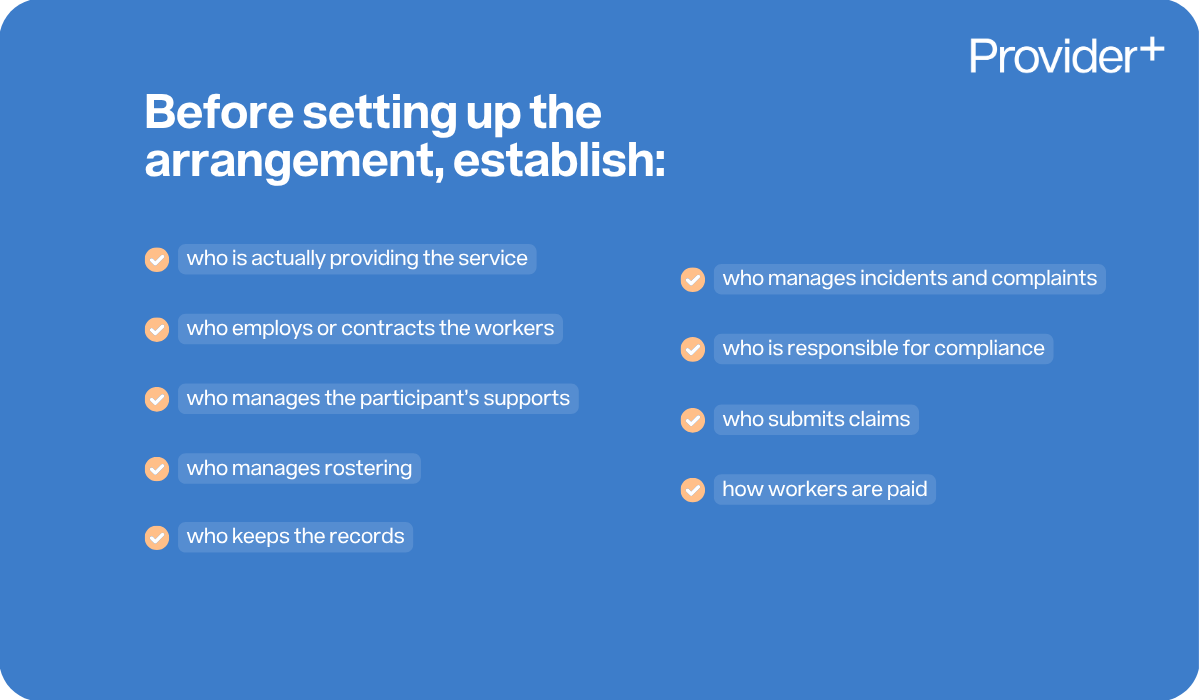
- who is actually providing the service
- who employs or contracts the workers
- who manages the participant’s supports
- who manages rostering
- who keeps the records
- who manages incidents and complaints
- who is responsible for compliance
- who submits claims
- how workers are paid.
If one business becomes the registered provider, it needs to understand the obligations attached to that provider status and the services it delivers.
Registration is not simply a way for one person in a group to process everyone’s NDIS payments.
The group also needs to understand who is carrying the business risk and administrative burden. If one person takes responsibility for registration, insurance, compliance, records, management and other provider obligations, that is a genuine business role and should be properly structured.
What about two providers sharing SIL funding?
This is one of the more difficult Service for One scenarios.
For example, imagine a participant receives SIL through a registered provider. A registered nurse also provides overnight support two nights a week as part of the participant’s broader support arrangement. The nurse wants to establish their own provider business and continue providing those two nights independently.
The question then becomes: Can the nurse’s business and the existing SIL provider both claim for different parts of the participant’s support arrangement?
Do not assume that they can.
The NDIS introduced new SIL claiming and registration requirements from 1 July 2026, including the new 0138 Assistance with Supported Independent Living registration group.
Where a proposed arrangement involves multiple entities delivering or claiming SIL, the billing and provider structure should be confirmed directly with the NDIA before proceeding. The rules governing how multiple providers can participate in and claim for the same SIL arrangement should not be assumed.
Where possible, obtain the NDIA’s advice in writing to provide a clear record and support future compliance decisions.
The practical question to resolve
If you want to be involved in the billing for a registered SIL service, you need to establish exactly what your legal and operational relationship with the SIL provider will be.
For example, the relevant questions include whether you are:
- an employee of the registered SIL provider
- operating as the registered provider responsible for the SIL service
- or proposing another arrangement that needs to be specifically confirmed as permissible.
Do not build a business model around an assumed billing structure without first confirming that the proposed arrangement is permitted.
The important point is that registration does not automatically create a right to claim part of an existing participant’s SIL funding.
Does SIL require NDIS registration?
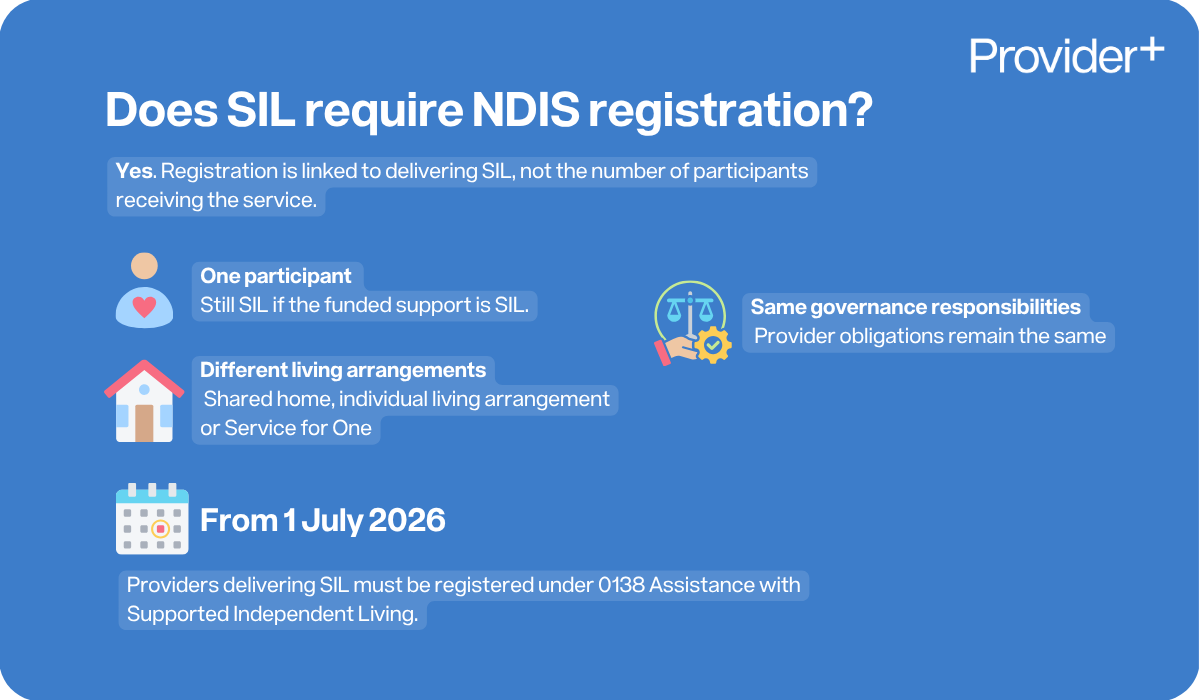
Yes.
The requirement to register is linked to delivering Supported Independent Living—not to the number of participants receiving the service.
A participant doesn't stop receiving Supported Independent Living simply because they are the only person supported by the provider. If the funded support is SIL, then it remains SIL regardless of whether it is delivered in a shared home, an individual living arrangement or through a Service for One model. The service model may look different, but the provider's governance responsibilities remain the same.
This includes responsibilities relating to governance, participant rights, worker competency, incident management, complaints management, emergency preparedness, risk management, internal auditing and continuous improvement.
The participant receiving support does not change these obligations simply because they are the only participant supported by the provider.
From 1 July 2026, providers delivering SIL must be registered, and SIL is delivered under the new 0138 Assistance with Supported Independent Living registration group.
Existing unregistered SIL providers have a transition pathway. The NDIS Commission states that an existing unregistered provider delivering SIL can continue during the transition if it submits a valid registration application for 0138 and other relevant registration groups before 1 October 2026.
New or unregistered providers entering the SIL market after 1 July 2026 cannot simply start delivering SIL while waiting for registration. The NDIS Commission states that new providers cannot deliver SIL until the Commission has made a decision on their registration application.
For someone considering a Service for One model around SIL, this makes the registration decision particularly important.
We have many resources available for SIL providers looking to register. Start with our SIL Operational Guidelines here.
What counts as SIL?
Supported Independent Living (SIL) is funding for support workers to help a person with daily tasks and personal care so they can live as independently as possible. SIL is generally designed around ongoing support, including arrangements where support is provided across a 24-hour period.
The NDIS says a participant may share a support worker or have an individual support worker depending on the level of help they need.
The important point is that the label used for a service does not determine whether it is SIL.
A person receiving support at home is not automatically receiving SIL. The actual support arrangement, funding and applicable NDIS rules need to be considered.
There can also be situations where supports that look similar to SIL are funded differently. For example, some participants may have supports funded through Core funding for Daily Living rather than through a dedicated SIL budget.
There are also specific questions around supports that may resemble SIL but are funded under particular Core or Daily Living arrangements, including line item 107 and 0115. The treatment of these arrangements, and whether they can continue outside the current SIL registration framework, should be confirmed against the participant’s actual funding and the current NDIS rules.
That is why providers should assess the participant’s actual plan, funding arrangement and support rather than assuming that calling a service something other than “SIL” removes the relevant registration requirements.
What If the Participant Has Regulated Restrictive Practices?
Another important consideration for Service for One arrangements is the implementation of regulated restrictive practices.
Where workers are implementing regulated restrictive practices authorised through an approved Behaviour Support Plan, registration obligations apply regardless of whether supports are delivered to one participant or hundreds of participants.
This often surprises providers supporting only one participant. They assume that because the arrangement is individualised, the regulatory requirements are reduced. In reality, the registration requirements relate to the implementation of regulated restrictive practices—not to the number of participants receiving support.
This reflects the higher level of regulatory oversight required when practices that restrict a person's rights or freedom of movement are being implemented.
Families operating a Service for One should therefore carefully consider whether their current or proposed support arrangements involve regulated restrictive practices and seek advice regarding the registration requirements that apply to their circumstances.
2. Financial viability: Does the business stack up financially?
The second question is whether the business actually makes financial sense.
A participant having substantial NDIS funding does not mean that funding automatically becomes the provider’s revenue or profit.
Running an NDIS provider business involves far more than paying support workers. Before deciding whether a Service for One model is financially viable, you'll need to understand the true cost of employing staff, maintaining insurance, managing compliance, purchasing software, completing audits and running the day-to-day business.
At a minimum, consider:
- worker wages
- superannuation and other employment costs
- insurance
- training and worker screening
- rostering
- administration
- accounting
- software
- compliance systems
- management time
- audit and registration costs where applicable.
This matters because a single participant can potentially represent a substantial amount of service delivery.
A business considering a Service for One model may therefore be looking at a participant with $100,000 or more in relevant funding, particularly where multiple supports such as community access are involved.
Pricing rules can also affect whether a Service for One model remains financially viable. The NDIS Annual Pricing Review 2026-27 proposes a 10% reduction to prices for unregistered providers delivering Social, Community and Civic Participation (SCCP) supports from 1 January 2027, while maintaining prices for registered providers.
For a provider relying heavily on one participant, changes like this can have a meaningful impact on revenue and operating margins. This is another reason to assess the long-term sustainability of the business rather than looking only at the participant's current plan funding.
The proposed change is specific to SCCP supports; it does not mean registered providers will receive 10% more than unregistered providers across all NDIS supports.
That is why these conversations matter to providers. A small contract may not justify setting up an entire business structure. A six-figure service arrangement can be a very different commercial decision.
Understand how the money actually works
One of the biggest challenges for small operators is understanding the operational side of the numbers.
It is not enough to know the participant’s total plan budget.
You need to understand how the relevant supports are priced and claimed, how the Schedule of Supports is structured, how wages are scheduled, and how costs are apportioned across the service.
Depending on the arrangement, this can involve understanding systems and tools such as rostering, payroll and the practical allocation of costs across one participant, one house or multiple participants.
For a SIL business, this becomes particularly important where the provider is managing workers, rosters, overnight arrangements, a house and multiple types of supports.
The more complex the delivery model, the more important it is to understand the actual cost of delivering the service rather than looking at the participant’s plan total and assuming the remaining amount is margin.
3. Compliance and lifestyle: Do you actually want to run this business?
This is the part that is easiest to overlook.
A Service for One model can begin with someone thinking:
“I already support this person. I just want to register so I can keep doing it.”
But you are not simply registering.
You are starting a business, and registration is just the first part of the process. .
Once you operate as a provider, there can be ongoing responsibilities around:
- compliance
- record keeping
- worker management
- incidents
- complaints
- risk management
- participant rights
- financial administration
- audits where applicable
- maintaining the requirements attached to your registration.
For providers moving from an informal or unregistered arrangement into registration, this can represent a significant change in how they operate.
For a Service for One provider, the participant relationship can be much more personal than a conventional client-provider relationship. Over time, participants, families and support workers may develop deep trust and familiarity, with the support team becoming an important part of the participant's life.
That can make changes to the arrangement particularly difficult. If funding changes, support needs shift, the participant moves to another provider or the service ends, the impact may be both commercial and personal. The provider therefore needs to plan for business continuity while maintaining professional boundaries and keeping the participant's needs at the centre of decisions.
The question is therefore not just whether you can register.
It is whether you want to operate this way.
Ask yourself:
- Do I actually want to support only one participant?
- Do I want to grow the business later?
- How many people do I eventually want to serve?
- How much administration am I prepared to handle?
- Am I prepared to maintain compliance systems?
- Can I manage workers and rostering?
- Can I manage incidents and complaints?
- Am I prepared for audits where they apply?
- What happens if the participant’s funding changes?
- What happens if the participant’s support needs change?
- What happens if the participant stops using my service?
These questions matter because many Service for One arrangements start from what was previously a small or informal working relationship.
Running a registered provider business is different.
What happens when several carers support one participant?
A common variation of the Service for One model involves a small group of independent carers who all support the same participant.
For example, five or eight carers might collectively provide the participant support, while none of them wants to take on the work of becoming a registered provider.
At some point, the group needs to define the business structure.
Ask:
- Who is the provider?
- Who contracts with the participant?
- Who employs or contracts the workers?
- Who manages the roster?
- Who is responsible for compliance?
- Who handles incidents and complaints?
- Who maintains participant records?
- Who submits claims?
- Who carries the financial and administrative burden?
One person may ultimately take on the provider role, while the others continue providing support under an appropriate employment or contractual arrangement.
The group should agree upfront on how responsibilities, payments and costs will be handled, particularly if one person is taking on additional business responsibilities. Any arrangement should be clearly documented and commercially fair to everyone involved.
There is no NDIS rule that says the answer is automatically a particular percentage or uplift. Any commercial arrangement should be properly structured and documented.
The Biggest Challenge Isn’t Registration
Many Service for One arrangements begin because everyone involved trusts one another. Over time, however, the arrangement often becomes more complex. As workers are engaged, responsibilities grow and compliance obligations increase, someone needs to take responsibility for managing the business—not just the supports.
They can become much harder when someone has to make formal decisions about:
- who is responsible
- who is employed
- who gets paid what
- who carries risk
- who manages performance
- who makes decisions for the business.
That is one reason to treat the move from an informal group to a provider business as a genuine business decision, rather than just a registration exercise.
Is the informal provider model changing?
Yes, particularly for SIL.
The NDIS has moved to mandatory registration for SIL providers from 1 July 2026, with the new 0138 registration group and SIL-specific requirements.
For existing unregistered SIL providers, the transition pathway requires a valid registration application before 1 October 2026 to continue delivering SIL during the transition.
The broader direction is towards greater oversight and more formal provider accountability.
For someone who has been operating as a small, informal or “cottage industry” provider, this means the question is no longer simply:
“How can I keep doing what I have always done?”
It is:
“Am I prepared to operate this as a proper provider business?”
That means understanding registration, compliance, workers, records, financial management and the responsibilities that continue after registration.
For a closer look at what's changing and the deadlines involved, see our guides on Mandatory SIL Registration 2026 and Already Registered for SIL Under 0115?
What if you have already started the registration process?
There are transition arrangements for providers who were already registered or progressing through registration before the SIL changes took effect.
For example, the NDIS Commission explains that existing registered providers delivering SIL under the former 0115 arrangements can have their registration varied to include 0138 Assistance with Supported Independent Living, with the new SIL Practice Standards applying from 1 July 2026.
The Commission also has a specific pathway for providers that had submitted a registration application before 1 July 2026. Where an audit occurred before 1 July, it did not include the new SIL Practice Standards. Where the audit occurs after 1 July, those standards apply.
If you are already part-way through registration, check which transition pathway applies to your specific circumstances rather than assuming you need to start again.
Mandatory registration transition pathway.
If your previous audit or registration pathway involved Daily Tasks Shared Living or another former arrangement, confirm how your specific circumstances translate into the current 0138 framework rather than assuming you are automatically covered.
What should you decide before starting a Service for One business?
Before committing to registration, work through these three questions:
If the model involves SIL, the current framework is particularly important. Mandatory registration began on 1 July 2026, and the new registration group is 0138 Assistance with Supported Independent Living. Existing unregistered SIL providers seeking to continue during the transition need to submit a valid application before 1 October 2026.
Planning to register as a Service for One provider? We can help you navigate these questions and requirements.
Provider+'s team has walked providers through this process thousands of times. If you want a second set of eyes from experts, a free 30-minute call could be one of the best decisions you make for your business.
Click here to book a time that suits.
Final Thoughts
A Service for One model can work.
You do not necessarily need a large client base to build an NDIS provider business around one participant.
But there are three questions you need to answer first:
- Can I legally and practically provide the support?
- Does the funding make the business financially viable?
- Do I actually want the ongoing responsibility of running the business?
If the participant is a family member, you may need NDIA approval before the arrangement can be funded.
If multiple providers are involved, do not assume the participant’s funding can simply be divided between them.
And if the model involves SIL, mandatory registration, the current 0138 framework and the applicable regulatory requirements need to be considered.
The biggest mindset shift is this: You are not just registering. You are starting a business, and registration is part of that.
At its heart, a Service for One isn't about building a disability business around one participant. It's about creating a governance framework that allows one person to receive safe, stable and person-centred supports from a trusted team of workers. When designed well, the model combines strong governance with genuine choice, continuity and quality of care—exactly the outcomes the NDIS was created to achieve.
We strive to keep our content accurate and up to date; however, NDIS Commission rules and requirements can change. For the latest information, visit the NDIS Quality and Safeguards Commission website or contact our team.
Need help with the NDIS?
Fill in the form below to get started.
FAQs
Yes.. There is no published NDIS minimum participant number for registration. However, you still need to meet the requirements that apply to the supports and registration groups you want to provide.
Not automatically. The NDIA generally only funds family members to provide NDIS supports in exceptional circumstances. Where the participant’s funding is NDIA-managed, the family member must be a registered provider if the NDIA approves the arrangement.
Potentially, but the arrangement needs to be structured correctly. Establish who is providing the service, who employs or contracts the workers, who manages the supports and who is responsible for claiming.
Yes. Providers delivering SIL must be registered under the current framework. The current SIL registration group is 0138 Assistance with Supported Independent Living.
Not every support that looks like SIL is necessarily funded through a dedicated SIL budget. Some arrangements may involve Core or Daily Living funding, including particular line items such as 107.
The correct treatment depends on the participant’s actual funding and the support being delivered. Do not assume that a SIL-like arrangement automatically falls outside SIL registration requirements.
Yes, potentially. The key questions are whether you meet the requirements for the support you want to provide and whether the business is financially and operationally sustainable.
Start with three questions: can you provide and claim the support, does the funding cover the cost of running the service, and are you prepared for the ongoing responsibilities of operating a provider business?
No. Registration is not the end of your compliance responsibilities. Registered providers must continue to meet the requirements that apply to their registration and supports, including applicable audits and ongoing compliance obligations.
Understand exactly why registration takes 6–12+ months