
NDIS Registration Requirements Explained: What Providers Must Have and Meet
- NDIS registration requirements include having an Australian Business Number (ABN), an appropriate legal business structure, suitable key personnel, required worker screening arrangements, evidence of the capacity to deliver the supports applied for, and the ability to meet the applicable NDIS Practice Standards at audit.
- Whether you need to register depends on the supports and services you provide, how participant funding is managed and whether the support is subject to mandatory registration.
- Supported independent living (SIL) and covered NDIS digital platform services became subject to mandatory registration from 1 July 2026.
- Registration groups determine which NDIS Practice Standards apply and whether the application is assessed through verification or certification.
- Registration is an ongoing responsibility. Providers need to demonstrate that their systems are implemented and operating in practice, not simply that policies exist.
NDIS registration is the process through which the NDIS Commission assesses whether a provider is suitable and capable of delivering the supports and services within its proposed registration scope. It involves more than completing an application. Your business structure, registration groups, key personnel, worker screening, Practice Standards and supporting evidence all need to align. Provider+ (Provider Plus), whose consultants include former NDIS lead auditors, prepares providers for every step.
This guide explains the main requirements providers need to understand, including the changes affecting supported independent living (SIL) and NDIS digital platform services from 1 July 2026. It also explains what the NDIS Commission looks at during suitability assessment and audit, why applications can be delayed or refused, and what continues after registration.
For a step-by-step overview, see How to Become a Registered NDIS Provider in 2026.
Do You Need to Be a Registered NDIS Provider?
Whether you need to register depends on the supports you deliver and how participants' plans are managed. Registration is mandatory for certain supports and services, while providers delivering other supports may be able to operate without registration where the applicable rules allow it.
The NDIS Commission identifies categories for which registration is required, including specialist disability accommodation (SDA), regulated restrictive practices, specialist behaviour support, plan management, supported independent living and covered NDIS digital platform services. See the NDIS Commission's current registration guidance.
For many other NDIS supports, providers can operate without registration where the applicable rules allow it. However, being unregistered does not mean being outside the NDIS regulatory framework. The NDIS Code of Conduct applies to registered providers and also applies to unregistered providers in relevant circumstances.
The distinction between registered and unregistered providers also affects which participants a provider can support. Unregistered providers cannot deliver supports that must legally be delivered by a registered provider. For other supports, an unregistered provider may generally work with participants who self-manage or plan-manage their NDIS funding.
If you are currently operating as an unregistered NDIS provider and need to become registered, Provider+ (Provider Plus) helps unregistered NDIS providers, including SIL providers, prepare for registration through its unregistered NDIS provider service.
What Changed for SIL Providers on 1 July 2026?
Supported independent living (SIL) and covered NDIS digital platform services became subject to mandatory registration on 1 July 2026.
For SIL providers, registration is now a requirement for delivering SIL supports within the relevant registration category. Providers need to understand how the requirements apply to their service model, registration scope and the supports they deliver.
Certain existing SIL providers had until 1 October 2026 to submit a valid registration application under the transition arrangements. That deadline has now passed. Eligible providers that applied by the deadline may continue delivering SIL while their application progresses, subject to the applicable transitional arrangements.
The NDIS Commission has also begun targeted compliance and enforcement action against SIL providers that failed to engage with the registration requirements. Providers need to understand their current registration status and whether they are authorised to continue delivering SIL supports.
The NDIS Commission sets out the registration requirements in its Apply for registration guidance, while the NDIS announcement explains the SIL transition arrangements. Read the NDIS announcement.
SIL Registration at a Glance
| Requirement | Position after the 2026 transition |
|---|---|
| SIL registration | Mandatory from 1 July 2026 |
| Existing SIL providers covered by the transition | 1 October 2026 was the application deadline |
| New SIL providers | Must be registered before delivering SIL |
| SIL registration group | 0138 – Assistance with Supported Independent Living |
| Digital platform services | Covered services became subject to mandatory registration from 1 July 2026 |
| Applicable standards | Determined by the provider's registration scope and applicable Practice Standards |
The definition of SIL also matters. Providers should assess whether the services they deliver fall within the relevant category rather than assuming that every accommodation or support arrangement is SIL.
The applicable supported independent living requirements are also reflected in the NDIS Practice Standards and the relevant rules and quality indicators.
NDIS Provider Registration Requirements: ABN, Business Entity and Insurance
Before applying, an NDIS provider needs more than an idea for a service. The NDIS Commission requires an applicant to have an Australian Business Number (ABN) and demonstrate the ability to deliver the classes of supports and services being applied for, including evidence of that capability.
Registration attaches to the provider entity applying. Your business structure should therefore be settled before you build the application around it.
At a practical level, prepare:

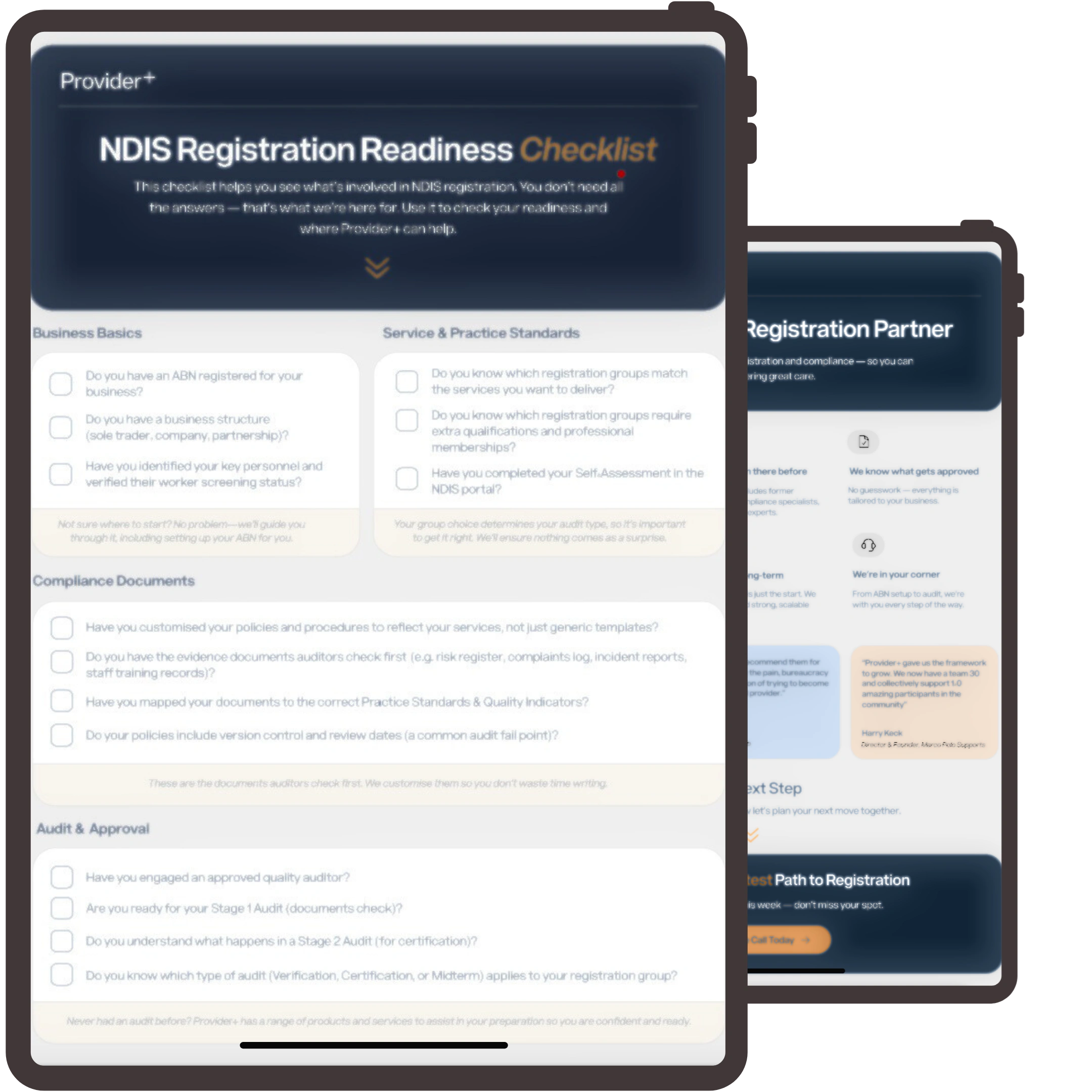
- your ABN and business details;
- the legal entity or business structure that will hold the registration;
- the services and supports you intend to deliver;
- evidence that you have the capability and systems to deliver those supports;
- the key personnel who will be assessed;
- worker screening arrangements for relevant roles;
- required insurance, including professional indemnity, public liability and accident insurance where applicable; and
- relevant policies, procedures and operational systems.
The registration application should be supported by evidence that demonstrates the provider can deliver the NDIS supports within its proposed scope, adhering to the NDIS Suitability Guidelines.
The applicable insurance indicator is contained in the NDIS Quality Indicators Guidelines. The indicator addresses appropriate insurance, including professional indemnity, public liability and accident insurance, without specifying a universal dollar amount.
Your legal entity, service scope, workforce arrangements and supporting systems should be established before you submit the application. Changing the legal entity, service scope or organisational arrangements while preparing the application can create inconsistencies between the information in the application and the evidence presented during the audit.
The NDIS provider registration requirements in 2026 therefore involve more than having an ABN. The Commission also needs to be satisfied that the applicant has the organisational arrangements, capability and evidence needed to deliver the supports within its proposed scope.
Provider+ (Provider Plus) helps unregistered providers through the whole registration process, from understanding the NDIS Commission requirements and choosing the right registration groups to preparing for audit. Learn more about how we can help you.
Who Are Key Personnel, and How Does the Commission Assess Them?
Key personnel are people who hold significant governance or decision-making roles within an NDIS provider organisation. The NDIS Commission considers the suitability of the applicant and each member of its key personnel as part of the registration assessment.
The Commission's About registration guidance explains the role of key personnel and suitability assessment.
The suitability assessment is broader than checking whether someone has an NDIS worker screening clearance. Providers should make sure ownership, directorships, management responsibilities, key personnel details and supporting records are current and consistent.
The Commission can consider matters relevant to whether the applicant and key personnel are suitable to hold their roles. This means providers should not treat suitability as a simple administrative declaration.
The application should accurately identify the people who have significant responsibility for planning, directing or controlling the provider's activities. If those arrangements change during registration, providers also have obligations to notify the Commission where required.
To read more about it, see Understanding NDIS Suitability of Key Personnel: Key Considerations.
What Staff Checks Does the Commission Require?
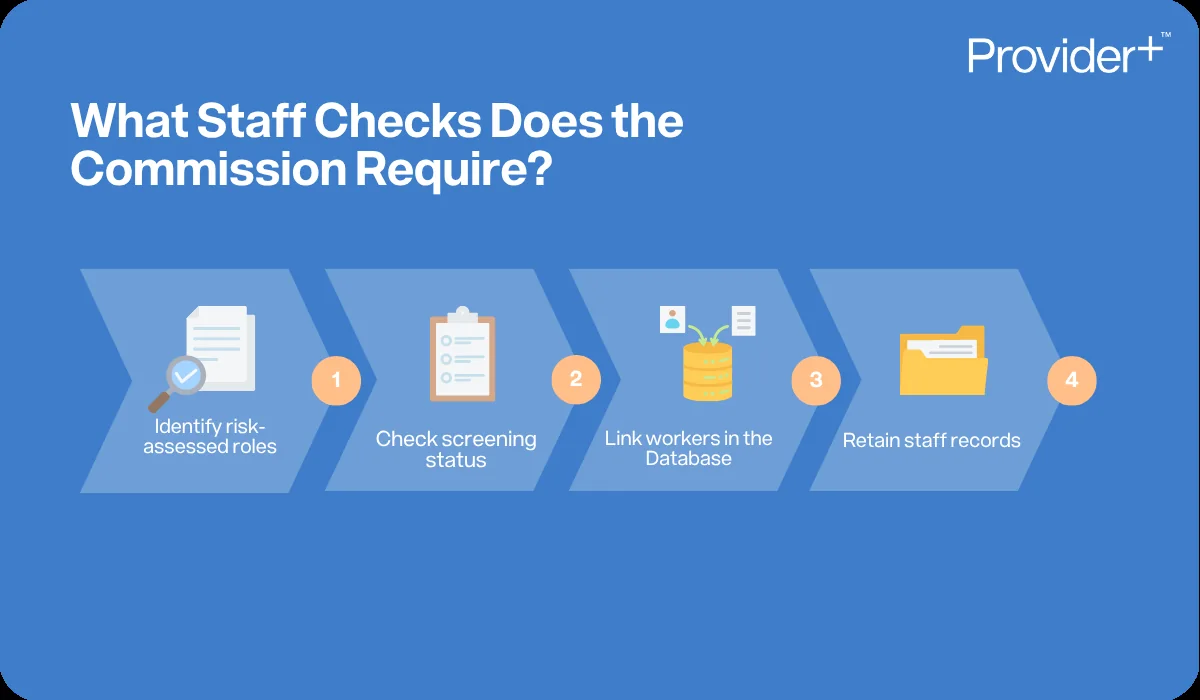
Worker screening is a registration requirement for key personnel and workers in risk-assessed roles. Relevant workers need the required NDIS worker screening clearance, and providers manage screening through the NDIS Worker Screening Database.
A risk-assessed role is a role for which the NDIS worker screening requirements apply because of the nature of the work and the potential risk to participants.
Providers should identify risk-assessed roles, check screening status, link workers appropriately in the NDIS Worker Screening Database and retain screening records, along with relevant qualification, training, induction and competency records.
The mandatory NDIS worker orientation program is also part of the applicable human resource requirements.
In Provider+'s experience preparing over 6000 providers for registration, workforce records can become an area of focus where screening, training and competency records have not been consistently maintained. Screening should therefore be addressed before the application is lodged rather than treated as something to resolve after the audit.
Which Registration Groups Do You Apply For, and What Qualifications Do They Need?
Registration groups identify the classes of supports a provider is applying to deliver. They matter because the groups determine the applicable Practice Standards and assessment method.
Choosing registration groups is therefore a scope decision, not just an administrative step. Selecting groups too broadly can create unnecessary audit and compliance obligations, while selecting them too narrowly can leave a provider without the scope needed for its services.
In one case Provider+ reviewed, a provider had carried Module 1 (High Intensity Supports) for five years with no participants who needed it and no registered nurse on staff, paying for a specialist auditor each cycle for a service that never ran.
Qualification requirements depend on the supports and registration groups involved. Providers should identify the qualifications, skills, experience and workforce capability needed for the NDIS services they intend to deliver.
"If you'll plausibly deliver it in the next 18 months, keep it. If not, it's costing you every audit cycle." - Will Flesher, CEO at Provider+
A provider should therefore start with what it actually intends to deliver rather than selecting registration groups simply because they appear to offer broader business opportunities. The registration scope needs to reflect the provider's real service model and the workforce available to deliver it.
The NDIS provider registration rules set out the classes of supports and the assessment method associated with the registration framework. Providers should use the current requirements when deciding their scope rather than relying on an old registration application or another provider's registration groups.
Not sure which groups to apply for? See NDIS Registration Groups and Qualifications: Why Less Is Often More.
What Do the NDIS Practice Standards Require of Your Documentation?
How the Practice Standards are structured
The NDIS Practice Standards set the quality requirements that registered providers must meet for the supports and services within their registration scope.
The framework includes the Core Module, supplementary modules and the Verification Module. The NDIS Practice Standards explain how the modules, outcomes and quality indicators apply.
What documentation do you need?
Quality indicators are the specific indicators used to assess whether the relevant outcomes and requirements are being met. The exact evidence depends on your registration scope, but your documentation and systems may need to address:
- Governance and operational management
- Risk management
- Complaints and incident management
- Human resource management
- Participant rights
- Information management
- Continuity of supports
- Service delivery
- Worker screening, training and competency
- Participant records
- Continuous improvement
The documentation and systems you need depend on your organisation's size, registration scope and the complexity of the supports you deliver. A small provider does not necessarily need the same volume of documentation as a large organisation, but it still needs systems that effectively address the requirements applicable to its scope.
Policies are not enough: the evidence auditors expect
In the audits we've prepared providers for, one recurring issue is the gap between having a policy and being able to demonstrate that the process is actually being followed.
This can include incomplete training records, missing internal audit evidence, or policies that describe processes but are not supported by records showing those processes are being carried out.
This is also what former NDIS Lead Auditor and Provider+ Senior NDIS Consultant Yvette Clark emphasises:
“Having policies isn't enough. Auditors aren't simply checking whether you've got documents sitting in a folder somewhere. They want evidence that your systems are operating across the organisation, that they're being monitored, and that improvements are actually happening.”
What is required in the self-assessment?
The registration application includes a self-assessment. The NDIS Commission explains the role of the self-assessment and its expectations when providers use consultants, advice services or purchased policies in its application guidance.
Providers remain responsible for the accuracy of their application and supporting evidence. Using external assistance does not remove the provider's responsibility to understand the systems it has submitted or demonstrate that those systems reflect how the organisation actually operates.
For practical guidance, see How to Write a Strong NDIS Self-Assessment: A Practical Guide for New Providers.
What Does the Quality Audit Involve, and What Do Auditors Look For?
What are the steps in the quality audit?
The quality audit is the independent assessment of the provider against the NDIS Practice Standards relevant to its application. The audit pathway is determined by the provider's registration groups and the applicable assessment method.
After the registration application is submitted, the provider receives an initial scope of audit identifying the applicable audit pathway and scope. The initial scope of audit sets out the relevant registration groups, service delivery types, applicable Practice Standards and information that needs to be shared with the auditor.
The provider then engages an approved quality auditor (AQA) to conduct the required audit.
In broad terms, a verification audit applies to relevant lower-risk supports, while a certification audit applies to higher-risk supports and services. The applicable pathway depends on the registration groups and legal requirements.
For a fuller comparison, see NDIS Certification vs Verification: Which Path Is Right for You?.
What do auditors look for?
An auditor assesses the organisation against the applicable Practice Standards and quality indicators. Depending on the audit pathway, this can involve:
- Reviewing documentation, policies and records
- Inspecting sites or services
- Interviewing relevant individuals, such as participants or their advocates
- Checking whether systems are implemented, monitored and supported by evidence
In Provider+'s experience preparing providers for certification audits, internal audit evidence is one area that can be overlooked. A provider may have a procedure stating that internal audits are conducted but struggle to produce completed audit records, findings and evidence of follow-up actions.
Former NDIS Lead Auditor and Provider+ Senior NDIS Consultant Gillian Collis puts it simply:
“The first thing is genuinely understanding your compliance obligations, not just knowing the standards exist, but understanding how your day-to-day operations align with them.”
A strong audit file does not simply contain policies. It should show how the requirement is addressed through the system, implemented in practice, supported by evidence and reflected in outcomes.
What happens after the audit?
The auditor may identify issues during the audit process that the provider needs to address. These audit findings form part of the assessment.
The auditor then submits a recommendation to the NDIS Commission, which completes its application review and suitability assessment before making the registration decision.
If the Commission proposes to refuse an application, the applicant is given an opportunity to provide information before a final decision is made. Applicants can also request a review of a decision within the applicable timeframe.
This means the registration process does not end when the audit is completed. The Commission still considers the auditor's recommendation and the provider's suitability before making the final registration decision.
Why Are Registration Applications Refused or Delayed?
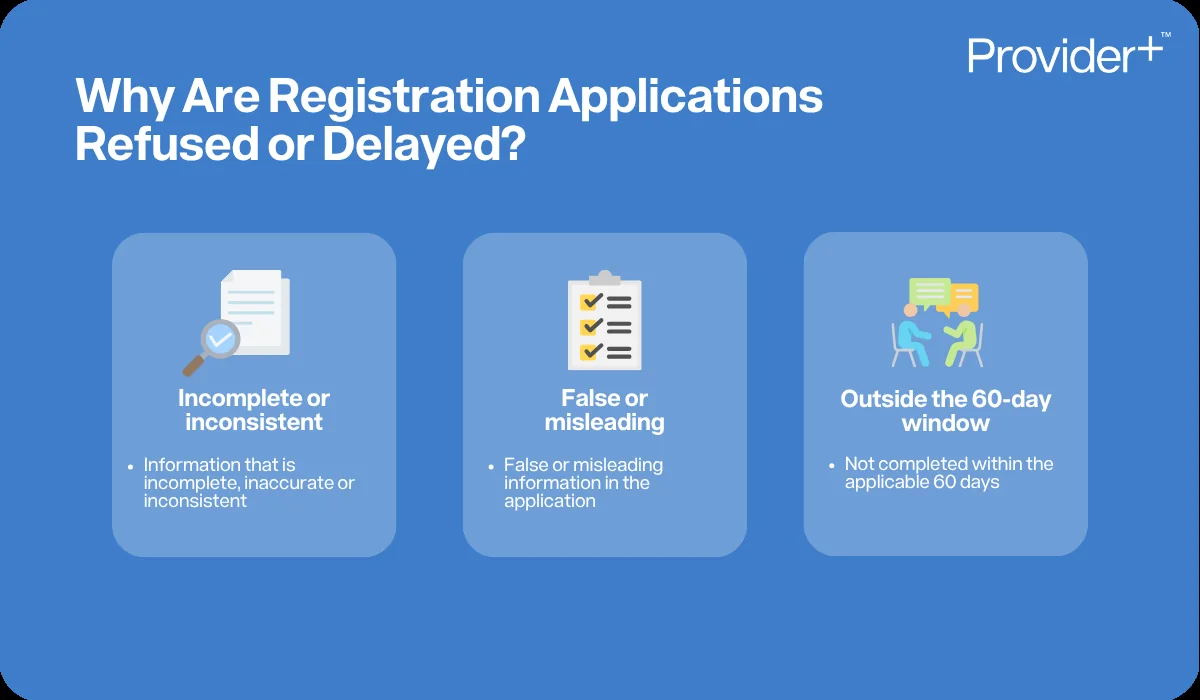
Applications can be delayed or refused when the information provided is incomplete, inaccurate, inconsistent or does not demonstrate that the provider can meet the applicable requirements.
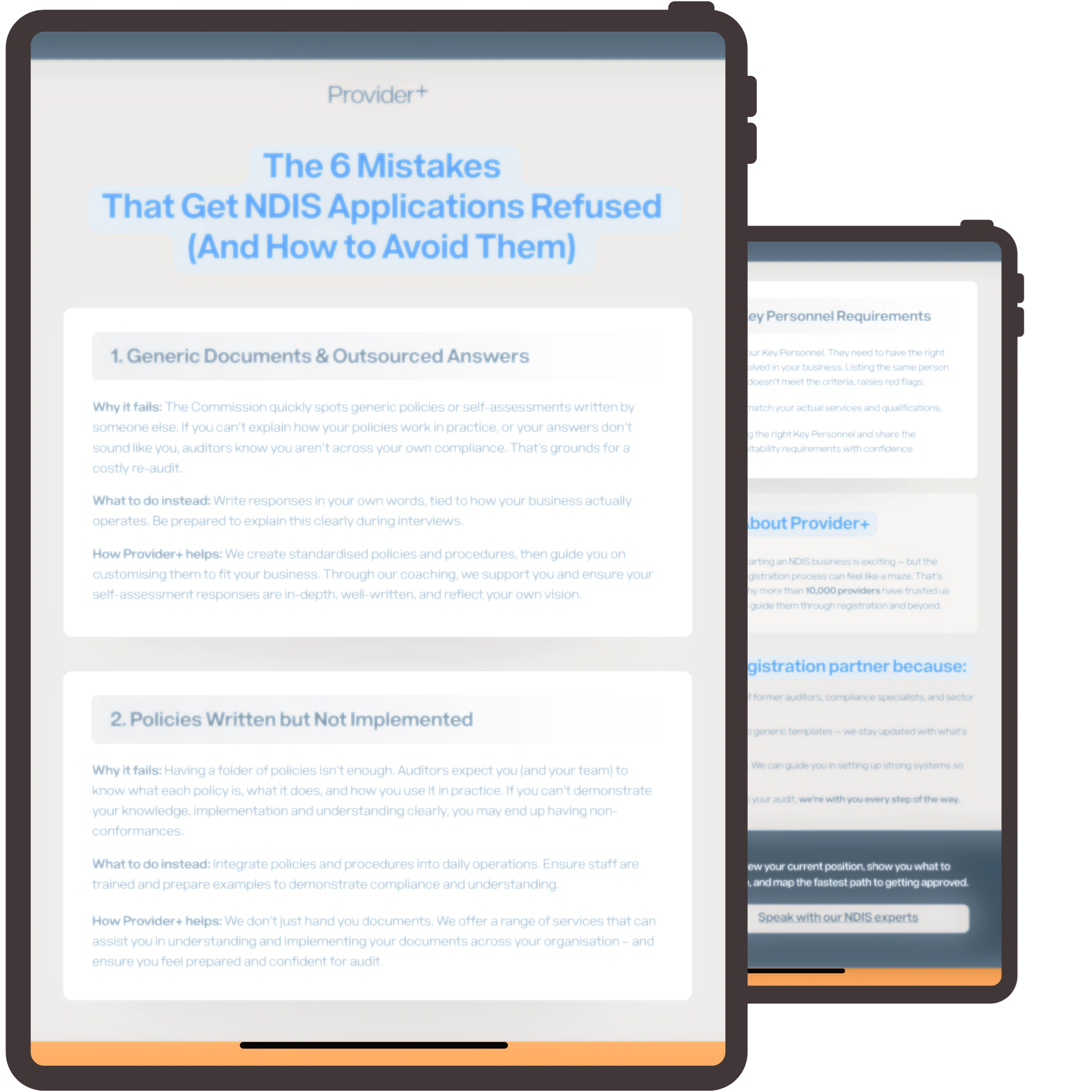
The NDIS Commission identifies false or misleading information, copied application responses or purchased policies, and applications that are not completed within the applicable 60-day window as issues providers need to understand.
The application must also accurately represent the provider's own organisation. Where consultants or purchased policies are used, the provider remains responsible for understanding and being able to explain what has been submitted.
In Provider+'s experience supporting providers through registration preparation, a recurring problem is that documentation can look complete while the provider cannot demonstrate how the system operates in practice. For example, a provider may have a policy describing incident management or internal audits but have limited records showing that workers have followed the process, findings have been reviewed or corrective actions have been completed.
In practice, this is particularly important when preparing self-assessment responses. Generic or artificial intelligence (AI) generated answers may appear complete on paper but fail to explain how the provider's own systems operate, who is responsible for them, what evidence exists and how the system is monitored.
Registration group selection can also create problems. If the groups do not accurately reflect the services the provider intends to deliver, the audit scope and evidence requirements may not align with the organisation's actual operations.
The NDIS provider registration rules therefore need to be considered alongside the provider's actual operations. Registration is not simply a document-production exercise.
What Do You Have to Keep Doing After Registration?
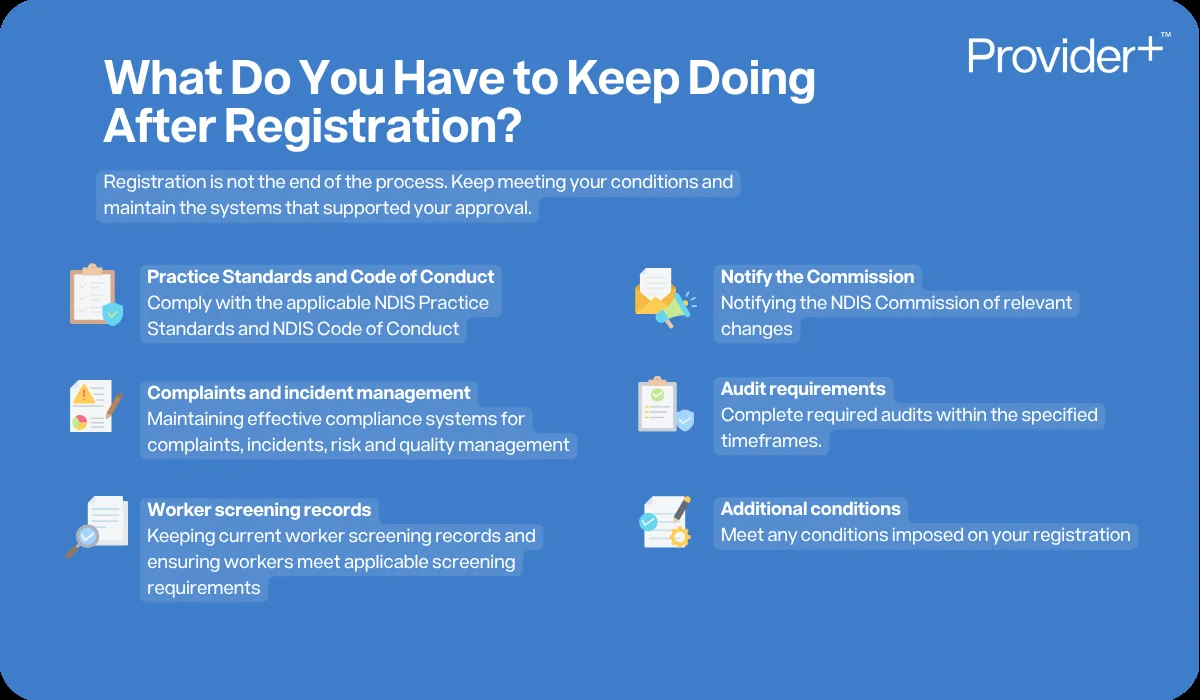
Registration is not the end of the process. A registered provider must continue meeting the conditions attached to its registration and maintain the systems that supported its approval.
A successful applicant receives a certificate of registration setting out the services or supports it is registered to provide, the registration period and any conditions that apply.
Registered providers are generally registered for three years, although the certificate is the document providers should rely on for their own registration period and renewal date.
The NDIS Commission's About registration guidance explains conditions of registration and additional conditions, while the application guidance covers the certificate of registration and what happens after successful registration.
Ongoing obligations can include complying with the applicable NDIS Practice Standards and NDIS Code of Conduct, maintaining effective compliance systems for complaints, incidents, risk and quality management, keeping current worker screening records and ensuring workers meet applicable screening requirements, notifying the NDIS Commission of relevant changes, meeting applicable audit requirements and meeting any additional conditions imposed on the registration.
Providers should also review their certificate of registration and understand exactly what their registration covers. The registration scope is not simply a statement that the organisation is an NDIS provider. It identifies the supports or services the provider is registered to deliver and the conditions attached to that registration.
For certification registration, providers may also have ongoing audit requirements during the registration period. These requirements mean that compliance needs to be maintained between registration and renewal rather than treated as something to revisit only when the next application is due.
Providers should also plan for renewal before their registration expires. Waiting until the end of the registration period can leave insufficient time to address gaps in systems, evidence or workforce arrangements.
The practical focus after registration should therefore remain the same: maintain systems, keep evidence current, monitor risks and issues, train workers, review performance and address gaps when they are identified.
Providers need to maintain compliance as their organisation and services evolve, rather than treating registration as a one-time approval. Provider+ provides ongoing NDIS compliance support so providers stay ahead for their next audit.
Final Thoughts
The NDIS provider registration requirements in 2026 introduced important changes, but the fundamentals of registration preparation remain the same: understanding your scope, meeting the applicable requirements and being able to show your systems work in practice long after the transition dates have passed.
Start with scope. Confirm whether you need to register, choose the registration groups that accurately reflect your services, and then build the governance, workforce, screening, documentation and evidence needed for the applicable Practice Standards.
The goal should not be to create the biggest policy folder. It should be to build an organisation that can demonstrate how its systems work in practice and continue to meet its registration obligations.
For guidance and support through the NDIS registration process, see our NDIS Registration service.
We strive to keep our content accurate and up to date; however, NDIS Commission rules and requirements can change. For the latest information, visit the NDIS Quality and Safeguards Commission website or contact our team.
Need help with the NDIS?
Fill in the form below to get started.
FAQs
There is no single registration price that applies to every provider. Costs vary depending on factors such as the registration groups, audit pathway, audit scope and auditor engaged. Providers should also budget for preparation, documentation and any work required to address gaps before the audit. Confirm current audit costs before applying.
In most recent cases amongst Provider+ clients, NDIS registration can take around 3-12+ months from initial preparation to receiving a Certificate of Registration. The timeframe depends on the provider’s readiness, registration scope, audit pathway, auditor availability, any gaps identified during preparation or audit, and the NDIS Commission’s assessment process.
You cannot skip any stage of the NDIS registration process, but you can reduce avoidable delays. Preparing your policies and supporting evidence before applying, selecting the correct registration groups, arranging an auditor early and responding promptly to requests for information can help keep the application moving.
There is no mandatory preparation period, but providers should allow enough time to establish their policies, systems, workforce records and supporting evidence before applying. The preparation period depends on how much documentation and infrastructure is already in place and whether gaps need to be addressed before the application or audit.
Yes. Provider+ can help providers understand the NDIS registration requirements, prepare their registration application, develop and align the required documentation and systems, and prepare for the applicable audit. The provider remains responsible for its application and compliance, while Provider+ provides guidance and registration preparation support.
No. Provider+ prepares providers for the NDIS registration process and applicable audit, but the audit itself is conducted independently by an Approved Quality Auditor. Provider+ can help you understand the applicable requirements, prepare your evidence and ensure your organisation is ready before the independent audit takes place.

Understand exactly why registration takes 6–12+ months