



How Long Does NDIS Registration Really Take?
- Most providers complete NDIS registration in 3 to 12 months. The exact timeline depends on your registration groups, audit type, level of preparation and the NDIS Commission's assessment process.
- Preparing your policies, systems and supporting evidence before applying is one of the most effective ways to reduce delays during the NDIS registration process.
- Providers requiring a Verification Audit generally complete NDIS registration sooner than providers requiring a Certification Audit because the audit process is less complex.
- The NDIS registration process includes six stages: checking eligibility, choosing registration groups, preparing documentation, submitting an application, completing a quality audit and receiving a registration decision.
- The NDIS Quality and Safeguards Commission does not charge an application fee for provider registration, but providers should budget
Most providers complete NDIS registration in between 3 and 12 months.
Providers requiring a Verification Audit typically complete registration in 3 to 6 months, while those requiring a Certification Audit generally take 6 to 12 months. The biggest factor isn't how quickly you submit your application. It's how prepared you are before you begin.
The NDIS registration process follows the same six stages for every applicant. However, your timeline depends on several factors, including your registration groups, audit type, documentation, and how long the NDIS Quality and Safeguards Commission takes to assess your application after your audit.
Many providers assume the application itself takes the longest. In reality, preparation and the quality audit are often where the most time is spent. Having your policies, systems and supporting evidence ready before you apply can help avoid unnecessary delays.
NDIS registration timeline at a glance
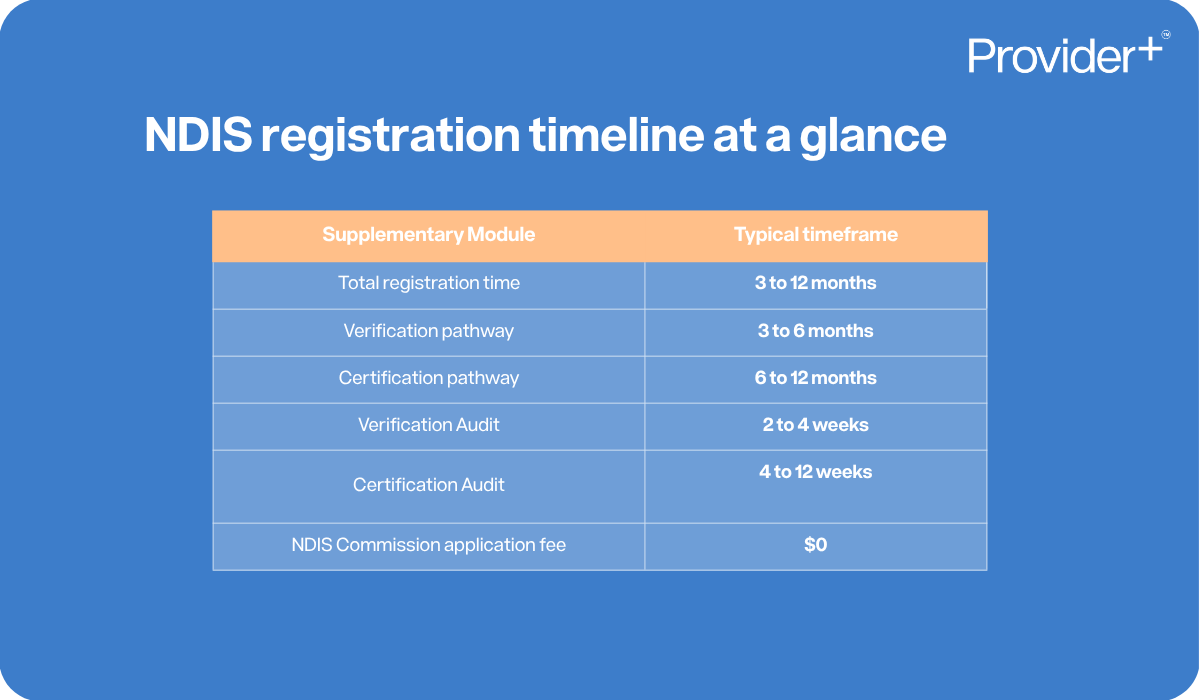
These are typical timeframes. Every application is different, and your registration may take more or less time depending on your circumstances.
What affects how long NDIS registration takes?
Preparation has the biggest impact on your registration timeline. While every provider follows the same process, not every provider starts at the same level of readiness.
Several factors influence how long registration takes, including:
- whether you need a Verification Audit or Certification Audit
- the registration groups you apply for
- how complete your policies and supporting documents are
- how quickly you can schedule your audit
- whether corrective actions are required
- how long the NDIS Commission takes to assess your application.
Many registration delays happen because providers are still developing policies or collecting evidence after their application has already been submitted. Preparing these documents before applying can significantly reduce the overall timeline.
What is the NDIS registration process?
Every registered provider follows the same six-step registration process. The NDIS Quality and Safeguards Commission uses this process to assess whether a provider is suitable to deliver registered NDIS supports.
The process includes:
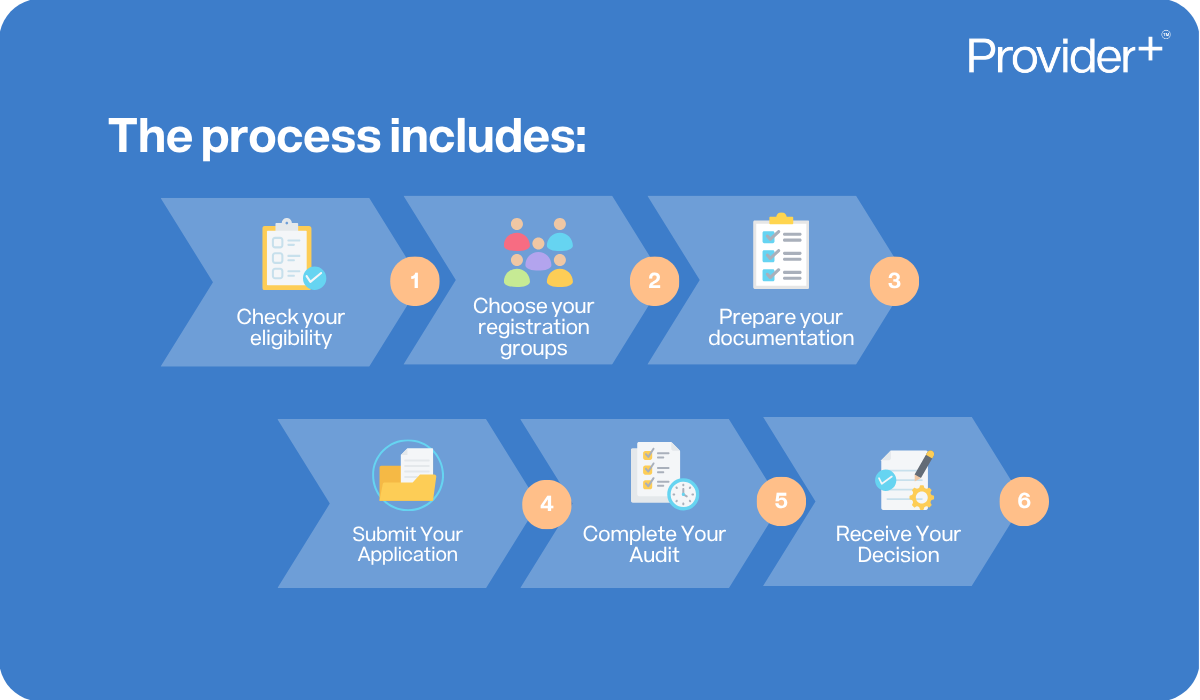
- Check your eligibility.
- Choose your registration groups.
- Prepare your documentation.
- Submit your application.
- Complete your quality audit.
- Receive a registration decision.
Each stage depends on the one before it. Spending more time preparing early often reduces delays later in the process.
Step 1: Check your eligibility
Before applying, you must have an Australian Business Number (ABN) and be able to demonstrate your ability to deliver the supports you're applying to provide.
The official registration process also requires key personnel to be suitable and hold valid NDIS Worker Screening clearances before an application is submitted.
Step 2: Choose your registration groups
Your registration groups determine the services you can provide and the audit you'll need to complete.
Some registration groups require a Verification Audit, while others require a Certification Audit.
If your application includes any Certification registration group, you'll complete a full Certification Audit, even if your remaining registration groups would otherwise only require Verification.
Selecting only the registration groups you genuinely plan to deliver can also reduce the scope of your audit and the amount of preparation required.
To learn more, read our NDIS Certification vs Verification blog.
Step 3: Prepare your documentation
Preparation is usually the most time-consuming stage of registration.
Before lodging your application, you'll need policies, procedures and systems that align with the NDIS Practice Standards. For many providers, this preparation takes 4 to 12 weeks, depending on how much documentation is already in place.
Your preparation may include:
- governance and operational policies
- risk management framework
- incident management system
- complaints management system
- worker qualifications
- NDIS Worker Screening clearances
- insurance certificates
- evidence supporting your registration groups.
The NDIS Commission also requires providers to complete a self-assessment against the NDIS Practice Standards as part of the application process.
Step 4: Submit your application
Applications are submitted through the NDIS Commission Applications Portal using myID and the Relationship Authorisation Manager (RAM).
As part of the application, you'll:
- choose your registration groups
- complete a self-assessment against the NDIS Practice Standards
- upload supporting evidence.
The NDIS Commission requires applications to be completed within 60 days of being started. If the application isn't submitted within that timeframe, it will be deleted and you'll need to start again.
There is no application fee to submit an NDIS registration application.
Step 5: Complete your quality audit
The quality audit is often the longest stage after you've submitted your application. The type of audit you complete depends on your registration groups. Providers delivering lower-risk supports generally complete a Verification Audit, while providers delivering higher-risk supports complete a Certification Audit.
After you submit your application, the NDIS Quality and Safeguards Commission will issue an Initial Scope of Audit. This document confirms the type of audit required based on your registration groups. You must then engage an Approved Quality Auditor to complete the audit.
How long does a Verification Audit take?
A Verification Audit is designed for eligible lower-risk registration groups and is generally completed more quickly than a Certification Audit.
A Verification Audit:
- is a desktop review of your documentation
- typically takes up to a day
- generally costs $900 to $1,800
- does not usually include a site visit.
During the audit, the Approved Quality Auditor reviews your policies, qualifications and business systems to confirm they meet the Verification Module requirements.
For a full breakdown of what a Verification Audit involves and how to prepare, see our guide: What Is an NDIS Verification Audit and How Do You Pass It?
How long does a Certification Audit take?
A Certification Audit is more comprehensive because it applies to higher-risk registration groups.
It has two stages:
- Stage 1: A desktop review of your documentation.
- Stage 2: Site visits and interviews with workers and participants.
Certification Audits typically take 2 to 6 days and generally cost between $3,000 and $12,000, depending on the size of your organisation, the number of sites and your registration groups.
Because Certification Audits assess compliance with the NDIS Practice Standards and relevant supplementary modules, they usually require more preparation and evidence than Verification Audits.
If you're working through a Certification Audit, our step-by-step guide, How to Get NDIS Certification: A Step-by-Step Guide for Providers, walks through what to expect at each stage.
Why Having Your Documents in Order Matters, No Matter the Audit
Whether you're completing a Verification Audit or a Certification Audit, one factor makes the single biggest difference to how smoothly it goes: how organised your evidence is.
In addition to checking that the right documents exist, auditors also check that everything is current, consistent and easy to locate.
This is where otherwise well-prepared providers often lose time. Missing signatures, outdated policies or evidence scattered across different systems can turn a straightforward audit into a longer, more stressful one, and increase the risk of non-conformances.
Our PQM Pro tool is built around exactly this problem. It helps you keep your policies, evidence and compliance documents organised and up to date, so everything your auditor needs is exactly where it should be when the audit begins. Through guidance and support from our NDIS consultants, who have worked with numerous providers throughout their audit journey, you can organise your evidence in a manner that will ensure a smoother audit with fewer surprises, and a lot less for you to worry about on the day.
Step 6: How long does the NDIS Commission take to make a decision?
Your registration isn't complete when your audit finishes. Once your Approved Quality Auditor submits their recommendation, the NDIS Quality and Safeguards Commission reviews your application before making a registration decision.
Current median processing times (NDIS Commission Quarterly Performance Report ) are:
These figures relate to the Commission's assessment stage after the audit has been completed. Individual applications may take more or less time depending on their complexity and whether additional information is required.
If your application is successful, you'll receive:
- a Certificate of Registration
- your approved registration groups
- your registration period (three years)
- any conditions attached to your registration.
Your organisation will also be listed on the NDIS Provider Register.
Why do some providers get registered faster than others?
Preparation is usually the biggest difference between a smooth registration and a delayed one. Two providers can submit an application at the same time but receive their registration months apart because one is audit-ready while the other is still preparing documents.
The most common causes of delays include:
- writing policies after submitting the application
- choosing incorrect registration groups
- incomplete supporting documentation
- delays booking an Approved Quality Auditor
- responding slowly to requests for information
- needing corrective actions before the audit can be finalised.
Many of these delays can be avoided by completing your preparation before lodging your application.
Need Help Getting Ready for NDIS Registration?
You cannot control how long the NDIS Commission takes to review your application, but you can manage how smoothly you run through the process. Provider+ has helped thousands of providers do exactly that.
Our team includes former NDIS auditors who know precisely where registrations stall, what auditors ask about and what providers often miss in their application. Book a consultation call now to get started.
How can you reduce your registration timeline?
You can't skip any part of the registration process, but you can avoid many common delays.
Before you apply, make sure you have:
- an active ABN
- the correct registration groups
- policies aligned with the NDIS Practice Standards
- governance documents
- risk management, incident management and complaints management systems
- NDIS Worker Screening clearances
- current insurance certificates
- evidence supporting your registration groups.
It's also worth engaging an Approved Quality Auditor early. Audit availability can affect your overall registration timeline, particularly during busy periods.
Can you provide NDIS services while waiting for registration?
It depends on the services you plan to deliver.
Some supports require providers to be registered before they can deliver NDIS-funded services. Others can be delivered by unregistered providers when working with self-managed or plan-managed participants.
The NDIS Commission states that registration is mandatory for providers delivering certain higher-risk supports, including Specialist Disability Accommodation (SDA), Plan Management, Specialist Behaviour Support, services involving regulated restrictive practices, and services delivered to NDIA-managed participants. Mandatory registration also applies to Supported Independent Living (SIL) providers from 1 July 2026.
If you're unsure whether registration is mandatory for your services, check the current registration requirements before accepting participants.
How much does NDIS registration cost?
The NDIS Commission does not charge a fee to submit your application. However, becoming a registered provider involves several other costs, with the quality audit typically being the largest expense.
For many providers, the total cost of registration ranges from $3,000 to $15,000, depending on the audit pathway, registration groups and size of the organisation.
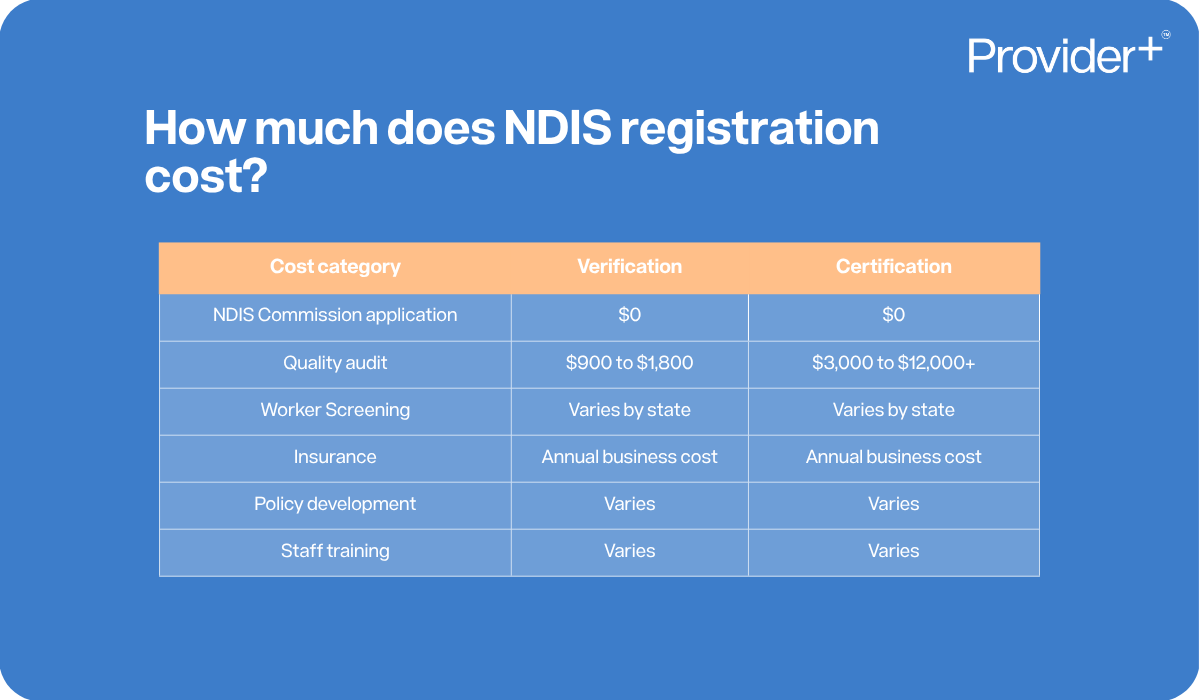
While costs are important, focusing on preparation can help avoid additional expenses caused by delays or corrective actions.
The bottom line
Most providers complete NDIS registration in between 3 and 12 months, but your preparation has the biggest impact on how long the process takes. Providers who have their policies, systems and supporting evidence ready before applying are generally better positioned to move through the audit and assessment process without unnecessary delays.
While the NDIS registration process follows the same six stages for every applicant, every provider's journey is different. Your registration groups, audit type, documentation and responsiveness throughout the process all influence your timeline.
The best way to reduce delays is to start preparing before you submit your application. Investing time upfront can make the audit smoother, reduce requests for additional information and help you progress through the registration process with greater confidence.
We strive to keep our content accurate and up to date; however, NDIS Commission rules and requirements can change. For the latest information, visit the NDIS Quality and Safeguards Commission website or contact our team.
Need help with the NDIS?
Fill in the form below to get started.
FAQs
Most providers complete NDIS registration within 3 to 12 months. Providers completing a Verification Audit typically finish in 3 to 6 months, while providers requiring a Certification Audit generally take 6 to 12 months. Actual timeframes depend on your preparation, audit requirements and the NDIS Commission's assessment process.
You can't skip any stage of the registration process, but you can reduce avoidable delays by preparing your policies and supporting documents before applying, selecting the correct registration groups, engaging an Approved Quality Auditor early and responding promptly to requests for additional information.
A verification audit applies to lower-risk, lower-complexity services. It involves a desktop document review and runs approximately 4 to 8 hours. A certification audit applies to higher-risk services, runs 12 to 36 hours, and may include site visits. Providers who add higher-risk registration groups to their scope may be required to move from a verification to a certification audit. Mid-term audits are also required 18 months into a registration period for providers who completed a certification audit.
No. The NDIS Quality and Safeguards Commission does not charge a fee to submit a registration application. However, providers should budget for other registration costs, including quality audits, worker screening, insurance, policy development and staff training. For many providers, total registration costs range from $3,000 to $15,000, depending on the registration pathway and the size of the organisation.
Registered providers generally renew their registration every three years. Throughout the registration period, providers must continue complying with the NDIS Practice Standards and other registration obligations. Some Certification providers may also need to complete additional audits, depending on their conditions of registration.
Many delays happen before the audit even begins. Common reasons include incomplete documentation, policies that don't align with the NDIS Practice Standards, delays booking an Approved Quality Auditor, corrective actions following the audit and slow responses to requests for additional information. Preparing these requirements before lodging your application can significantly reduce your overall registration timeline.

Understand exactly why registration takes 6–12+ months


.webp)