SIL Registration Checklist: What Do Unregistered Providers Need to Know?
Update
The 1 October 2026 date was the transition deadline for certain existing SIL providers to apply for registration. For providers reading this guide after that date, the transition deadline has passed. The relevant question is whether the provider is registered and meeting the requirements that apply to its circumstances.
If you are currently delivering Supported Independent Living (SIL) services without NDIS registration, you are still able to continue operating during the transition period if you meet the NDIS Commission's requirements and submit your registration application within the required timeframe.
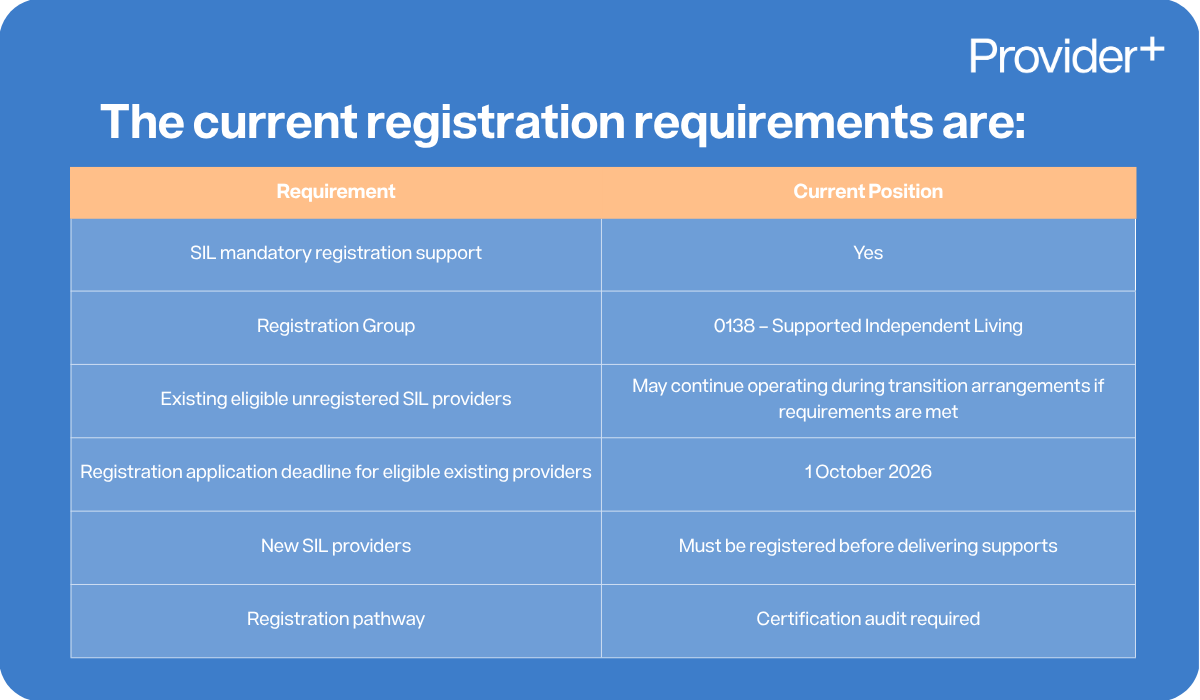
Supported Independent Living (SIL) is now a mandatory registration support under Registration Group 0138 – Supported Independent Living. Providers delivering SIL supports must comply with the relevant NDIS Practice Standards and complete the certification registration pathway.
Eligible unregistered SIL providers that were already delivering SIL supports prior to the commencement of mandatory registration requirements may continue operating during the transition period while progressing through registration. Providers that commenced delivering SIL supports after the commencement date must obtain registration before providing SIL services.
Because SIL is classified as a higher-risk support, providers are subject to additional regulatory requirements, including certification audits, SIL-specific Practice Standards and enhanced participant safeguarding obligations.
Current Mandatory Registration Requirements for SIL Providers
The current registration requirements are:
What Makes SIL Registration Different?
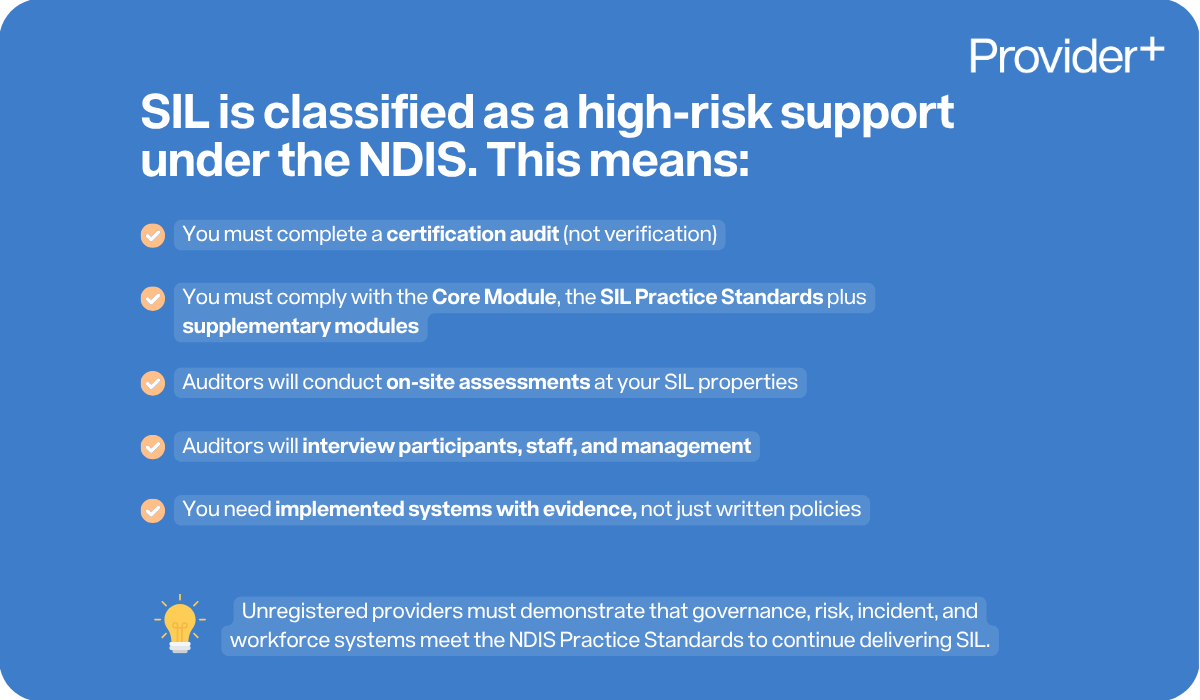
SIL is classified as a high-risk support under the NDIS. This means:
SIL is classified as a high-risk support under the NDIS. This means:
- You must complete a certification audit (not verification)
- You must comply with the Core Module, the SIL Practice Standards plus supplementary modules
- Auditors will conduct on-site assessments at your SIL properties
- Auditors will interview participants, staff, and management
- You need implemented systems with evidence, not just written policies
Unregistered providers who have operated without oversight face a significant shift. You will need to demonstrate that your governance, risk management, incident reporting, and workforce systems meet the NDIS Practice Standards before you can continue delivering SIL.
Explore our SIL operational guidelines for NDIS providers.
Practice Standards Modules for SIL Providers
SIL providers must demonstrate compliance with multiple NDIS Practice Standards modules.
Core Module ((Mandatory)
The Core Module applies to every registered provider and covers:
- Rights and responsibilities of participants
- Governance and operational management
- Provision of supports
- Support provision environment
- Feedback and complaints management
- Incident management
- Human resource management
- Information management
- Mealtime management and nutrition supports (where required)
- Medication management
Module 5A – Supported Independent Living (Mandatory)
All SIL providers registered under Registration Group 0138 are required to comply with Module 5A – Supported Independent Living.
Module 5A includes requirements relating to:
- Participant choice and control
- Shared living arrangements
- Compatibility assessments
- Participant rights and privacy
- Supported decision-making
- Vacancy management
- Individualised support delivery
- Active support approaches
- Independent living skill development
- Participant safeguarding
- Workforce capability requirements
- Emergency and disaster planning
- Tenancy rights and housing arrangements
- Dignity of risk
- Community participation and inclusion
The SIL Practice Standards place significant emphasis on ensuring participants exercise meaningful choice and control over their home, supports, relationships, daily routines and living arrangements.
Module 1: High Intensity Daily Personal Activities (Where Applicable)
Most SIL providers deliver high-intensity supports and must comply with this module, which covers:
- Assessment, planning, and delivery of high-intensity personal supports
- Safe personal care that respects dignity and privacy
- Ongoing monitoring and documentation
- Responsive support delivery that adapts to changing needs
- Incident escalation and response
- Worker training, competency, and supervision
Module 2a: Implementing Behaviour Support Plans
If you support participants with restrictive practices, you must comply with this module, which covers:
- Understanding and applying approved Behaviour Support Plans
- Reducing restrictive practices in line with NDIS Commission requirements
- Person-centred, trauma-informed, rights-based support delivery
- Embedding positive behaviour support strategies
- Monitoring and reviewing behaviour support outcomes
- Recognising and responding to behaviours of concern
- Incident escalation and reporting
- Collaboration with Behaviour Support Practitioners
- Worker training and supervision for implementing Behaviour Support Plans
Assess Your Readiness
Use this summary to assess where you stand across the 16 key areas auditors will examine:
If you have multiple areas marked "Not Started" or "Partial", you need to begin preparation immediately.
Complete SIL Registration Checklist
Use this checklist to assess your readiness and work through each section systematically. Explore our Complete guide to mandatory SIL registration.
1. Governance and Organisational Structure
Documents and evidence required:
- Organisational chart showing current structure and reporting lines
- Position descriptions for all roles (including Board/Directors if applicable)
- Evidence of defined roles and responsibilities for key personnel
- Evidence of management meetings and documented decisions
- Strategic plan or business plan demonstrating organisational direction
- Constitution or governing rules (for incorporated entities)
- Evidence of active Board or governance oversight (for larger organisations)
- Conflict of interest register and management process
- Delegation of authority framework
Key questions auditors will ask:
- How does your governance structure provide oversight of SIL services?
- How do you ensure accountability for participant safety?
- How are strategic decisions made and communicated?
2. Business Registration and Compliance
Documents and evidence required:
- ABN registration
- ASIC company extract (if applicable)
- Trust deed (if operating as a trust)
- Evidence of compliance with state/territory business registration requirements
- Evidence of compliance with any sector-specific registration (e.g. community housing registration if applicable)
3. Insurance
Documents and evidence required:
- Public liability insurance certificate (minimum $10 million recommended for SIL)
- Professional indemnity insurance certificate
- Workers compensation insurance (if employing staff)
- Property insurance (if you own or lease SIL properties)
- Evidence that insurance coverage is appropriate for SIL service delivery
4. Policies and Procedures
SIL providers need a comprehensive policy suite covering all NDIS Practice Standards. Each policy must be:
- Specific to your organisation (not generic templates)
- Reflective of how you actually operate
- Implemented with evidence of use
- Reviewed regularly (at least annually)
- Understood by workers and translated into day-to-day practice
- Reviewed following incidents, complaints, participant feedback, legislative changes, or significant organisational changes
Core policies required:
- Governance policy
- Risk management policy and procedure
- Quality management and continuous improvement policy
- Privacy and confidentiality policy
- Information management policy
- Feedback and complaints policy and procedure
- Incident management policy and procedure (including reportable incidents)
- Human resources policy
- Recruitment and selection procedure
- Worker induction procedure
- Training and development policy
- Supervision policy and procedure
- Performance management procedure
- Code of conduct
- Work health and safety policy
- Emergency and disaster management policy
- Continuity of supports policy
- Safeguarding policy
- Participant Rights and Dignity policy
- Advocacy and Participant Engagement policy
SIL-specific policies required:
- SIL service delivery policy
- Participant intake and assessment procedure
- Service agreement procedure
- Support planning procedure
- Shared living arrangements and compatibility assessment procedure
- Participant rights and choice policy
- Mealtime management procedure (if applicable)
- Medication management procedure (if applicable)
- Restrictive practices policy and procedure (if applicable)
- Behaviour support implementation procedure (if applicable)
- Overnight and sleepover support procedure (if applicable)
- Participant money and property policy (if managing participant funds)
- Vacancy management procedure
5. Risk Management
Documents and evidence required:
- Risk management framework
- Risk register with identified risks, assessments, and treatments
- Evidence of regular risk register reviews (at least quarterly)
- Evidence of how risks are escalated and managed
- SIL-specific risks identified (e.g. shared living, participant compatibility, staffing continuity)
Key questions auditors will ask:
- How do you identify and manage risks in your SIL services?
- What are the biggest risks in your SIL operations and how do you mitigate them?
- How do you monitor whether risk controls are working?
6. Quality Management
Documents and evidence required:
- Quality management framework
- Internal audit schedule and reports
- Evidence of continuous improvement actions taken
- Participant feedback collection and analysis
- Quality improvement register or action log
- Evidence of regular service delivery reviews
- Key performance indicators for SIL services
Key questions auditors will ask:
- How do you know if your SIL services are delivering good outcomes?
- Give an example of an improvement you made based on feedback or audit findings.
7. Complaints Management
Documents and evidence required:
- Complaints policy and procedure
- Complaints register with all complaints logged
- Evidence of complaint investigations and outcomes
- Evidence outcomes were communicated to complainants
- Evidence of systemic improvements following complaints
- Information provided to participants about how to make complaints
- Easy-read or accessible complaints information for participants
Key questions auditors will ask:
- How do participants know how to make a complaint?
- Walk me through how a recent complaint was handled.
8. Incident Management
This is a critical area for SIL providers. Auditors will scrutinise your incident management closely.
Documents and evidence required:
- Incident management policy and procedure
- Incident register with all incidents logged
- Evidence of incident investigations with root cause analysis
- Corrective actions documented and implemented
- Evidence of reportable incidents notified to NDIS Commission within required timeframes (24 hours for most reportable incidents)
- Evidence of staff training on incident identification and reporting
- Incident trend analysis and reporting to management
- Evidence incidents inform risk register and quality improvement
Reportable incidents include:
- Death of a participant
- Serious injury of a participant
- Abuse or neglect of a participant
- Unlawful sexual or physical contact
- Sexual misconduct
- Unauthorised use of restrictive practices
Key questions auditors will ask:
- How do staff know what to report and when?
- Show me how a recent incident was managed from identification to resolution.
- How do you ensure reportable incidents are notified within 24 hours?
9. Worker Screening
All workers delivering SIL supports must have a valid NDIS Worker Screening Check clearance. This is mandatory.
Documents and evidence required:
- Register of all workers (employees, contractors, volunteers)
- Current NDIS Worker Screening Check clearance for every worker
- System for tracking clearance expiry dates
- Process for verifying clearances before workers commence
- Evidence clearances are checked before workers have contact with participants
Important notes:
- Processing times vary by state (typically 2 to 6 weeks, but can be longer)
- Workers cannot deliver supports until clearance is received
- You must verify clearances yourself (do not rely on worker self-declaration)
10. Staff Training and Competency
Documents and evidence required:
- Training register for all workers
- Evidence of NDIS Worker Orientation Module completion for all workers
- Induction records for all workers
- Role-specific training records
- Evidence of competency assessment for high-risk tasks
- Ongoing professional development records
- Signed code of conduct acknowledgements
SIL-specific training should include:
- Manual handling and personal care
- Mealtime management (if supporting participants with swallowing difficulties)
- Medication administration (if applicable)
- Behaviour support and de-escalation
- Restrictive practices (if authorised to use)
- First aid and emergency response
- Infection control
- Fire safety and evacuation
- Participant rights and dignity
- Privacy and confidentiality
- Incident identification and reporting
- Trauma-informed care
- Supported decision making
- Housing and tenancy rights
Key questions auditors will ask:
- How do you ensure workers have the skills to support participants safely?
- How do you assess competency for high-risk tasks like medication administration?
11. Supervision and Support
Documents and evidence required:

- Supervision policy and procedure
- Supervision schedule for all workers
- Records of supervision sessions
- Evidence of how supervision addresses worker performance and development
- Clear reporting lines documented
- On-call or after-hours support arrangements for workers
Key questions auditors will ask:
- How often do workers receive supervision?
- How do you support workers dealing with challenging situations?
12. Participant Files
Auditors will sample participant files to verify your service delivery. Each file should include:
Intake and assessment:
- Referral or enquiry documentation
- Intake assessment
- Compatibility assessment (for shared living arrangements)
- NDIS plan or relevant extracts
- Funding confirmation
Service agreement:
- Service agreement signed by participant (or representative)
- Evidence of informed consent
- Evidence participant understood the agreement (e.g. easy-read version, interpreter used)
- Schedule of supports
- Fees and charges clearly documented
Support planning:
- Individual support plan aligned to NDIS goals
- Evidence participant was involved in developing their plan
- Regular plan reviews documented
- Evidence supports are delivered as planned
Daily records:
- Progress notes or shift notes
- Evidence of supports delivered
- Communication records
- Any variations to planned supports documented
Health and safety:
- Health information and care needs
- Medication records (if applicable)
- Mealtime management plan (if applicable)
- Behaviour support plan (if applicable)
- Risk assessments specific to the participant
- Emergency plan for the participant
Consent and privacy:
- Consent forms for information sharing
- Evidence of privacy being maintained
- Records stored securely
13. Restrictive Practices (If Applicable)
If your SIL services involve restrictive practices, this area will receive significant scrutiny.
Documents and evidence required:
- Restrictive practices policy and procedure
- Evidence all restrictive practices are authorised under relevant state/territory legislation
- Current behaviour support plans for all participants where restrictive practices are used
- Evidence plans are developed by a registered Behaviour Support Practitioner
- Restrictive practice use register
- Evidence of reporting to NDIS Commission as required
- Evidence of reduction strategies and progress toward reducing restrictive practices
- Training records for all staff implementing restrictive practices
- Competency assessments for staff using restrictive practices
Key questions auditors will ask:
- How do you ensure restrictive practices are only used as a last resort?
- Show me evidence of how you are working to reduce restrictive practice use.
14. Properties and Environment
Documents and evidence required:
- Evidence SIL properties are safe and fit for purpose
- Fire safety compliance (smoke alarms, evacuation plans, fire extinguishers)
- Electrical safety compliance
- Pool safety compliance (if applicable)
- Accessibility features appropriate to participant needs
- Maintenance records
- Cleaning schedules and records
- Emergency evacuation plans for each property
- Evidence of regular safety inspections
15. Emergency and Continuity Planning
Documents and evidence required:
- Emergency and disaster management plan
- Business continuity plan for SIL services
- Evidence of emergency drills conducted
- After-hours emergency contact arrangements
- Backup staffing arrangements
- Participant-specific emergency plans
Key questions auditors will ask:
- What happens if a worker does not show up for a shift?
- How would you maintain services during a major incident or disaster?
Timeline: What You Should Be Doing Now
Registration Timeline
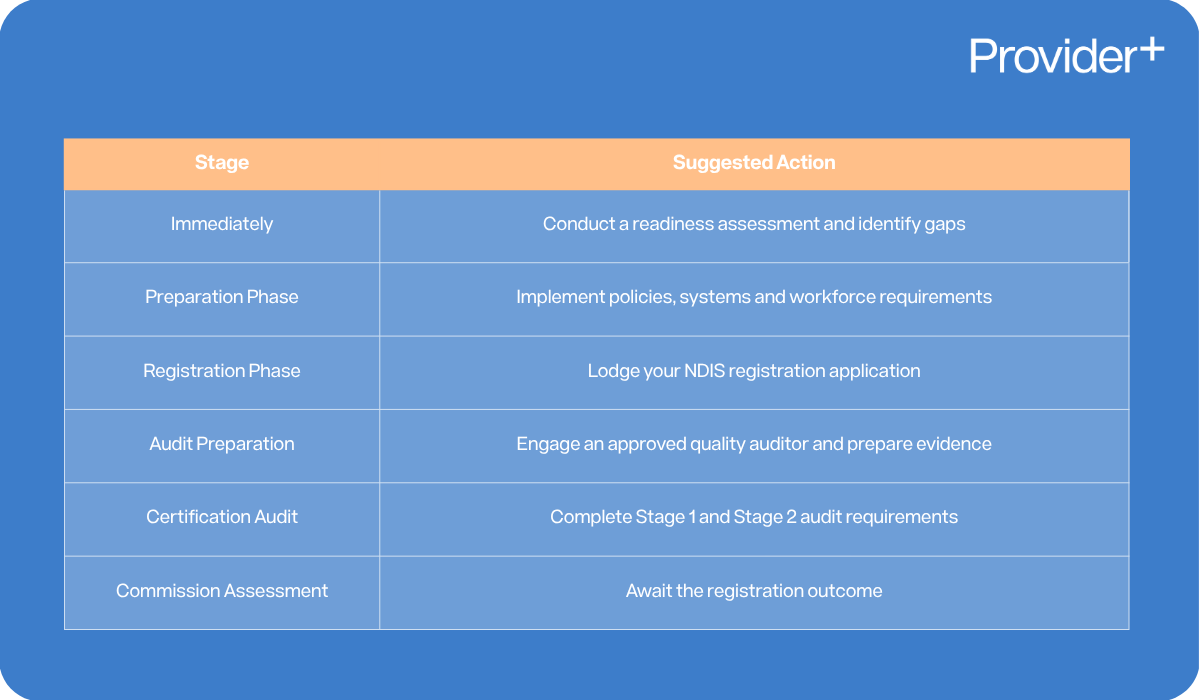
Providers should avoid waiting until regulatory deadlines before beginning preparations.
Estimated Costs
Budget for the following costs:
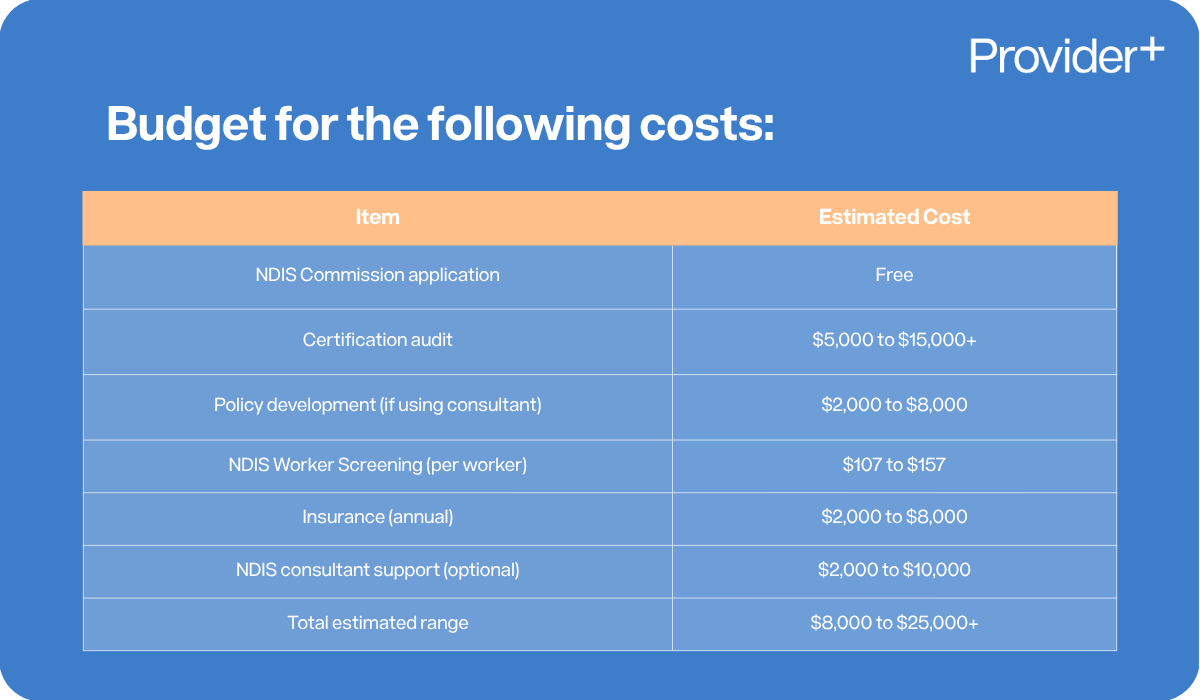
Costs vary significantly based on organisation size, number of workers, number of SIL properties, and whether you use consultants for support. Worker screening fees are set by each state and territory and are subject to change. Confirm current costs on your state portal before applying.
How Provider+ Can Help
Provider+ has helped hundreds of SIL providers achieve registration. We understand the specific challenges unregistered providers face in meeting certification requirements for the first time.
We offer:
Dedicated Expert Consultant. A specialist NDIS registration and compliance expert is assigned to guide you 1:1 through your entire registration process, answering your questions and advising you every step of the way.
NDIS Policies, Forms and Procedures. All the policies, forms and procedures required for your registration, designed to pass audit and be practically implemented in your business.
Personal Audit Coach. A structured 6-step program working 1:1 with you to fully prepare for your certification audit, tackling each audit area in sequence from required documents to the questions auditors will ask.
PQM Pro. Our Quality Management System keeps your documentation centralised, version-controlled, and always audit ready.
Start Up Club. Training and support to get your NDIS business operational once registration is complete.
Provider+ Community. An exclusive provider-only platform with live workshops, Q&As, Audit School, and ongoing NDIS business support.
Do not risk your ability to continue delivering SIL services.
Book a free 30-minute call with our team to assess where you stand and map out your pathway to registration.
We strive to keep our content accurate and up to date; however, NDIS Commission rules and requirements can change. For the latest information, visit the NDIS Quality and Safeguards Commission website or contact our team.
FAQs
Yes. Supported Independent Living is a mandatory registration support under Registration Group 0138.
Yes. Eligible providers may continue delivering SIL supports while progressing through registration, provided they complete and submit an application to become a registered provider by 1 October 2026.
Registration Group 0138 – Supported Independent Living.
Yes. SIL registration requires certification rather than verification.
Yes. All providers registering under Registration Group 0138 – Supported Independent Living must comply with Module 5A – Supported Independent Living.
Possibly. Providers delivering High Intensity Daily Personal Activities or implementing Behaviour Support Plans must comply with the applicable supplementary modules.
Registration costs vary depending on the size and complexity of your organisation and the scope of the certification audit.

Understand exactly why registration takes 6–12+ months