Registered vs Unregistered NDIS Provider: Key Differences, Obligations and When You Must Register
- Registered NDIS providers can support participants under all three funding types, within their approved scope. Unregistered providers generally work with plan-managed and self-managed participants.
- The NDIS Code of Conduct applies to all providers and workers, regardless of registration status. Unregistered providers must also meet applicable recordkeeping and other legal obligations.
- Registration brings additional requirements, including the NDIS Practice Standards, audits, worker screening and formal incident and complaints management systems.
- Certain supports and services require registration, including supported independent living (SIL), specialist disability accommodation (SDA), plan management, specialist behaviour support, regulated restrictive practices and specified NDIS digital platform services.
- Funding arrangements determine how providers are paid and whether NDIS price limits apply. Registration also affects access to NDIA-managed participants, the Provider Finder and registered provider logos.
Choosing the registered vs unregistered NDIS provider path decides which participants you can support, how you get paid and which rules apply under the National Disability Insurance Scheme (NDIS). This guide compares both for established providers, new businesses and sole traders. The NDIS Quality and Safeguards Commission (NDIS Commission) is the independent regulator that registers providers. If you're already delivering supports unregistered, see how we help providers make the move.
What Are Registered and Unregistered NDIS Providers?
A registered provider has NDIS Commission approval to deliver specified supports. An unregistered provider delivers NDIS-funded supports without that approval, where the support and the participant's funding allow it.
What Is a Registered NDIS Provider?
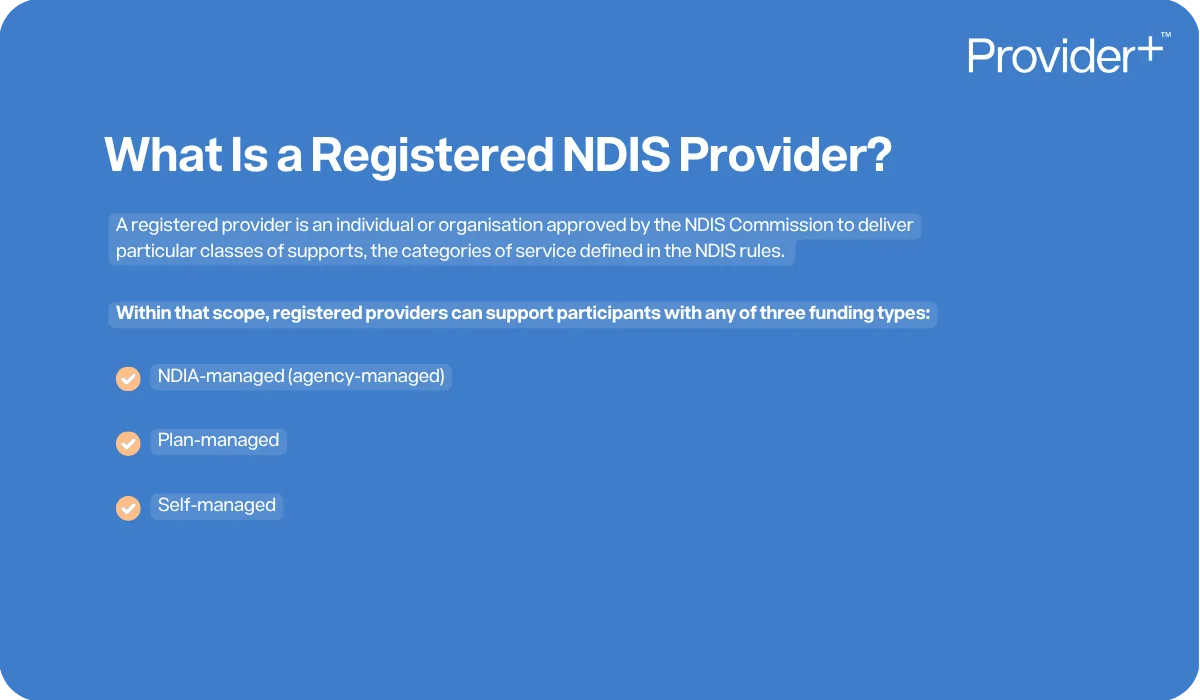
A registered provider is an individual or organisation approved by the NDIS Commission to deliver particular classes of supports, the categories of service defined in the NDIS rules. Providers apply for the registration groups that match their services, such as group 0138 for SIL, and registration covers only the classes listed on their certificate (NDIS Act, s73E). To stay registered, a provider must meet the NDIS Practice Standards: the quality and safety standards registered providers are audited against.
Within that scope, registered providers can support NDIS participants with any of three funding types:
- NDIA-managed (agency-managed): the National Disability Insurance Agency (NDIA), the government agency that runs the scheme and manages plans, pays the provider directly.
- Plan-managed: a plan manager, a registered provider who manages the participant's funding, pays the provider.
- Self-managed: the participant manages their own funding and pays the provider.
What Is an Unregistered NDIS Provider?
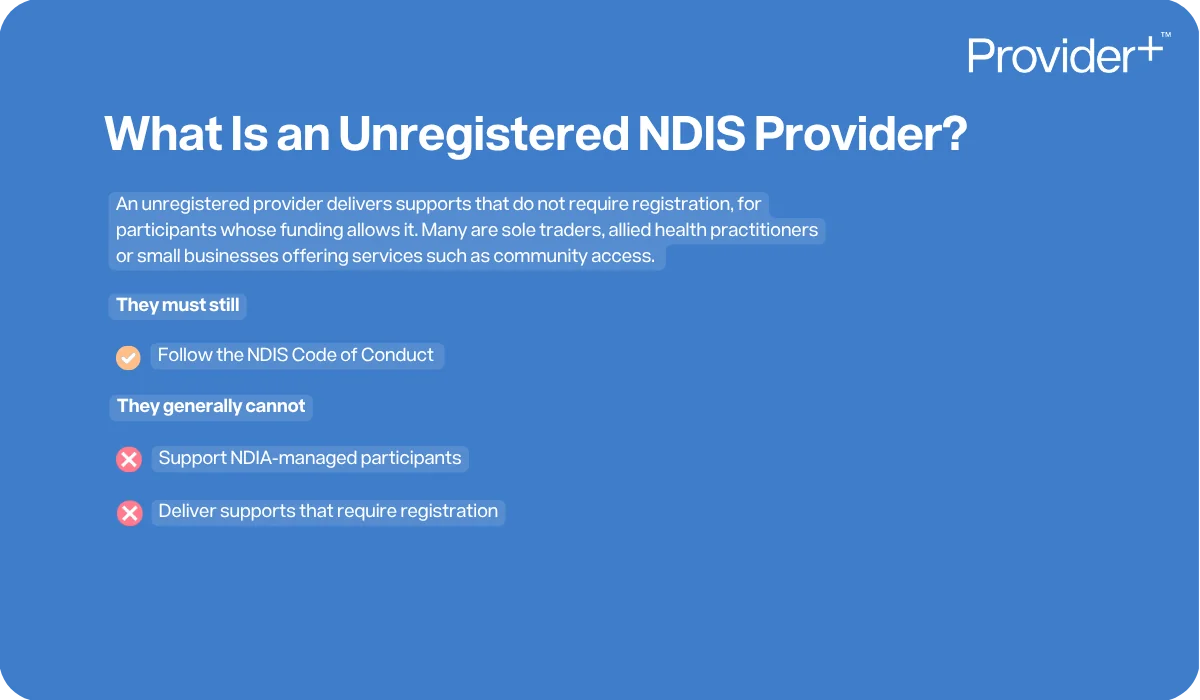
An unregistered provider delivers supports that do not require registration, for participants whose funding allows it. Many are sole traders, allied health practitioners or small businesses offering services such as community access. They must still follow the Code of Conduct (Code of Conduct Rules, s5), but they generally cannot support NDIA-managed participants or deliver supports that require registration.
NDIS Registered vs Unregistered Providers: The Differences Side by Side
The main difference between NDIS registered vs unregistered providers is access: registered providers can support NDIA-managed participants and deliver registration-only supports, within their scope. The Code of Conduct applies to both.
| Point of comparison | Registered provider | Unregistered provider |
|---|---|---|
| Self-managed and plan-managed participants | Yes, within approved scope | Yes, where registration is not mandatory |
| NDIA-managed participants | Yes, within approved scope | No |
| How you are paid | NDIA claims for NDIA-managed participants; invoices for others | Invoices to the participant or plan manager |
| Supports that require registration | Within approved scope | Cannot deliver |
| NDIS Practice Standards and audits | Required | Not required |
| Formal incident and complaints systems | Required | Not a registration condition |
| NDIS Code of Conduct | Applies | Applies |
| Worker screening | Required for risk-assessed roles | Recommended, not generally mandatory |
| Registered Provider logos and Provider Finder | Yes | No |
Price limits do not depend on registration status; they follow the participant's funding type.
Which Participants Can You Support, and How Do You Get Paid?
Your registration status decides which participants and supports you can work with. The participant's funding type decides how you are paid and whether price limits apply.
Which Participants Can You Support?
The NDIS Guide to Working with Providers sets out three cases. NDIA-managed participants must use registered providers. Plan-managed and self-managed participants can use either, provided the support does not require registration.
Funding arrangements can change. The NDIA may make some or all of a participant's funding agency-managed, for example where it sees an unreasonable risk. An unregistered provider then loses access to that funding, and the participant may need to move to a registered provider. To see how this can affect your client base, read The Ultimate Guide for Unregistered NDIS Providers (2026 Update).
How Do Registered and Unregistered Providers Get Paid?
| Funding type | Who pays | How the provider is paid |
|---|---|---|
| NDIA-managed | NDIA | The registered provider submits a payment request through the myPlace provider portal |
| Plan-managed | Plan manager | The provider invoices the plan manager |
| Self-managed | Participant | The provider invoices the participant |
The myPlace provider portal is the NDIA's online system for payment requests; unregistered providers cannot claim through it. Clear service agreements and itemised invoices help prevent payment disputes.
Do Price Limits Apply to Unregistered Providers?
Yes, when the participant is plan-managed. Price limits are the maximum prices for eligible supports, published with item numbers and descriptions in the NDIS pricing schedules; the current set is the NDIS Pricing Arrangements and Price Limits 2026–27. Self-managed participants are not bound by them and can negotiate prices with you directly. The limits also apply to NDIA-managed funding, but those participants must use registered providers, so that case affects only registered providers.
Can Unregistered Providers Use the NDIS Logo or Appear on the Provider Finder?
No. No provider may use the NDIS logo without the NDIA's written permission. Only registered providers can use the Registered Provider logos, call themselves a "registered provider" or appear on the Provider Finder.
Can Unregistered Providers Use the NDIS Logo?
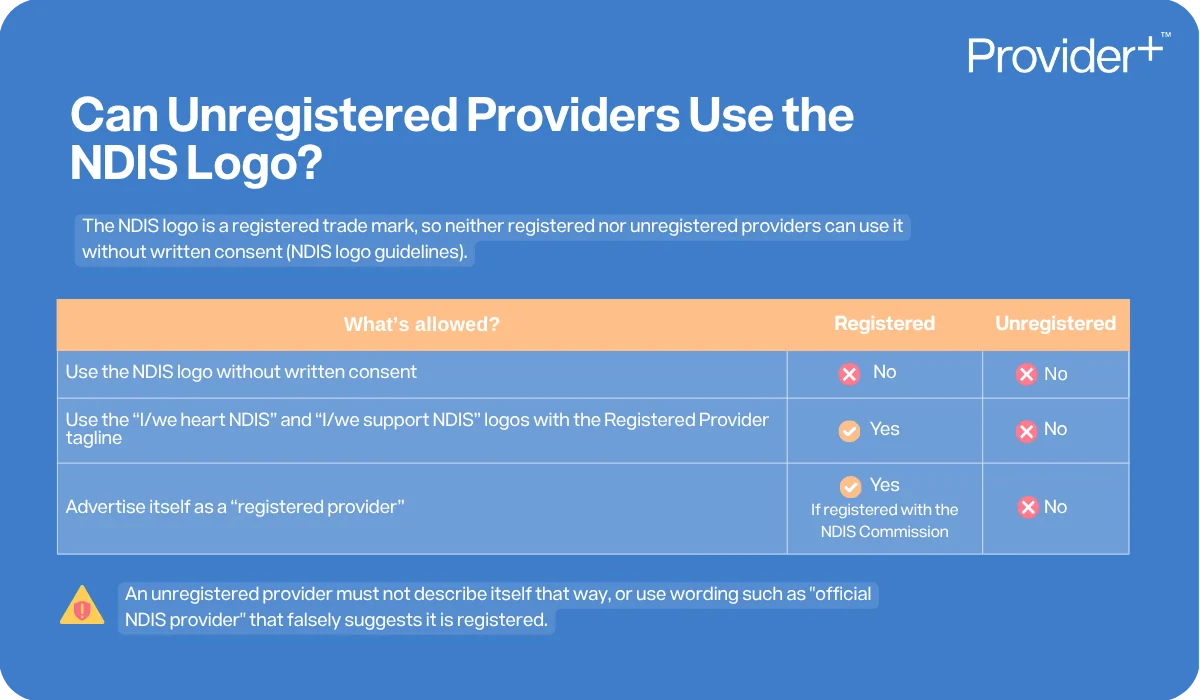
The NDIS logo is a registered trade mark, so neither registered nor unregistered providers can use it without written consent (NDIS logo guidelines). Registered providers may use the "I/we heart NDIS" and "I/we support NDIS" logos with the Registered Provider tagline; unregistered providers cannot. The same rule covers the words themselves. Only a provider registered with the NDIS Commission may advertise itself as a "registered provider". An unregistered provider must not describe itself that way, or use wording such as "official NDIS provider" that falsely suggests it is registered.
Can Unregistered Providers Appear on the Provider Finder?
No. The NDIS Provider Finder, the search tool on the NDIS website, lists only registered providers and their registration details. A listing helps visibility but does not guarantee referrals, so unregistered providers rely on professional networks, referrals and their own websites.
What Are the Requirements for Unregistered NDIS Providers?
Unregistered NDIS providers and their workers must follow the NDIS Code of Conduct. Providers must also keep records of the supports they claim for and must not present themselves as able to deliver supports that require registration (NDIS Act, s73B(3)).
Do Unregistered Providers Have to Follow the NDIS Code of Conduct?
Yes. The Code applies to all providers and their workers (NDIS Act, s73V; Code of Conduct Rules, s6). It sets the standard for safe and ethical service delivery and has seven elements. Providers and workers must:
- Act with respect for individual rights to freedom of expression, self-determination and decision-making in accordance with applicable laws and conventions.
- Respect the privacy of people with disability.
- Provide supports in a safe and competent manner, with care and skill.
- Act with integrity, honesty and transparency.
- Promptly raise and act on concerns that may affect the quality and safety of supports.
- Take all reasonable steps to prevent and respond to violence, exploitation, neglect and abuse.
- Take all reasonable steps to prevent and respond to sexual misconduct.
Anyone can complain to the NDIS Commission about a provider or worker. The Commission can investigate and take action, including a banning order: a legal order that stops a provider or worker from delivering some or all NDIS supports (s73ZN).
Do Unregistered Providers Need NDIS Worker Screening?
Not generally by law. The NDIS Worker Screening Check is a national assessment of whether a worker poses a risk to people with disability, and the NDIS Worker Screening Database records clearances so providers can verify them. The Commission recommends that unregistered providers consider screening workers in close-contact roles, and participants can ask for screened workers. Either way, check qualifications and references and provide induction and ongoing training.
Does the NDIS Commission Audit Unregistered Providers?
Not routinely. Unregistered providers have no audit cycle, but they remain under regulatory oversight. The Commission can investigate complaints and possible Code breaches, and in serious cases it can issue a banning order.
Do Unregistered NDIS Providers Need an ABN?
Not under the NDIS rules. An Australian Business Number (ABN), the 11-digit number that identifies a business, is required only to apply for registration (Provider Registration and Practice Standards Rules 2018, section 11). Most businesses will want one anyway for tax and invoicing, but that is a tax question, not an NDIS requirement.
Do Unregistered Providers Have to Keep Records?
Yes. Under section 45B of the NDIS Act, providers paid from NDIS funding must keep records relating to those claims, whether or not they are registered. Keep service agreements, invoices and notes showing which support was delivered, to whom, when and by whom. These records are what the NDIA or the Commission will ask for if a claim is questioned.
What Obligations Come With NDIS Registration?
Registration adds ongoing quality and safety duties: meeting the applicable Practice Standards, running incident and complaints systems, screening workers and passing audits.
What Are the Conditions of NDIS Registration?
Under section 73F of the NDIS Act, registered providers must:
- Meet the NDIS Practice Standards that apply to their registered scope.
- Comply with the Code of Conduct.
- Maintain an incident management system and notify the Commission of reportable incidents.
- Maintain a complaints management system.
- Meet worker screening requirements for risk-assessed roles. These include key personnel: the people who make executive decisions for the organisation or plan, direct or control its activities, such as directors and the CEO.
- Meet behaviour support requirements where applicable.
- Keep required records and give the Commissioner information or documents on request.
A reportable incident is a serious event that registered providers must notify under the Incident Management and Reportable Incidents Rules 2018. Examples include a participant's death, serious injury, abuse or neglect, unlawful sexual or physical contact with or assault of a participant, and the unauthorised use of a restrictive practice (a practice that limits a person's rights or freedom of movement).
An information request must generally allow at least 14 days for a response, unless the Commissioner reasonably believes a shorter period is needed to prevent serious harm to a participant. The Commissioner can also impose conditions on an individual certificate (section 73G).
What Changes Most in the First Few Months After Registration?
The biggest change is that compliance becomes part of your day-to-day operations, rather than something you prepare for just before an audit. Providers need to consistently follow their policies and procedures, keep participant and compliance records up to date, train and supervise workers, and manage incidents and complaints appropriately.
The challenge is maintaining these practices as the organisation grows and its operations change.
As a former NDIA Planner and Regulatory and Compliance Officer with the NDIS Commission, Provider+ NDIS Consultant Sarah Mouhajer emphasises:
"Being registered means always auditing yourself. You're always improving yourself which contributes to the larger Commission's goal of a skilled workforce and providing good quality supports and services."
Verification or Certification: Which Audit Applies to You?
Each class of supports is assessed through a verification or certification audit, and the Commission sets the pathway from your registration groups.
Verification generally covers lower-risk supports: an auditor reviews evidence such as qualifications, insurance, policies and systems.
Certification covers higher-risk or more complex supports: an auditor assesses you against the Practice Standards, which can include interviews with workers and participants. Applications mixing both may follow the higher requirement. For a closer look, see NDIS Certification vs Verification: Which Path Is Right for You?
Former NDIS Lead Auditor and Provider+ Senior NDIS Consultant Gillian Collis highlights:
"The biggest misconception about NDIS registration is that it is simply about having the right paperwork and off-the-shelf policies and procedures. It is about ensuring your documentation reflects how you implement your systems and processes in your day-to-day operations to meet the NDIS Practice Standards."
She adds:
"Auditors are looking to ensure staff understand their documentation and systems have been implemented across the organisation."
This is why providers need evidence of actual implementation, not simply completed policies and procedures.
How Long Does NDIS Registration Last?
Generally three years, with the expiry date stated on your certificate. Certification providers usually need a mid-term audit about halfway through; verification providers do not. The Commission may also require other audits, such as a condition audit. To renew, apply before your certificate expires and complete a new audit; a timely application generally keeps your registration in force while the Commission assesses it.
Do You Need to Be a Registered NDIS Provider?
You must register if you deliver a class of supports that requires registration or want to support NDIA-managed participants. Since 1 July 2026, mandatory registration also covers SIL and NDIS digital platform services.
Which Supports Have Always Required Registration?
The NDIS rules reserve these classes for registered providers:
- Specialist disability accommodation (SDA): housing for people with extreme functional impairment or very high support needs.
- Specialist behaviour support: assessing behaviours of concern and developing behaviour support plans, delivered by an NDIS behaviour support practitioner.
- Plan management: managing a participant's NDIS funding and paying their providers.
- Regulated restrictive practices: practices such as seclusion or chemical, mechanical, physical or environmental restraint. Providers implementing behaviour support plans or using these practices must meet the registration requirements.
NDIA-managed participants must also use registered providers for any support.
What Changed on 1 July 2026?
- Supported independent living (SIL): help with daily tasks in a shared or individual home, often with overnight or 24-hour support, under registration group 0138. Existing unregistered SIL providers that lodged a valid application before 1 October 2026 may keep delivering SIL while it is assessed; others must stop until registered. See What Happens If You Haven't Registered for SIL After 1 July 2026?
- NDIS digital platform services: online platforms that meet the definition in the NDIS rules and connect participants with workers, under group 0137, with the same transition.
The Commission's mandatory registration guidance explains the changes.
What About Support Coordination?
Mandatory registration for support coordination was considered but is paused. A support coordinator can keep operating unregistered where the funding arrangements and support allow it. If you are unsure whether your supports need registration, our team can help you check. Still an unregistered NDIS provider? Let's change that.
What Are the Pros and Cons of NDIS Registration?
Where registration is not mandatory, it is a business decision: wider access to participants and services against audit costs, preparation time and ongoing compliance.
What Are the Benefits of NDIS Registration?
Registration opens up NDIA-managed participants and NDIA claiming (see above), the Provider Finder and the Registered Provider logos. It also lets you deliver registration-only supports within your scope and prepares you for further reforms, so you are not rushing an application if your services or clients change.
What Are the Drawbacks of NDIS Registration?
- Cost: the Commission charges no application fee, but you pay an approved quality auditor, and certification audits generally cost more than verification. Building systems, training workers and preparing evidence add to it. See How Much Does NDIS Provider Registration Cost in 2026?
- Time: preparing documents, completing the self-assessment and arranging an audit can take months.
- Ongoing workload: registers, staff records, incident and complaints systems and audit evidence need regular attention; compliance is not a one-off project.
When Should You Consider Becoming Registered?
For providers that do not currently deliver registration-only supports, the decision often comes down to business growth and the types of participants they want to support.
Former Planner with the NDIA and Regulatory & Compliance Officer with the NDIS Commission and Provider+ NDIS Consultant Sarah Mouhajer recommends considering registration when expanding into new markets:
"When you're looking to expand your business. Agency-managed participants can only use registered providers, which is an untapped market, particularly as the unregistered market is shrinking as more mandatory registration groups come in."
Former NDIS Lead Auditor and Provider+ Senior NDIS Consultant Gillian Collis adds that providers should prepare before their organisation becomes too large:
"I would recommend to NDIS providers transitioning from unregistered to become a registered provider prior to their organisation growing too large to ensure you are implementing your services as per the NDIS Practice Standards."
Why Do Some Providers Stay Unregistered?
Providers that work only with self-managed and plan-managed participants, outside the mandatory categories, can keep costs lower and start sooner. The trade-off is reduced access: they may lose a client whose funding moves to agency management, cannot appear on the Provider Finder and must work harder on referrals.
How to Register as an NDIS Provider
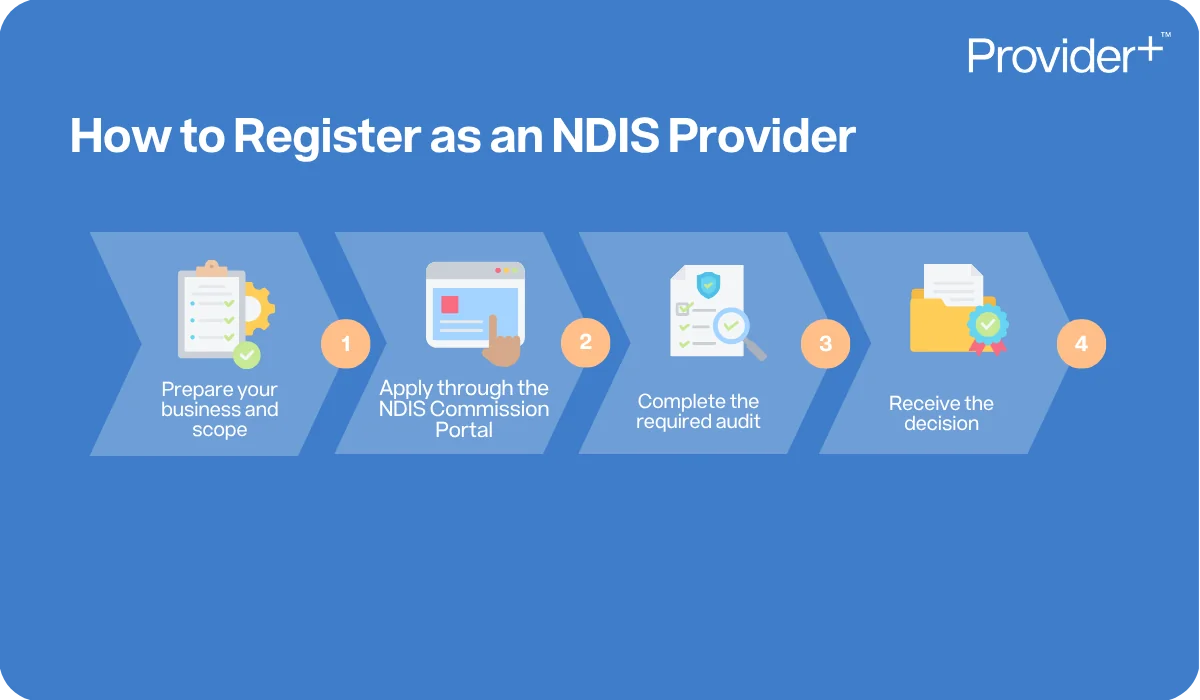
The registration process has four steps: define your services, apply to the NDIS Commission, complete an audit and receive a decision. There is no application fee; your costs are the audit and your preparation.
- Prepare your business and scope. Choose the supports you will deliver and the matching registration groups. You need an Australian Business Number (ABN). Build policies and systems that reflect how you actually operate.
- Apply through the NDIS Commission Portal. From 12 October 2026, new applications start in the new portal. You provide your organisation's details, key personnel and registration groups, then complete a self-assessment against the Practice Standards.
- Complete the required audit. The Commission tells you whether verification or certification applies. You engage an NDIS-approved quality auditor, who sends an audit report to the Commission.
- Receive the decision. The Commission reviews your application, the audit report and the suitability of your key personnel. If approved, you receive a certificate setting out your scope and any conditions.
If you need support with the process, Provider+ NDIS Registration can guide you through each stage, from preparation through to your audit and the Commission's decision. See How Long Does NDIS Registration Really Take?
Applications most often stall where documents and practice diverge: policies exist but workers do not follow them, or there is no evidence of how risks, incidents, complaints and training are managed.
A Practical Example of Successful SIL Registration:
Good preparation shows in the result. Provider+ supported Boujee Boutique Accommodation and Respite Care Pty Ltd through its SIL registration with policies, registration preparation and audit coaching, and the provider achieved registration with zero non-conformances. Read the full SIL provider registration case study.
Not sure where your documents and your day-to-day practice diverge? Book a free 30-minute call.
For each step, from your policies to the audit, see our guide: How to Transition From an Unregistered to a Registered NDIS Provider.
Final Thoughts
Before pursuing NDIS registration, it is important to understand which requirements apply to your business and the supports you intend to deliver. Registration is only one part of compliance. Having the right systems, processes and documentation in place is equally important.
Provider+ (Provider Plus) works with you to understand your obligations and prepare your business. In a free 30-minute call, a consultant checks which of your supports need registration, which audit path applies and what to prepare first.
Need help with the NDIS?
Fill in the form below to get started.

Understand exactly why registration takes 6–12+ months