Sole Trader Delivering SIL? What Mandatory Registration Means for You
In short: If you are a sole trader who delivers, manages and coordinates Supported Independent Living (SIL), mandatory NDIS registration applies to you. There is no exemption based on business size or operating as a sole trader. SIL providers must meet the requirements for Registration Group 0138 (Assistance with Supported Independent Living) and comply with the published SIL Practice Standards. The registration pathway you follow depends on your current registration status.
If you are a sole trader supporting someone to live in their own home, mandatory registration probably feels like a great deal to take on alone, and quite possibly like a burden aimed at problems you did not create. That reaction is understandable, and it is widely shared across the sector. This guide will not pretend otherwise. What it will do is explain plainly where you stand, why the rules apply to you the way they do, and the most practical route through, so the decision in front of you feels less like a wall and more like a set of steps.
Does mandatory registration apply to me as a sole trader?
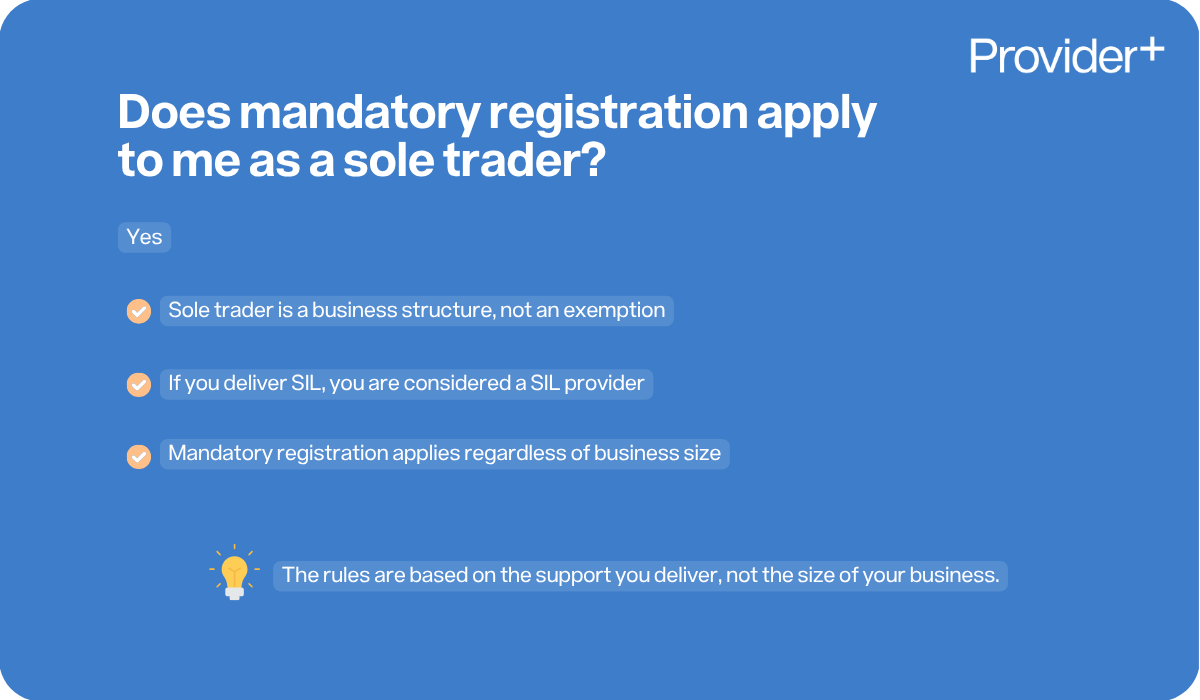
Yes, if you meet the definition. The Commission's test is straightforward: if you are delivering, managing and coordinating a participant's supports that meet the definition of supported independent living, you are considered a SIL provider. Operating as a sole trader does not change that. "Sole trader" is a business structure, not a category that sits outside the rules.
So there is no size exemption, and that is the first thing to be clear-eyed about. A one-person operation delivering SIL is a SIL provider in the same way a large organisation is, and mandatory registration reaches both.
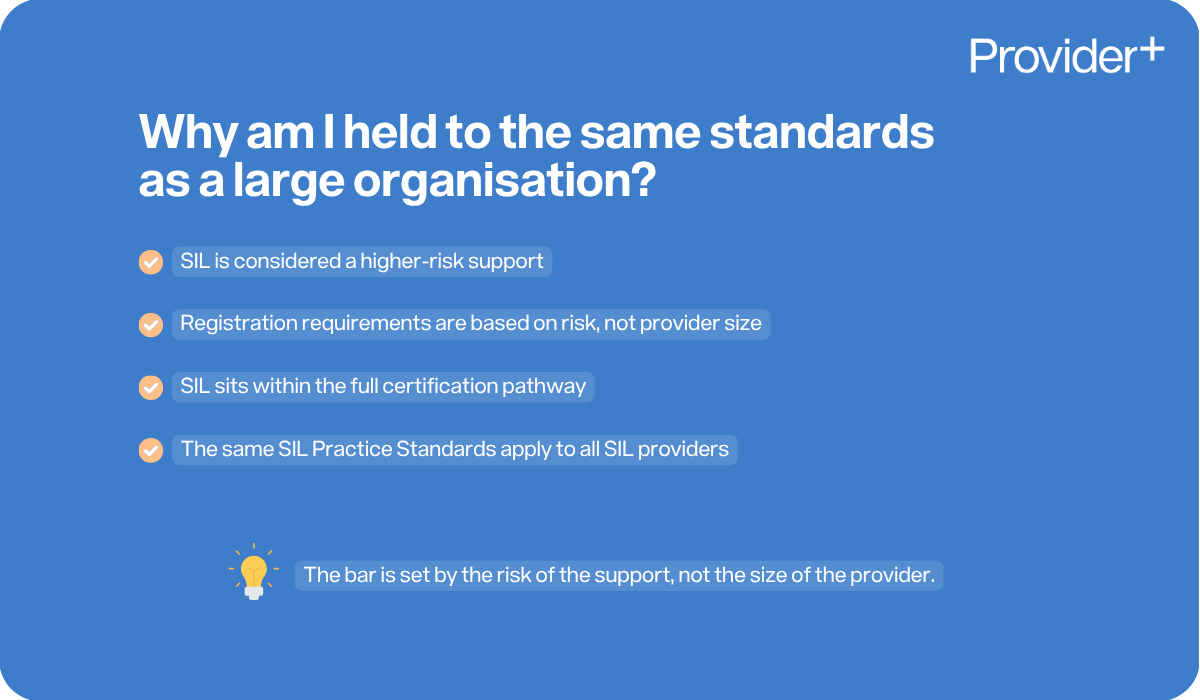
Why am I held to the same standards as a large organisation?
This is the heart of the frustration, and it deserves an honest answer rather than a brush-off.
Under the current system, a sole trader and a multi-million-dollar organisation delivering under the same registration groups are assessed against the same standards. The independent NDIS Review noticed this and named it as a genuine problem, because an expensive, time-consuming process that treats a one-person business like a large provider discourages good small operators from registering at all. The Review even recommended a risk-proportionate model, with lighter-touch registration for lower-risk providers, precisely to ease this kind of burden.
Here is the catch that lands on you specifically. That proportionality applies by risk, not by size. SIL is treated as one of the higher-risk supports in the scheme, because it happens in people's homes, often overnight, for people who depend on it and may not easily be able to raise a concern. So SIL sits in the full certification tier regardless of how small the provider is. The lighter touch the Review wanted exists for lower-risk supports, but it does not reach SIL. That is why you, as a sole trader, face the same certification pathway and the same SIL Practice Standards as a large provider.
None of that makes the workload feel lighter. But understanding it helps: the bar is set by the risk of the support, not by a view that your operation is the problem. Knowing where the line is drawn, and why, at least lets you plan against it rather than argue with it.
Which pathway do I actually follow?
- Already delivering SIL without registration: Follow the guide for providers currently delivering SIL during the mandatory registration transition.
- Not currently delivering SIL and not yet an NDIS provider: Follow the guide for new NDIS providers registering to deliver SIL.
- An unregistered provider delivering other supports: Follow the guide for unregistered providers adding SIL.
- Already a registered NDIS provider: Follow the guide for registered providers varying their registration to add Registration Group 0138 (Assistance with Supported Independent Living).
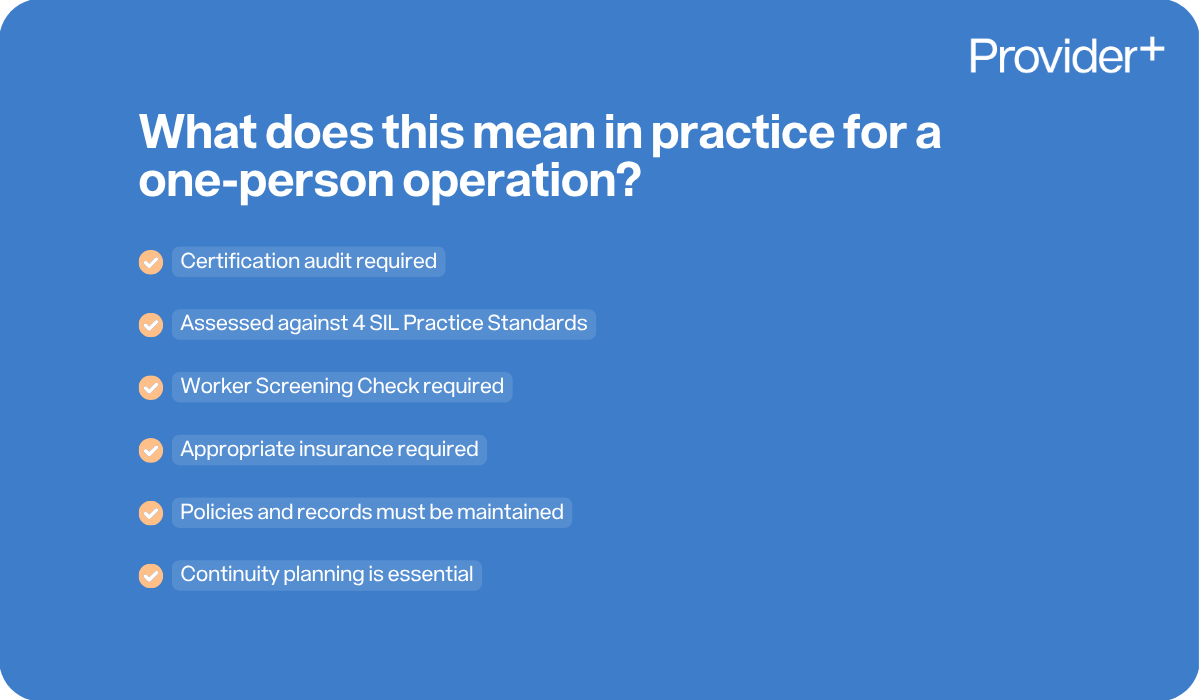
What does this mean in practice for a one-person operation?
A few realities are worth planning for, because they hit sole traders differently than they hit organisations.
You will go through a certification audit, the more thorough of the two audit types, and you will be assessed against the four SIL Practice Standards: supported decision-making, safeguarding, practice governance, and agreements about tenancy, housing and support. Practice governance can feel odd as a single operator, since it is partly about oversight and supervision, but it still applies. You will need to show that your own practice is structured, reviewed and accountable, not just well-intentioned.
You will generally need your own NDIS Worker Screening Check clearance, since you are a worker in a risk-assessed role, and clearances for anyone you bring in too. You will need appropriate insurance in place. And you will need real policies and records, not because a large bureaucracy demands them, but because an auditor draws evidence from your documents, your records, what they observe, and what your participants say.
There is one issue that is genuinely sharper for sole traders, and it is worth facing head-on: continuity of support. If you are unwell or take leave, your participant may be left without the daily, sometimes overnight, support they rely on, where an organisation could cover with other staff. The regulator is conscious of this, and so should you be. Having a backup arrangement is both good practice and part of delivering SIL responsibly on your own.
Is the frustration justified? A fair look at both sides
It is worth holding both halves of this honestly.
On one side, sole traders and the participants who choose them point to real strengths: flexibility, continuity with a single trusted person, and often a closer relationship than a larger provider can offer. Many participants pick a sole trader precisely for those reasons, and the added cost and administration of registration can feel like it threatens a model that was working well for them.
On the other side, the same closeness that participants value can mean fewer of the checks that larger providers have built in. Research and inquiries have raised the concern that sole trader and direct arrangements can reduce oversight and, in a minority of cases, create room for harm to go unnoticed. Mandatory registration is the attempt to keep the strengths of small, personal support while adding the safeguards that protect the person receiving it.
You do not have to love the trade-off to work with it. But seeing both sides tends to make the requirement feel less like an insult and more like a genuine, if imperfect, attempt to balance two things that matter.
What does it cost and how long does it take?
It is fair to say plainly that the cost burden falls hardest on sole traders, because the fixed costs of registration sit on one person's revenue rather than being spread across an organisation. The NDIS Commission charges no fee for the application itself, but you will meet the cost of a certification audit, insurance, your worker screening and your preparation. Because SIL requires the more thorough certification pathway, audit fees run higher than for low-risk verification, and the Commission does not set those fees, so they vary by auditor. Getting more than one quote is worth your time.
On timing, allow six to twelve months end to end, from starting preparation to holding a certificate. If you are currently delivering, your deadlines (1 July, and 1 October to keep delivering while you register) are set out in the currently-delivering guides linked above. If you are planning to start, you cannot deliver SIL until your registration is approved, so that timeline is your runway.
What should I do now?
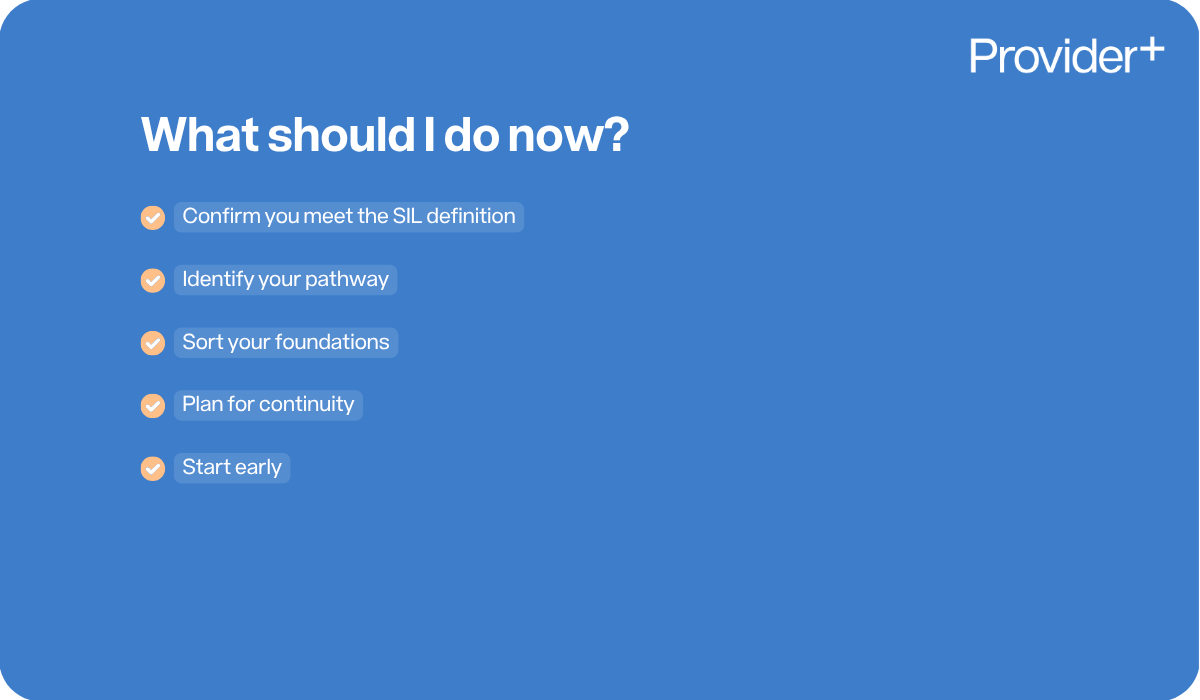
- Confirm you meet the SIL definition (delivering, managing and coordinating a participant's SIL supports).
- Identify your pathway from the list above, based on your current registration status and timing.
- Sort your foundations: your own worker screening, insurance, and the policies and records an audit expects.
- Plan for continuity, so your participants are covered if you are unavailable.
- Start early, because the workload is real and the auditor queue tightens closer to the deadline.
How Provider+ can help
Provider+ works with sole traders through SIL registration: confirming your pathway, building the policies, records and evidence the new SIL Practice Standards require in a way that fits a one-person operation, and guiding you through the certification audit so you are not navigating it alone.
Book a Call
This guide is general information for SIL providers. It is not legal advice and is not a substitute for the NDIS Practice Standards, the NDIS Act, or guidance from your approved quality auditor. For the authoritative and current position, see the NDIS Commission Reform Hub.
This article was published on 19/06/2026. We strive to keep our content accurate and up to date; however, NDIS Commission rules and requirements can change. For the latest information, visit the NDIS Quality and Safeguards Commission website or contact our team.
FAQs
Yes, if you deliver, manage and coordinate a participant's supports that meet the definition of supported independent living. Operating as a sole trader does not exempt you, because it is a business structure rather than a category outside the rules.
Because the standards are set by the risk of the support, not the size of the provider. SIL is treated as high-risk, so it sits in the full certification tier regardless of provider size. The lighter-touch registration the NDIS Review recommended applies to lower-risk supports, not to SIL.
The same one that matches your registration status and timing. If you currently deliver SIL unregistered, you follow the currently-delivering pathway (and the 1 October deadline). If you plan to start, you follow the relevant planning pathway. Your sole-trader status does not change which pathway applies.
Yes. As a sole trader delivering SIL you are generally a worker in a risk-assessed role, so you need your own NDIS Worker Screening Check clearance, along with clearances for anyone you engage.
This is a real consideration for sole traders, since you may not have other staff to cover. Planning a backup arrangement is both good practice and part of delivering SIL responsibly, and it is something the regulator is conscious of.
Understand exactly why registration takes 6–12+ months

.webp)