


NDIS Mandatory Registration for SIL Providers: What's Changing from 1 July 2026 (and What It Means for You)
In short: From 1 July 2026, providers of Supported Independent Living (SIL) must be registered with the NDIS Quality and Safeguards Commission to deliver SIL supports, and must meet new SIL-specific Practice Standards. Providers already delivering SIL can keep operating while they apply, as long as they submit a valid application by 1 October 2026.
Status update, 19 June 2026: The new SIL Practice Standards are currently in final draft. The NDIS Commission is expected to publish the final version before 1 July 2026. The substance is well established and unlikely to shift much this close to the start date, so you can begin preparing against the draft now. When the final standards are published, we'll update this guide with a plain-English summary of what changed and link you to the official version.
If you deliver Supported Independent Living (SIL), the way you're regulated is about to change, and for one group of providers it's changing quickly.
From 1 July 2026, mandatory registration begins for SIL providers. If you deliver SIL supports, you'll need to be registered with the NDIS Commission and meet a new set of SIL-specific Practice Standards. This is the biggest regulatory shift the sector has seen in years, and the timeline is firm.
Depending on your situation, you may have less to do than you expect. The path to registration changes depending on where you're starting from, and some of the deadlines leave little room if you miss them. Working out which path is yours is the first thing to get right.
This guide is the big picture: what's changing, why it's happening, the dates that matter, and how to find the pathway that applies to you. It's general information to help you get your bearings, not legal advice, so always check the NDIS Commission's Reform Hub and speak with your approved quality auditor before you act.
What is changing for SIL providers?
Supported Independent Living is help with, and supervision of, everyday tasks so a person can live as independently as possible. It's usually delivered in a shared home, often includes overnight support, and goes to people who rely on it for the basics of daily life.
Today, many providers deliver SIL without being registered with the NDIS Commission. From 1 July 2026, SIL providers must be registered to deliver these supports. The same applies, separately, to platform providers.
According to the Commission, registration provides greater oversight and visibility of providers, so it can reduce risks to participants, identify and respond to wrongdoing and fraud, and reduce risks to the scheme as a whole.
Two things change at once:
- Registration becomes mandatory. SIL providers must hold registration with the Commission to keep delivering SIL.
- A new set of SIL Practice Standards applies. Registration is ongoing. It comes with quality and safety standards that your service is audited against.
Why is mandatory registration happening?
Several independent reviews and inquiries examined how SIL is delivered, and found a recurring pattern: unregistered providers operated with limited oversight, and that left some of the most vulnerable participants exposed. SIL happens inside people's homes, often overnight, in shared settings, and frequently for people who can't easily raise a concern or move elsewhere. The Commission's position is that supports this intimate need consistent standards, worker screening, incident reporting, and a regulator that can see what's happening and step in when something goes wrong.
That's the case for the reform, and it's worth understanding, because it explains why the requirement is firm and unlikely to soften.
It's also worth being honest about the other side of it. Plenty of unregistered providers deliver excellent, safe support, and many feel they're being asked to carry the cost and paperwork of fixing problems caused by a minority. The expense is real. Registration brings an upfront audit cost, and then ongoing costs that don't go away: audits on a recurring cycle, plus the documentation, governance, worker screening and training needed to stay compliant in between. For sole traders and small providers this lands especially hard, because the framework applies to them in much the same way it applies to large organisations. Some worry the overhead will push good small operators out of SIL altogether, which would narrow the choices available to participants.
Those concerns are widely held across the sector, and they're reasonable. They don't change the requirement, but they do shape the smart response. The providers who come through this best are the ones who treat registration as a planned project, with a budget and a timeline, rather than a cost sprung on them at the last minute.
What are registration groups 0115 and 0138?
There are two registration groups worth knowing, because the whole transition applies to these.
- 0115, Assistance with Daily Life Tasks in a Group or Shared Living arrangement. This is the existing group many SIL providers already hold or apply under.
- 0138, Assistance with supported independent living. This is the new, dedicated SIL registration group introduced as part of the reform.
How you reach 0138 depends on your situation. For some providers the Commission adds it automatically. For others, you apply for it directly. The pathway pages below sort out which applies to you.
What are the new SIL Practice Standards?
Alongside registration, the Commission is introducing SIL-specific Practice Standards, co-designed with Inclusion Australia and pilot-tested with a group of registered providers in early 2026. They sit alongside the existing Core Practice Standards rather than replacing them, and they move the focus from documenting processes toward showing measurable outcomes for participants.
The draft is built around four domains:
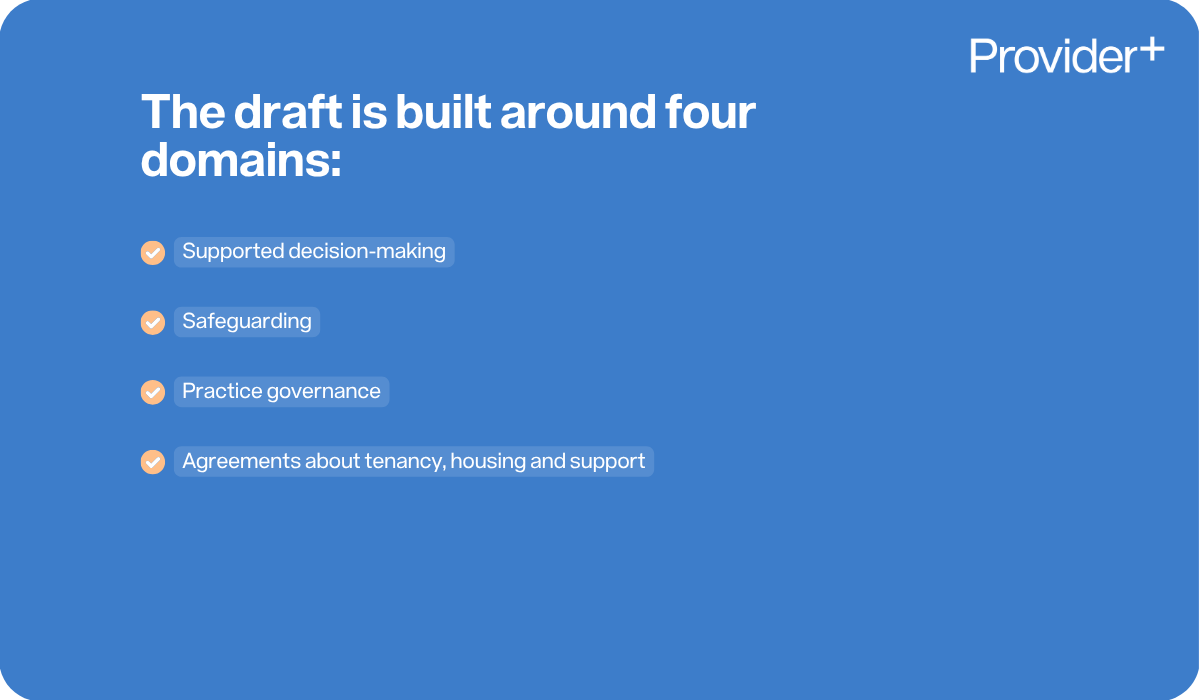
- Supported decision-making: participants making genuine choices about their home and daily life, with the support to do so.
- Safeguarding: keeping participants safe from harm while preserving choice and dignity of risk, including risks that arise between people who share a home.
- Practice governance: the systems and oversight that keep quality consistent.
- Agreements about tenancy, housing and support arrangements: clarity and fairness in how living and support arrangements are set up.
Important for providers who are already registered: holding existing registration does not exempt you. The new standards apply to everyone delivering SIL from 1 July 2026, and you'll be assessed against them at your next audit, whether that's a mid-term audit or a renewal.
The final standards are expected before 1 July 2026 and will be published on the NDIS Practice Standards page. We'll summarise the final version here as soon as it lands.
What does registering involve?
Registration is a process with a few clear stages. The detail differs by pathway, but the shape is the same for everyone.
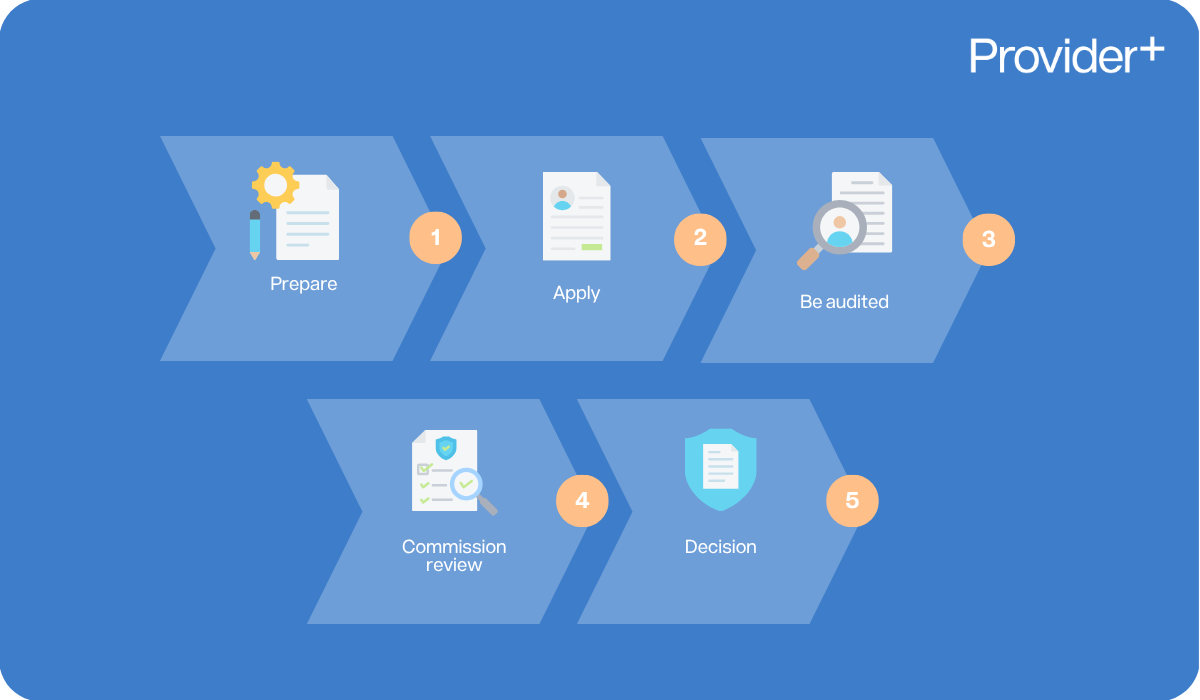
- Prepare. Review how you operate against the SIL Practice Standards and the Core Practice Standards, and get your documentation, policies and governance evidence in order.
- Apply. Submit a valid registration application to the NDIS Commission for the relevant registration group or groups. You then receive a scope of audit, which sets out what you'll be assessed against.
- Be audited. Engage an Approved Quality Auditor, an independent body approved by the Commission to assess providers against the Practice Standards, and complete a certification audit.
- Commission review. The Commission reviews your application and audit results, and may ask you for more information.
- Decision. If your application is approved, you receive a certificate of registration. If it isn't approved, you can't deliver SIL.
One point that catches providers out: registration is ongoing. Certification lasts for a set period, and you're audited again across the cycle, including a mid-term audit and a renewal. Audit fees are set by auditors rather than by the Commission, so they vary from provider to provider. Treating registration as a continuing commitment, rather than a single hurdle, is the realistic way to approach it.
Key dates for SIL mandatory registration
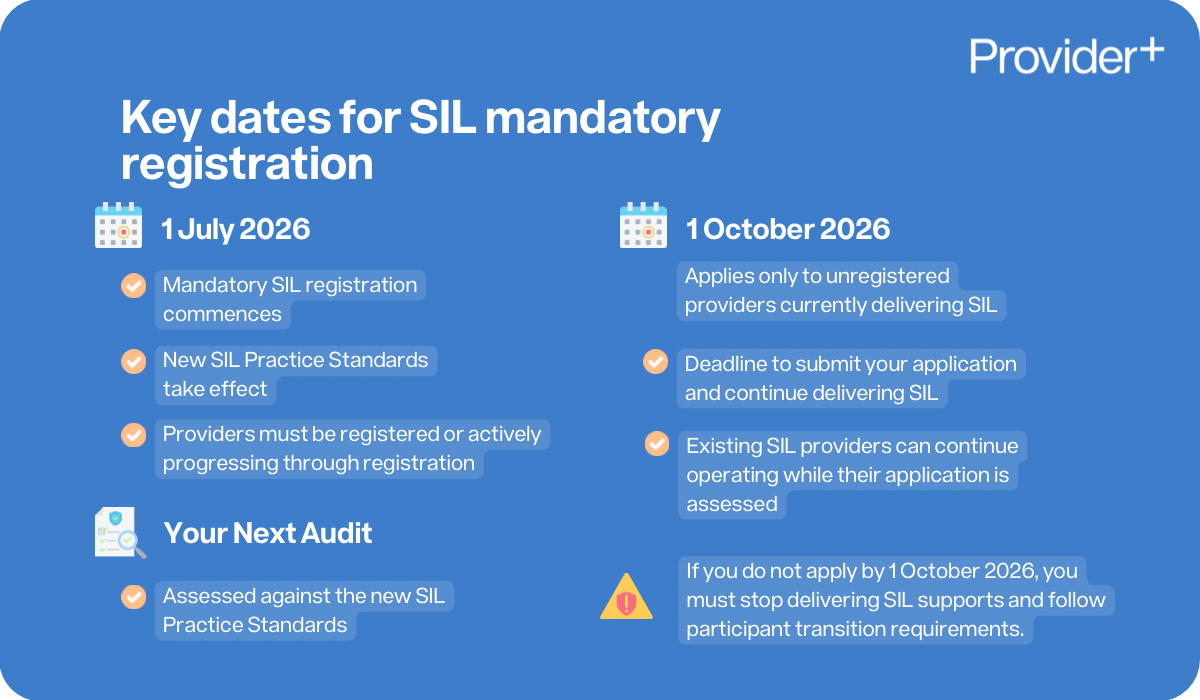
- 1 July 2026: mandatory registration commences. SIL providers must be registered, or have a valid application in progress under the transition arrangements below. The new SIL Practice Standards apply from this date.
- 1 October 2026: the transition cutoff for continuing to deliver while you apply. If you're currently delivering SIL, the Commission's transition arrangements let you keep delivering while your application is processed, but only if you've submitted a valid application by 1 October 2026.
- Your next audit: the point at which you're assessed against the new standards.
A word on consequences, in the Commission's own terms. Delivering SIL without registration on or after 1 July 2026 may breach the NDIS Act, and the Commission describes it as a serious offence. The maximum penalty is up to two years' imprisonment, a fine of 120 penalty units, or both. If you choose not to apply, or haven't applied by 1 October 2026, you'll need to stop delivering SIL and follow the Commission's notification and participant-transition steps.
The practical takeaway is simple: there is a path through this for every situation, and the cost of not taking it is high. The most useful thing you can do today is find the one that's yours.
Which SIL registration pathway applies to you?
Your path depends on two things: whether you're delivering SIL now or planning to, and your current registration status. Find yourself below.
I'm currently providing SIL supports
- I'm a registered provider and already hold 0115: You're the best-positioned of everyone. You don't re-apply. The Commission updates your certificate to add 0138 automatically. Your job is getting ready for the new standards before your next audit. [Read the full pathway →]
- I'm unregistered (including sole traders) and I'll apply before 1 July 2026: Apply under 0115 now, keep delivering throughout, and you have a choice about audit timing. [Read the full pathway →]
- I'm unregistered (including sole traders) and I'll apply after 1 July 2026: Apply directly for 0138, and watch the 1 October cutoff closely. It's the date that decides whether you can keep delivering. [Read the full pathway →]
I'm planning to provide SIL in future
- I'm a registered provider without 0115: Submit an application for variation to add 0138 to your registration, be assessed against the applicable NDIS Practice Standards and wait for the NDIS Commission to make a determination prior to commencing SIL supports. [Read the full pathway →]
- I'm new to SIL registering as a SIL Provider: Submit an application for registration for 0138 (plus other applicable registration groups), engage an approved quality auditor and be assessed against the applicable NDIS Practice Standards, then wait for the NDIS Commission to make a determination prior to commencing SIL supports as a registered provider. [Read the full pathway →]
- I'm not currently an NDIS provider: Submit an application for registration for 0138 (plus other applicable registration groups), engage an approved quality auditor and be assessed against the applicable NDIS Practice Standards, then wait for the NDIS Commission to make a determination prior to commencing SIL supports as a registered provider. [Read the full pathway →]
Not sure if you're a SIL provider at all? If you're delivering, managing and coordinating a participant's supports that meet the Commission's definition of supported independent living, you're considered a SIL provider, including if you operate as a sole trader. Refer to the definition of supported independent living and the pathway that matches your registration status.
Is the SIL registration reform definitely going ahead?
Yes. It's tempting to read "the standards are still in draft" as "this might not happen yet." That isn't the case. The timeline is locked, and 1 July 2026 is confirmed. What's being finalised is the precise wording of standards whose substance is already settled. The legislative backdrop points the same way: the NDIS Amendment (Integrity and Safeguarding) Bill 2025, introduced in late 2025, is designed to strengthen the Commission's regulatory powers.
Registration also takes time. Engaging an approved quality auditor, completing an audit, and working through the Commission's review usually takes months. The parts you control, such as your documentation, policies and governance evidence, are the parts to start on now. Waiting for the final standards before you begin only shortens the time you have.
What should SIL providers do now?
- Find your pathway above and read it in full.
- Map your current state against the draft SIL Practice Standards and note where the gaps are.
- If you'll need to apply, start early. Work backwards from your deadline (1 July or 1 October) and the audit lead time.
- Bookmark this page. We're keeping it current as the final standards and transition details are confirmed.
Frequently asked questions
What is Supported Independent Living (SIL)? SIL is help with, and supervision of, everyday tasks so a person can live as independently as possible. It's usually provided in a shared living arrangement and often includes overnight support.
When does NDIS mandatory registration for SIL start? It starts on 1 July 2026. From that date, providers must be registered with the NDIS Commission to deliver SIL supports.
Do all SIL providers have to register? Yes. From 1 July 2026, SIL becomes a registered support, and every provider delivering it must be registered, including sole traders. If you're already delivering, the transition arrangements let you keep operating provided you lodge a valid registration application by 1 October 2026; you don't need to be registered by 1 July.
Why is SIL registration being made mandatory? Independent reviews and inquiries found that unregistered SIL providers operated with limited oversight, which created risk for some of the most vulnerable participants. Mandatory registration gives the NDIS Commission visibility of providers and the ability to enforce consistent quality and safety standards.
How do I register as a SIL provider? You prepare your documentation against the Practice Standards, submit a valid application to the NDIS Commission, receive a scope of audit, engage an Approved Quality Auditor to complete a certification audit, and then the Commission reviews your application and makes a decision.
What is the difference between registration groups 0115 and 0138? 0115 (Assistance with Daily Life Tasks in a Group or Shared Living arrangement) is the existing group many SIL providers hold or apply under. 0138 (Assistance with supported independent living) is the new, dedicated SIL registration group created by the reform.
What are the new SIL Practice Standards? They are SIL-specific quality and safety standards built around four areas: supported decision-making, safeguarding, practice governance, and agreements about tenancy, housing and support arrangements. They apply from 1 July 2026 and sit alongside the existing Core Practice Standards.
What happens if I don't register? Delivering SIL without registration on or after 1 July 2026 may breach the NDIS Act. The Commission describes it as a serious offence, with a maximum penalty of up to two years' imprisonment, a fine of 120 penalty units, or both.
Can I keep delivering SIL while my application is processed? If you currently deliver SIL, you can keep delivering during your application, provided you submit a valid application by 1 October 2026.
Are the new SIL Practice Standards finalised yet? As of June 2026, they are in final draft. The Commission is expected to publish the final version before 1 July 2026. The commencement date of 1 July 2026 is confirmed.
Does mandatory registration also apply to platform providers and support coordinators? Platform providers also move to mandatory registration from 1 July 2026. Mandatory registration for support coordination was proposed but is currently paused.
Provider+ helps SIL providers achieve registration and audit readiness with a clear, tailored plan for your specific pathway.
Talk to Our Team
This guide is general information for SIL providers. It is not legal advice and is not a substitute for the NDIS Practice Standards, the NDIS Act, or guidance from your approved quality auditor. For the authoritative and current position, see the NDIS Commission Reform Hub.
This article was last updated on 18/06/2026. We strive to keep our content accurate and up to date; however, NDIS Commission rules and requirements can change. For the latest information, visit the NDIS Quality and Safeguards Commission website or contact our team.

Understand exactly why registration takes 6–12+ months

.webp)
